Oakland freezes new data centers, with no votes to spare
Oakland's council passed a 45-day pause on new data centers with exactly the seven votes it needed. Here is what it stops, the Uptown building behind it, and the five other Bay Area cities that got there first.

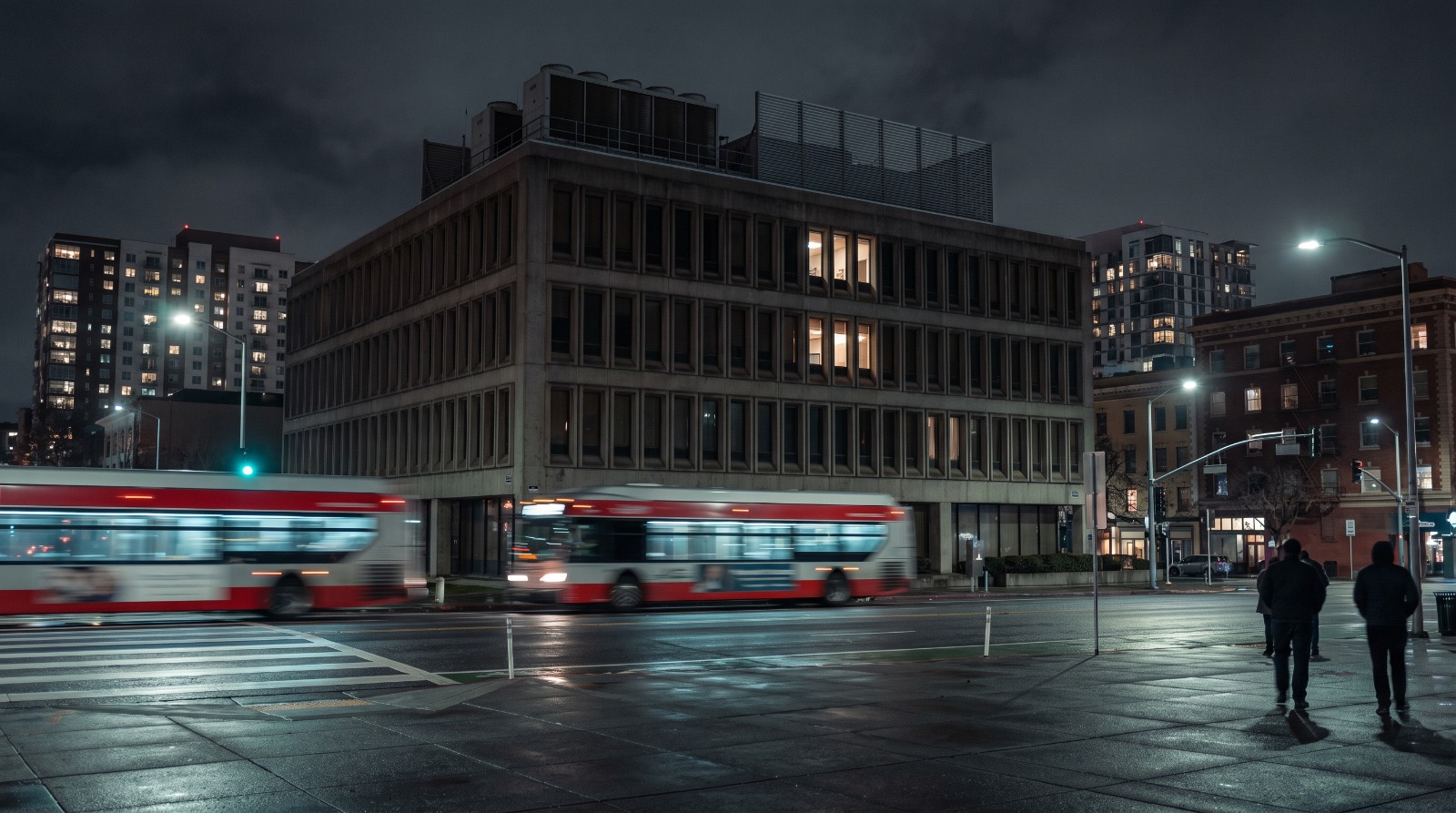
AI-rendered night view of the four-story concrete former supercomputing building at 415 20th Street in Uptown Oakland Photo: Houseberry
The four-story concrete box at 415 20th Street has been mostly dark since about 2015. On Tuesday night it got 45 more days of quiet. The Oakland City Council adopted an urgency moratorium on new data centers at its October 6 meeting, passing it 7 to 0 on the consent calendar, according to the city's Legistar record of the vote.
Seven was the exact number it needed. An urgency ordinance under state law takes four-fifths of the council, and the one member who was not in the room was Carroll Fife, who wrote it.
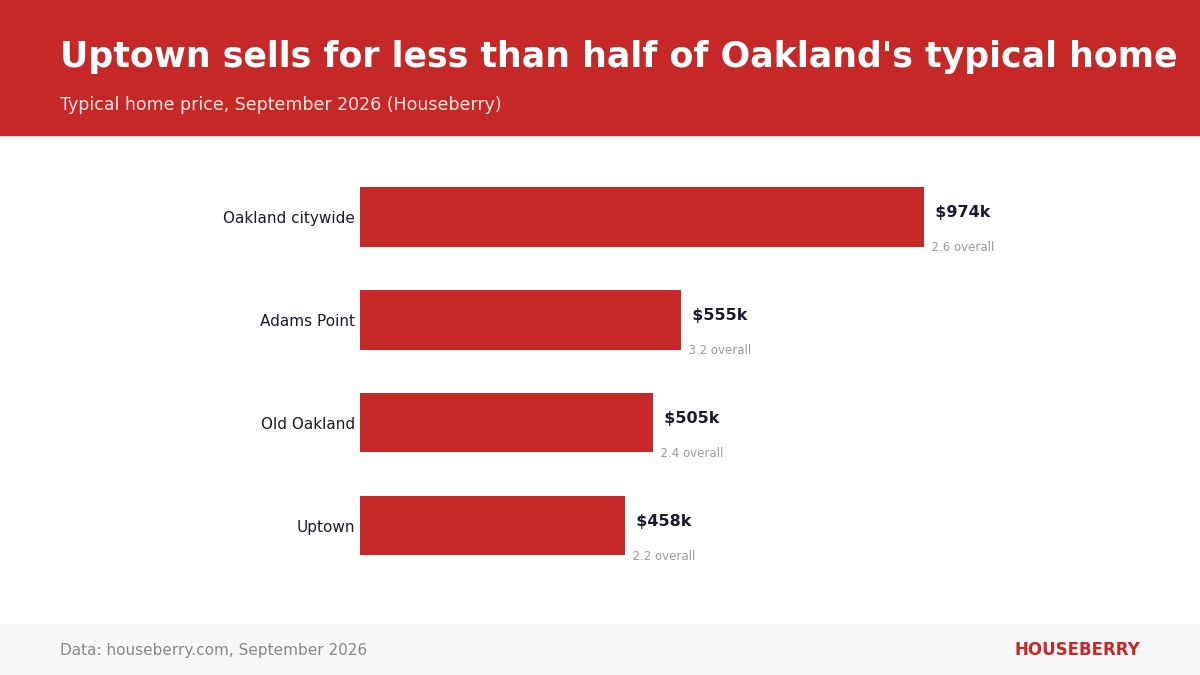
For anyone who lives or owns near Uptown, this is a story about one building and the rule that will replace the pause. The building sits a block from the 19th Street BART station in a neighborhood where, by Houseberry's price data for Uptown Oakland, the typical home sold for about $457,700 in September 2026. That is less than half of Oakland's citywide figure.
What the pause stops, and what it does not
The ordinance title is plain about its reach. It bars the city from approving "any land use entitlements and/or agreements" for building or operating a data center in Oakland, and it took effect the moment it passed.
That covers new permits. It does not shut anything that already runs, and it does not by itself decide whether Behring needs a new permit at all. The building held a federal supercomputer for years, and Behring has pitched its plan as an office-scale computer room rather than a new industrial plant. Nothing in Tuesday's record says how the city will treat that argument. The city's legislation packet was not readable when we checked, so the exact definition of a data center, and any size threshold, still needs a look before anyone treats this as a ban on a specific project.
The clock matters more than the vote. State law (Government Code 65858) lets a city extend a pause like this by 10 months and 15 days, then by one more year. Both extensions need the same four-fifths. Tuesday showed that the council can find 7 votes, and also that it found exactly 7.
The Oakland Scientific Facility, as Lawrence Berkeley National Laboratory called it, is 83,000 square feet. Hines paid about $36 million for it in 2019, DatacenterDynamics reported. Behring paid $6.8 million in December 2025.
That works out to roughly $82 a square foot, about 81 percent below the 2019 price. Downtown office space has been repricing like that all over the Bay Area, and a building wired for 4.5 megawatts is worth more as a computer room than as empty office floors. Behring's plan would put about 20,000 square feet of AI and robotics computing inside and raise the building's power to 20 megawatts.
Colin Behring pitched it to KQED in August as "really strong computers in your office." Fife, at the time, said it was "not the large-scale mega-facility" people feared, KQED reported. By September she was carrying the moratorium anyway, telling the Daily Californian the city needed "to pause, particularly in light of the fears and concerns that so many people have."
We covered the opening round of this fight in September in our first look at the Oakland moratorium. The difference now is that the pause is law.
Six Bay Area cities in six months
Oakland is not out on a limb. The Bay Area went from zero data center pauses to six between April and October 2026.
| City | Adopted | Where it stands |
|---|---|---|
| Oakley | April 14, 2026 | Extended in May to April 2027 |
| Morgan Hill | August 26, 2026 | 45 days, also covers grid batteries |
| Gilroy | September 14, 2026 | 45 days, exempts Amazon's approved site |
| Richmond | September 15, 2026 | 45 days, no project on file |
| San Francisco | October 6, 2026 | 45 days, extendable to 22 months |
| Oakland | October 6, 2026 | 45 days, 7 to 0 with the sponsor absent |
Sources for the table: Contra Costa News on Oakley, the Morgan Hill Times, NBC Bay Area on Gilroy and Richmond, and the SF Standard on San Francisco. Hayward started its own process in September and Santa Clara, home to dozens of data centers, has so far studied the question without pausing.
The list splits in two. Oakley, Gilroy and Richmond are guarding open land where a campus could pull hundreds of megawatts. San Francisco and Oakland are dealing with old buildings downtown that already have big power lines running into them. Those are different problems, and a rule written for one will fit the other badly.
Uptown's prices were already sliding
Uptown is a dense, mixed neighborhood. On Houseberry's yardstick it scores 2.2 out of 5 overall and 3.7 on amenities, which is mostly the theaters, bars and restaurants along Broadway and Telegraph. Its safety score is 1.4. Prices have slid: from about $515,600 in October 2025 to about $457,700 in September 2026, an 11 percent drop in 12 months on Houseberry's Uptown page.
Adams Point, up the hill by Lake Merritt, scores 3.2 overall and sat at about $554,800 in September. Old Oakland, on the other side of downtown, was about $504,700. All three trail Oakland's citywide typical price of about $974,200 by a wide margin.
A 20,000-square-foot computer room does little to any of those numbers on its own. It adds almost no jobs per square foot and almost no foot traffic. What would move Uptown is the rest of Behring's pitch: the company has floated a 39-story residential tower over the 19th Street station as part of the same campus. A moratorium on the data center does not touch that tower, but a developer who loses the cash flow from one building may not hurry to build the other.
We think a 45-day pause is a reasonable way to write a rule. Oakland has no zoning definition of a data center, and it should have one before anyone approves a 20-megawatt load downtown.
The risk is the next vote. If the council spends its extensions treating a converted office building in Uptown like a 300-megawatt campus on farmland, it will chase off a building owner who is offering to fill a dark block next to BART. We would rather see a rule that sets noise, backup generator and power limits, and lets the old supercomputer building be a supercomputer building again.
The pause runs out around November 20. Before then, see how every one of the 130 neighborhoods on Houseberry's Oakland ranking compares, and where Uptown sits in it. For the longer question of whether data centers change home values at all, start with what host towns have seen.
Sources
- Oakland City Council meeting record, October 6, 2026 (Legistar)
- NBC Bay Area: Oakland council data center vote, October 6, 2026
- KQED: the proposed Oakland data center, August 15, 2026
- DatacenterDynamics: former LBNL facility targeted for 20 MW
- SF Standard: San Francisco data center moratorium, October 6, 2026
The Houseberry Research Team is Houseberry's reporting team: Bay Area real estate analysts, data specialists and longtime local market watchers. Every day we check the public record: building permits, city council and planning agendas, county recorder filings, state housing bills, police incident data and school results. Then we tie each story to what it means for specific neighborhoods, using Houseberry's own neighborhood data on prices, appreciation, safety, schools and amenities. Questions or corrections: Contact us.
Map of Oakland Neighborhoods
Loading map...
View Full Map
Top Neighborhoods in Oakland, CA






All information provided on this website including but not limited to - school ratings, safety, amenities, user opinions, and property data - is for general informational purposes only. We do not guarantee its reliability, accuracy, or completeness. Users should independently verify information and consult appropriate professionals as needed. By using this website, you agree Houseberry is not responsible for actions, decisions, or consequences arising from reliance on the information provided
houseberry.com - CA DRE# 01847391
 Bay East ©2025. CCAR ©2025. bridgeMLS ©2025. Information Deemed Reliable But Not Guaranteed. This information is being provided by the Bay East MLS, or CCAR MLS, or bridgeMLS. The listings presented here may or may not be listed by the Broker/Agent operating this website. This information is intended for the personal use of consumers and may not be used for any purpose other than to identify prospective properties consumers may be interested in purchasing. Data last updated at October 7, 2026 12:00 AM