Arroyo Lago Pleasanton: What the Annexation Vote Means
Pleasanton moved the Arroyo Lago site toward annexation on a 3-2 vote. Here is what 189 homes and 48 junior ADUs actually add to the city, and why the argument was really about a road.
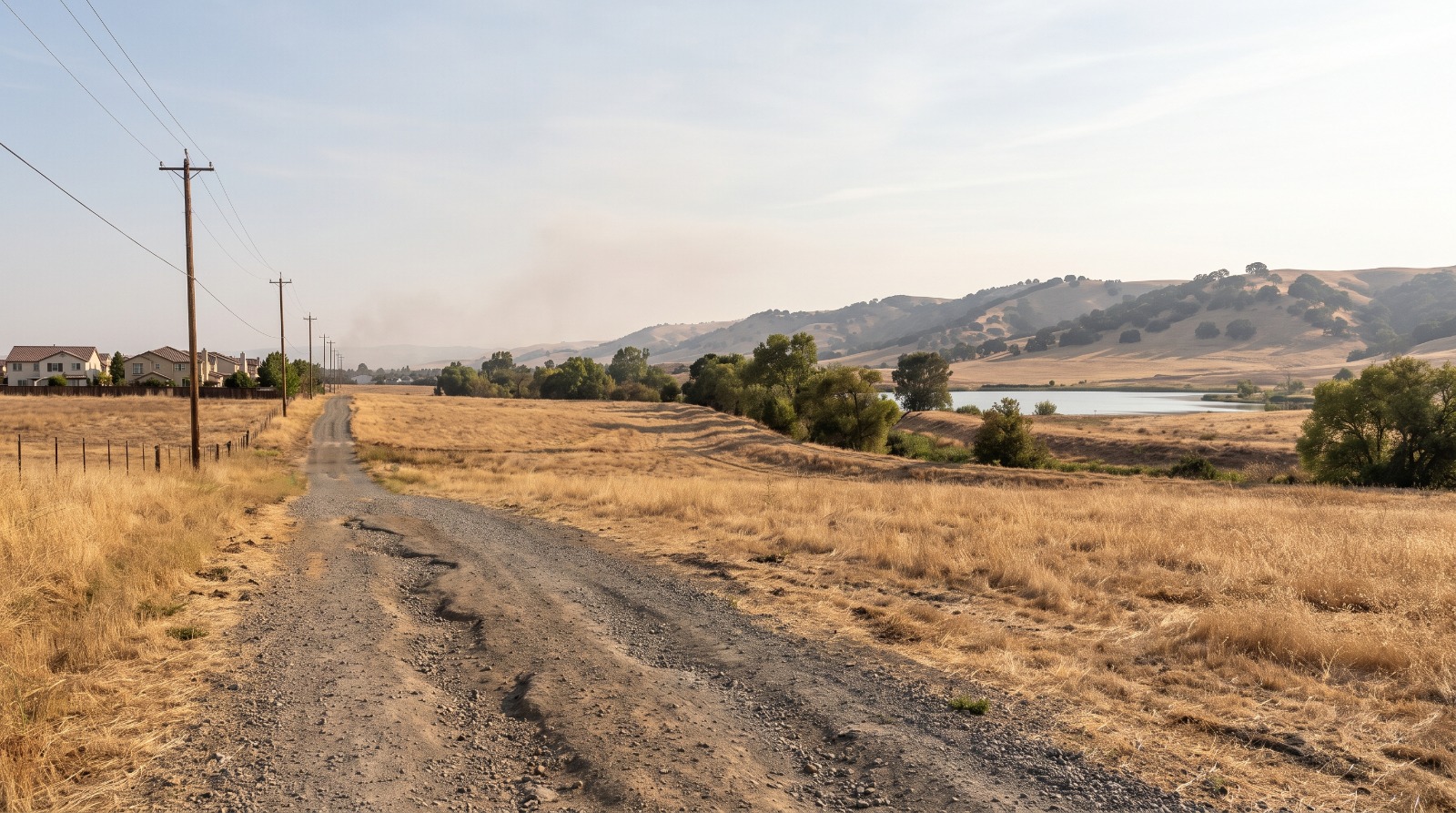
Open county land at the eastern edge of Pleasanton, California, where the Arroyo Lago housing annexation is proposed. Photo: Houseberry
Pleasanton's council spent the back half of its July 27 meeting arguing about a road. The vote that came out of it was 3-2, and it kept the Arroyo Lago developer's contribution to the El Charro Road extension at $3 million against an estimated $8 million cost. The same night, the council approved the pre-annexation and development agreement and started formal annexation proceedings on the site. The houses themselves were never the fight.
What Pleasanton is moving to annex is about 26.6 acres of unincorporated Alameda County land east of Valley Avenue and Busch Road, north of Stanley Boulevard and south of the Arroyo Mocho. That is the quarry-lake side of town, not the downtown side. On it: 189 single-family homes and 48 deed-restricted junior accessory dwelling units.
The short version, if you read no further:
- 237 total units. 189 detached houses, 159 of them two-story, plus 48 junior ADUs of 170 to 212 square feet each.
- The site already sits inside Pleasanton's Urban Growth Boundary, which voters approved in 1996. This is not a boundary expansion. It is the city taking in land it already claimed.
- Alameda LAFCO still has to sign off. The council vote begins annexation. It does not finish it.
- The road money is the open question. Two council members wanted $8 million from the developer and lost 3-2.
The mayor said the quiet part plainly
Mayor Jack Balch's line at the meeting was blunter than Tri-Valley council members usually get: "Clearly annexation is what we want to do... the choice of no development is not a choice." He is right about the mechanics. The parcel is inside the city's growth boundary and inside its LAFCO sphere of influence. Leaving it in county hands does not freeze it in amber. It just means somebody in Oakland writes the rules instead of somebody in Pleasanton.
The meeting was supposed to happen on July 21. It moved to the 27th because of the Little Fire, which burned roughly 1,007 acres between Sunol and Pleasanton and put parts of southern Pleasanton, Ruby Hill included, under evacuation orders. A land-use hearing postponed by a wildfire is a very 2026 detail.
The road fight, in dollars per house
The gap the council voted on is $5 million. Spread across 237 units, that works out to about $21,100 a home. That is the whole argument: whether the developer carries roughly $21,000 per unit of the El Charro Road extension, or whether Pleasanton finds it somewhere else. Councilmembers Jeff Nibert and Julie Testa wanted the higher figure and were outvoted.
Here is the rest of the deal in one place.
| Arroyo Lago deal terms | Detail |
|---|---|
| Homes | 189 single-family, 159 two-story and 30 one-story |
| Junior ADUs | 48, deed-restricted, 170 to 212 square feet |
| Site | About 26.6 acres of unincorporated Alameda County land |
| Lot sizes | 3,500 to 5,652 square feet |
| El Charro Road contribution | $3 million, against an estimated $8 million cost |
| Community Facilities District revenue | About $4.5 million over 30 years |
| Build-out deadline | Within 10 years of annexation |
The $4.5 million over 30 years is the number worth sitting with. That is $150,000 a year in special-district revenue from a project the city will be maintaining streets and storm drains for over the same period. Whether that pencils is a fair question, and it is the one Nibert and Testa were actually asking.
East Pleasanton is where nearly all the new housing is going
Arroyo Lago is not a one-off. It is the smallest of three residential projects stacked up in the same corner of the city, and the city's own project list is the clearest place to see it.
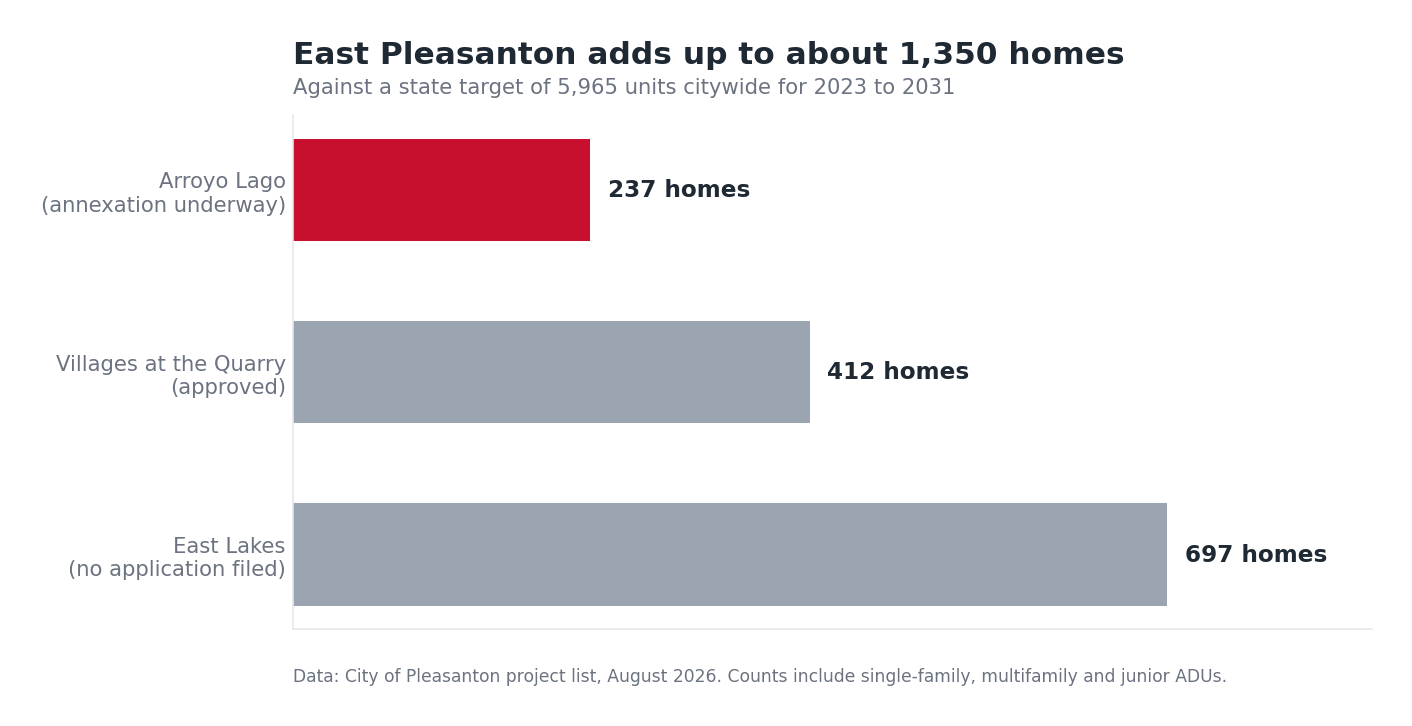
Villages at the Quarry is already approved at 310 single-family homes plus 102 multifamily units. East Lakes, at 330 single-family and 367 multifamily, has not filed an application yet. Add Arroyo Lago and the corner comes to roughly 1,350 homes. It is also where a 640,000-square-foot Amazon warehouse and 300,000 square feet of industrial on Parcel H are headed. Pleasanton is putting its housing growth and its truck traffic in the same square mile, which is a choice, and one the residents of those 1,350 homes will notice.
For scale: Pleasanton has to plan for 5,965 new units between 2023 and 2031, including 2,758 for lower-income households. Arroyo Lago is about 4 percent of that. It also was not in the certified sixth-cycle Housing Element inventory, so it is extra credit rather than a site the state is already counting.
What Pleasanton costs while this gets sorted out
The city is not cheap and has not gotten cheaper in any way that helps a buyer. Pleasanton's median sale price was $1.71 million in July 2026, down 3.5 percent from June and inside a 12-month band that ran from $1.69 million last September to $1.79 million in April. Here is how that sits against the rest of the corridor.
| City | Median sale price, July 2026 | Houseberry overall score |
|---|---|---|
| San Ramon | $1.76M | 4.0 |
| Pleasanton | $1.71M | 4.2 |
| Dublin | $1.60M | 3.9 |
| Livermore | $1.27M | 3.4 |
Pleasanton scores highest of the four and prices second. That combination is exactly why 237 homes matters more here than the raw number suggests: this is a city where buyers are already stretching, across 31 neighborhoods we rank that average 4.2 out of 5 against a nearby-cities average of 3.7. When we compare neighborhoods, the supply question and the score question are the same question. Good places that add almost nothing get expensive, and stay that way.
Nine homes an acre is better than it sounds
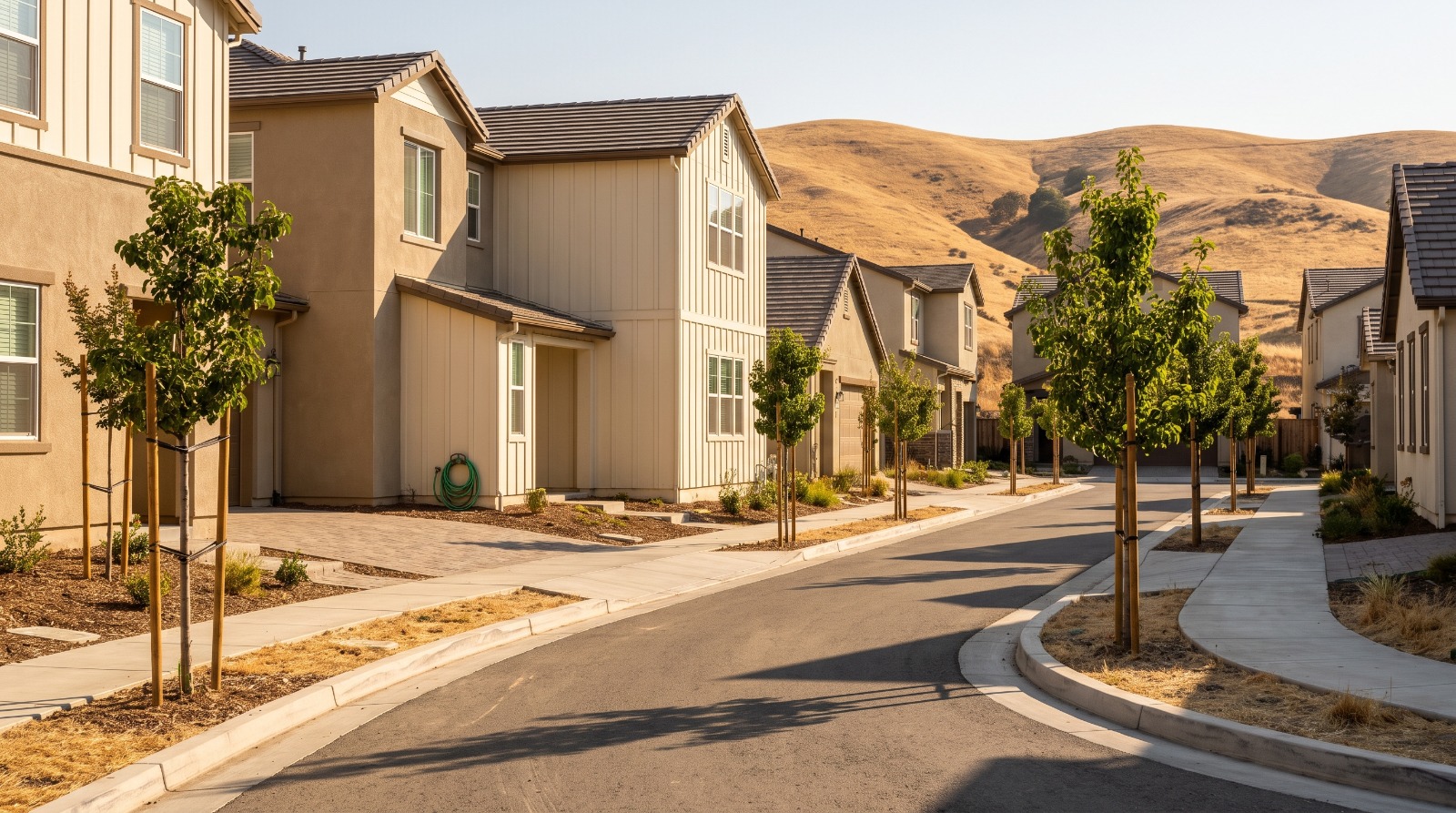
Run the math and 237 units on 26.6 acres is about 8.9 an acre. For detached single-family in this city, that is a lot. Lots starting at 3,500 square feet are genuinely small by Tri-Valley standards, and the junior ADUs are deed-restricted, which means they stay in the affordable column instead of quietly becoming home offices.
The honest downside: 170 to 212 square feet is a bedroom with a kitchenette, not family housing, and the site is a long drive from the Dublin/Pleasanton BART station. This is edge-of-town, car-first growth with a road-funding fight attached. The homes the region needs most are the ones near Dublin's transit spine, not the ones at the end of Stanley Boulevard. But 237 homes is 237 homes, and Pleasanton has spent two decades proving how hard it is to get even that.
What to watch
Annexation now goes to Alameda LAFCO, and no hearing date has been announced. The more consequential thing to watch is East Lakes. When that application lands, it arrives with nearly three times the units and the same El Charro Road question, and the $3 million the council just settled on becomes the number every future applicant points to. Precedents set on small projects get spent on big ones. If you are weighing where in the Tri-Valley to buy, the school-score map across Pleasanton is still doing more work than any single subdivision will.
Sources
- Pleasanton Weekly, Pleasanton council gives green light to move forward with annexing Arroyo Lago housing development site, August 12, 2026
- Pleasanton Weekly, Council to consider project design, annexation documents for Arroyo Lago, July 20, 2026
- Pleasanton Weekly, Planning Commission endorses Arroyo Lago housing project, June 29, 2026
- City of Pleasanton, East Pleasanton projects and Urban Growth Boundary
- 330 Land Company, Arroyo Lago project page
- Pleasanton Weekly, Council adopts 2023-31 Housing Element, January 30, 2023
- Houseberry city and neighborhood price history for Pleasanton, Dublin, San Ramon and Livermore, July 2026
All information provided on this website including but not limited to - school ratings, safety, amenities, user opinions, and property data - is for general informational purposes only. We do not guarantee its reliability, accuracy, or completeness. Users should independently verify information and consult appropriate professionals as needed. By using this website, you agree Houseberry is not responsible for actions, decisions, or consequences arising from reliance on the information provided
houseberry.com - CA DRE# 01847391
 Bay East ©2025. CCAR ©2025. bridgeMLS ©2025. Information Deemed Reliable But Not Guaranteed. This information is being provided by the Bay East MLS, or CCAR MLS, or bridgeMLS. The listings presented here may or may not be listed by the Broker/Agent operating this website. This information is intended for the personal use of consumers and may not be used for any purpose other than to identify prospective properties consumers may be interested in purchasing. Data last updated at September 26, 2026 12:00 AM