San Francisco pauses new data centers until September 2027
San Francisco will not process permits for new data centers until about September 2027. Here is what the pause covers, why District 10 pushed for it and what it means for Dogpatch and the Bayview.

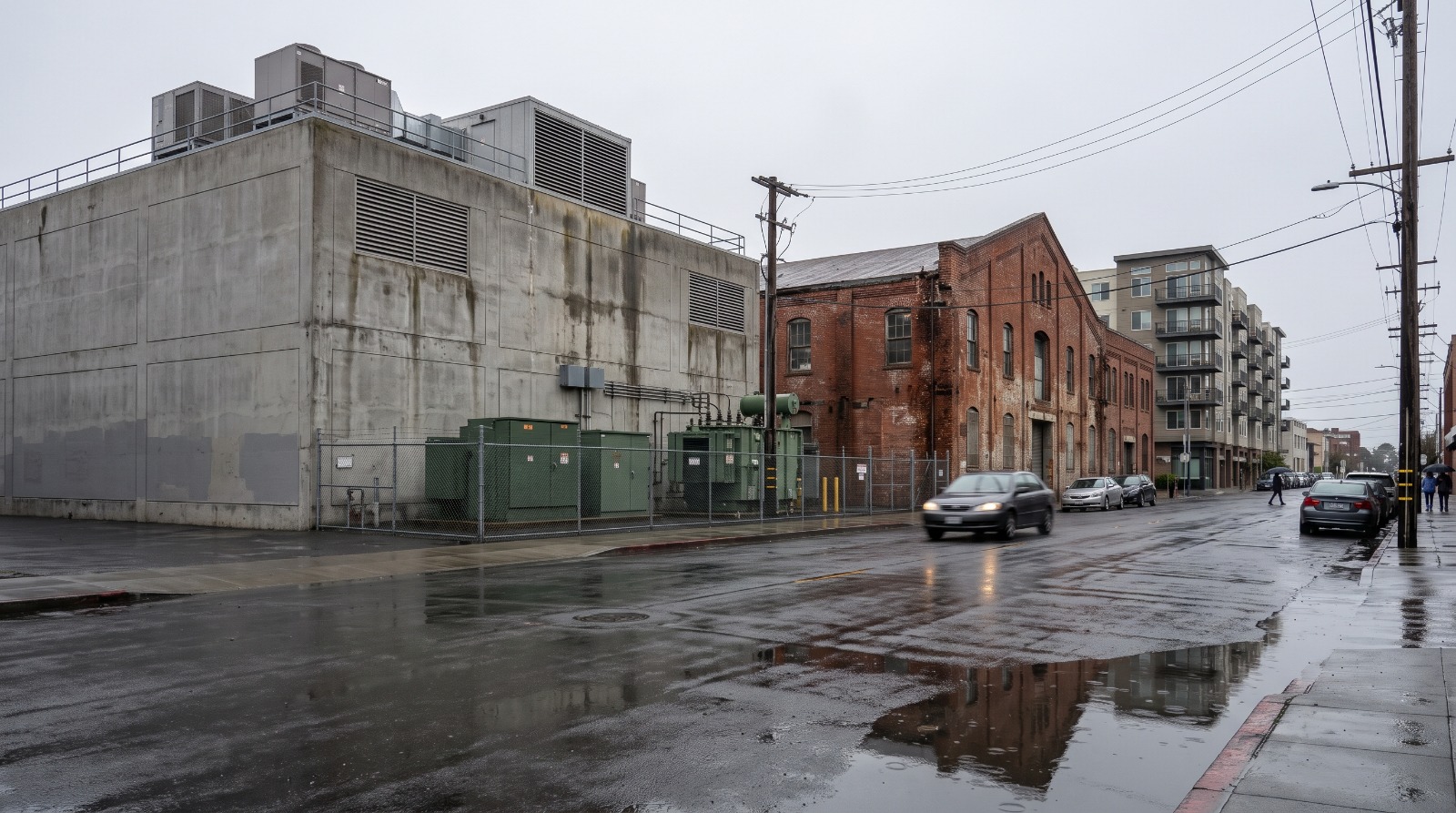
Windowless industrial building and old brick warehouse on a wet Dogpatch street in San Francisco (AI-generated illustration) Photo: Houseberry
San Francisco will not process a permit for a new data center until next September. Mayor Daniel Lurie signed the extension of the city's data center moratorium on Monday, Nov. 23, a week after the Board of Supervisors passed it without a dissenting vote, the SF Standard reported.
For homeowners in the southeast of the city, the extension matters more than it sounds. Nobody had a data center application in front of the Planning Department. The pause is about what could land in Dogpatch and the Bayview next, and about who gets the power when the grid is tight. In October we listed San Francisco's original 45-day pause in our tracker of Bay Area data center moratoriums. This is the longer version.
What the pause covers
The extension bars the city from processing permits to set up new data centers while staff study how many there are, how much power and water they use, and where they should go. The original 45-day version, adopted in October, also reached expansions of existing data centers.
The reason in the Planning Department's first report is arithmetic. San Francisco's electricity transmission is near capacity. A 50-megawatt data center would draw as much as 25,000 new homes. The city's own housing plan calls for 82,000 new homes by 2031, so one large data center would claim power equal to almost a third of that goal.
That is the trade the moratorium is really about. Data centers and apartments compete for the same wires.
Why District 10 pushed for it
District 10 runs from Dogpatch and Potrero Hill south through the Bayview to Visitacion Valley, and it holds most of the city's industrial land. Of the three standalone data centers city staff found, two are in the Bayview, and one has five active notices of violation from the Bay Area Air District over its diesel backup generators, expired permits and run-time limits, according to the SF Standard.
Interest in more is real. A lobbyist for a private equity firm known for building data centers met city officials in August about permits for a large plot in Dogpatch. We looked at one Dogpatch candidate, 1215 Michigan Street, in September, and counted the city's existing data centers the same month.
Walton terms out in January. Theo Ellington, who campaigned on a District 10 data center moratorium, takes the seat. That makes it likely the rules written during the pause will be written with a skeptical supervisor watching.
What it does to the blocks around it
The neighborhoods with the most industrial zoning are also the ones where San Francisco is still, by its own standards, affordable. Houseberry data puts the typical home in Central Waterfront and Dogpatch at about $1.13 million in October 2026, up about 2.7 percent from November 2025. The typical Bayview home was about $915,600, up about 4.3 percent.
Across the whole city, Houseberry's San Francisco city page shows the typical home at about $2.2 million in October, up from about $1.89 million a year earlier.
| Houseberry data | Typical home, Oct. 2026 | Change since Nov. 2025 |
|---|---|---|
| Central Waterfront/Dogpatch | $1.13M | +2.7% |
| Bayview | $915,600 | +4.3% |
| San Francisco citywide | $2.2M | +16.4% |
The two neighborhoods where data centers are most likely to be proposed cost roughly half or less of the citywide figure, and they gained a fraction of what the city gained in the past year. On Houseberry's scores, Dogpatch rates 2.9 out of 5 overall and the Bayview 2.4, with amenities the weakest factor in both, at 2.6 and 1.9.
A windowless building full of servers does not help either number. It brings few jobs for its size and no storefronts, and it takes up the kind of large flat lot that could hold housing.
Ten months is the right length. A 45-day pause was never going to produce a standard for a building that can draw as much power as a small city, and an open-ended ban would be much harder to defend. The test comes next September. If San Francisco arrives with clear rules on power, diesel generators and location, the pause did its job. If it arrives with another extension, it will have turned a study into a ban without saying so.
If you are weighing a home in Dogpatch, Potrero Hill or the Bayview, see how they compare with the rest of the city on Houseberry's San Francisco neighborhood rankings before the rules are written.
Sources
The Houseberry Research Team is Houseberry's reporting team: Bay Area real estate analysts, data specialists and longtime local market watchers. Every day we check the public record: building permits, city council and planning agendas, county recorder filings, state housing bills, police incident data and school results. Then we tie each story to what it means for specific neighborhoods, using Houseberry's own neighborhood data on prices, appreciation, safety, schools and amenities. Questions or corrections: Contact us.
Map of San Francisco Neighborhoods
Loading map...
View Full Map
Top Neighborhoods in San Francisco, CA





All information provided on this website including but not limited to - school ratings, safety, amenities, user opinions, and property data - is for general informational purposes only. We do not guarantee its reliability, accuracy, or completeness. Users should independently verify information and consult appropriate professionals as needed. By using this website, you agree Houseberry is not responsible for actions, decisions, or consequences arising from reliance on the information provided
houseberry.com - CA DRE# 01847391
 Bay East ©2025. CCAR ©2025. bridgeMLS ©2025. Information Deemed Reliable But Not Guaranteed. This information is being provided by the Bay East MLS, or CCAR MLS, or bridgeMLS. The listings presented here may or may not be listed by the Broker/Agent operating this website. This information is intended for the personal use of consumers and may not be used for any purpose other than to identify prospective properties consumers may be interested in purchasing. Data last updated at November 25, 2026 12:00 AM