San Jose Revisits Mobile Home Space Rent This Fall
San Jose is proposing to let space rent rise when a mobile home sells, in three steps from 2028. Here is what that would do to the city's 10,500 cheapest homes, and when the council decides.
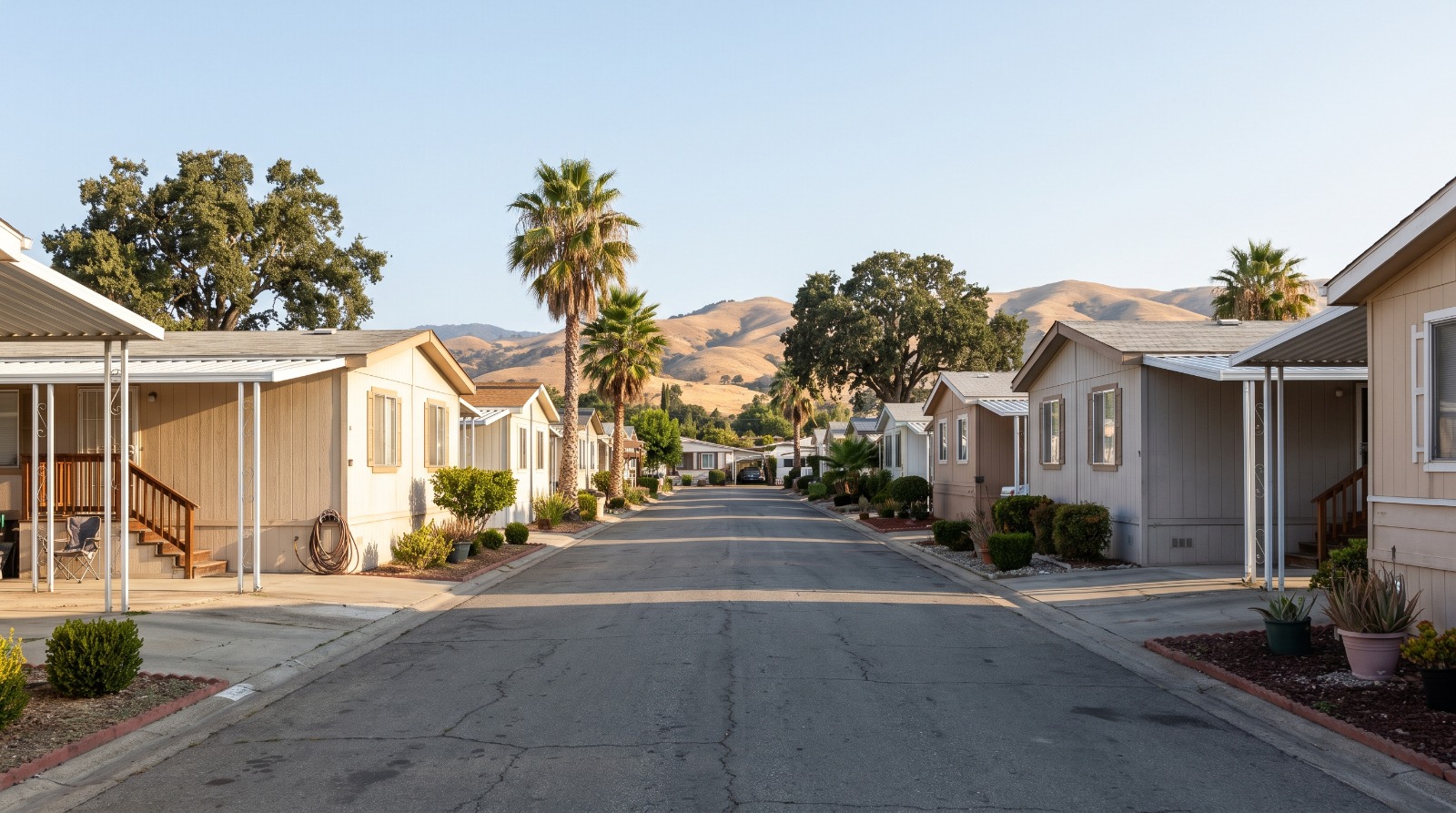
Rows of single-story manufactured homes along a quiet interior road in a San Jose mobile home park, with the Santa Teresa foothills behind. Photo: Houseberry
San Jose's Mobilehome Rent Ordinance contains one provision that does more for affordability than anything else in it, and most of the city has never heard of it. When a mobile home in a rent-stabilized park is sold, the space rent underneath it does not reset. The buyer inherits the seller's rent.
That provision is what the city is proposing to unwind, in three annual steps beginning in 2028. It affects roughly 10,500 spaces across 58 parks, the largest pool of unsubsidized affordable homes in San Jose, and the council is scheduled to take it up again this fall.
The first three are process reforms that residents largely asked for. The fourth is the one that moves money, and it is a partial rollback of vacancy control. That is the cleanest way to read the whole package.
The rule it would replace
San Jose's current cap is tight and predictable. Annual space rent increases are limited to 75% of the change in the San Francisco-Oakland CPI, with a 3% floor and a 7% ceiling, one increase per year. For the period beginning October 1, 2025, the allowable increase is 3%, the floor, which is where it lands in most years.
Park owners who need more can file a fair return petition and argue it before a hearing officer. Residents opposing the change point out that only eight fair return hearings have happened in the past 20 years. If the existing safety valve were genuinely unusable, you would expect it to have been used more than once every two and a half years.
Coverage is also frozen in time. The ordinance applies to spaces permitted before September 7, 1979. Anything newer is permanently exempt, which is part of why no one has built a rent-stabilized park in decades.
Why a rent increase at sale is really a price cut
This is the mechanism that makes the fight worth understanding. A mobile home buyer is purchasing a depreciating structure and renting the land under it, so the monthly space rent is priced straight into what the home is worth.
Nancy Stevens, a park resident who testified against the change, put the exchange rate at roughly $10,000 of resale value for every $100 a month of added space rent. That is her estimate rather than a city study, but the direction is not in dispute and the arithmetic is familiar to anyone who has priced a leasehold.
Run it forward. A 10% step on a $1,200 space rent is $120 a month, which on that rule of thumb takes about $12,000 off what the seller can get. The increase lands on the buyer as rent and on the seller as a lower price. It is a transfer from the resident side of the ledger to the park owner side, phased over three years.
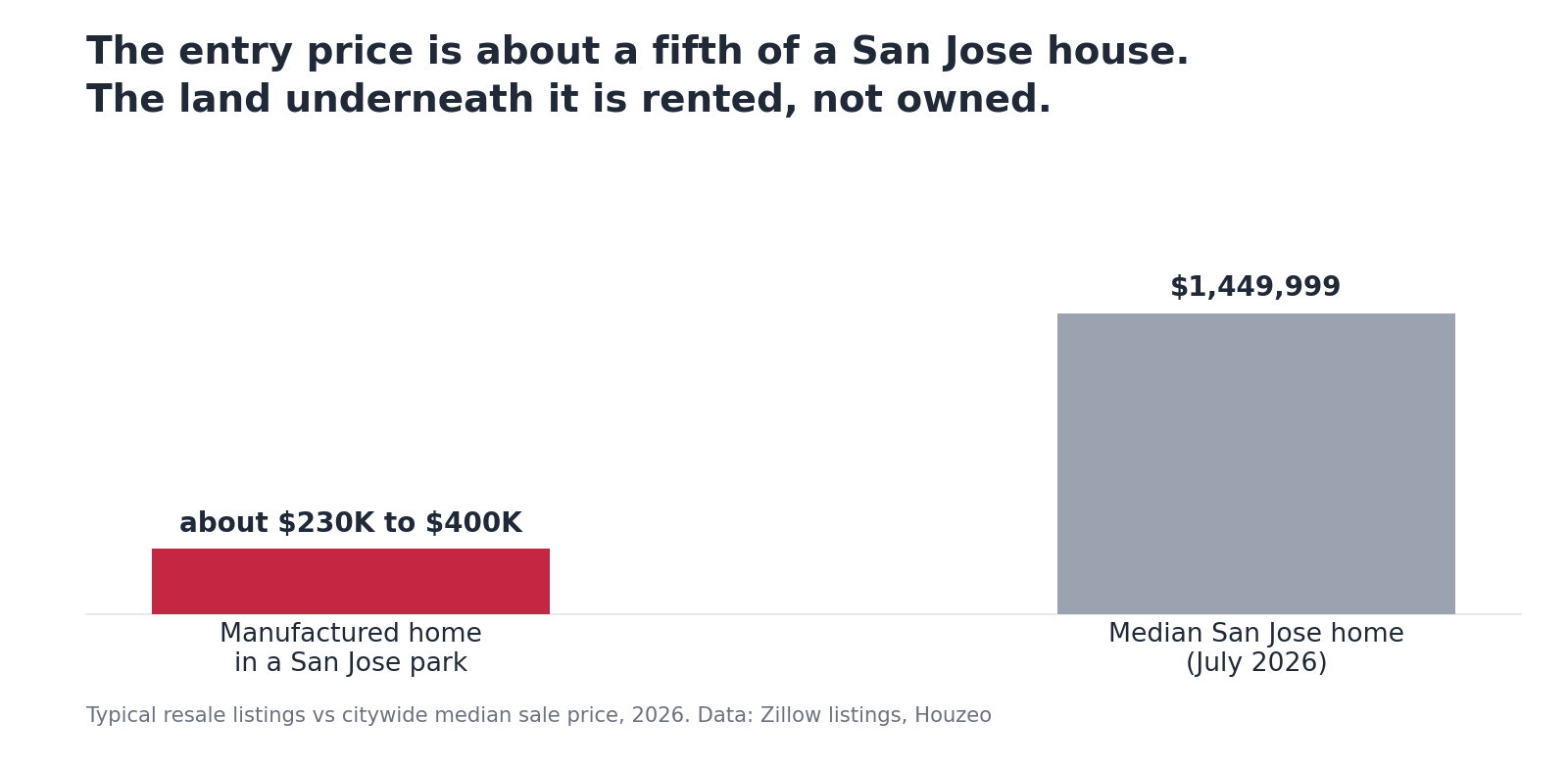
The entry price is why people care. Manufactured homes in San Jose parks were listed between $160,000 and $699,000 in August 2026, with the ordinary resale band running about $230,000 to $400,000. The citywide median sale price was $1,449,999 in July 2026. That is the cheapest path to owning anything in this city, and it is the one the ordinance is holding open.
How the vote went, and why it stalled
The Housing and Community Development Commission rejected the original version 9 to 4 on December 12, 2025. Chair Ruben Navarro said there was not real data to support the changes. The commission is advisory, so the recommendation went to the council rather than settling anything.
The council then voted 10 to 1 on January 28, 2026 to delay, with District 7's Bien Doan the lone dissent because he wanted the proposal rejected outright rather than deferred. Staff were directed to hold community meetings with residents and owners and return in fall 2026.
The delay followed reporting by San José Spotlight that the housing director had solicited feedback on draft policy language in September 2025 from a property manager for a company that owns eight San Jose parks, months before the draft was public, and that other commissioners reported no comparable outreach. That is the kind of process problem that costs a proposal a year even when the underlying policy has a case.
As of this summer, residents say the makeup meetings are not going much better. In coverage from July 30 and August 1, 2026, residents described hand-raising disabled in the virtual sessions and some in-person meetings restricted to park residents only. A city spokesperson said written-only questions are a precaution against disruption.
Where the parks actually are
San Jose is not a typical mobile home city. It has 10,667 rent-stabilized spaces, more than four times the next-largest Bay Area program.
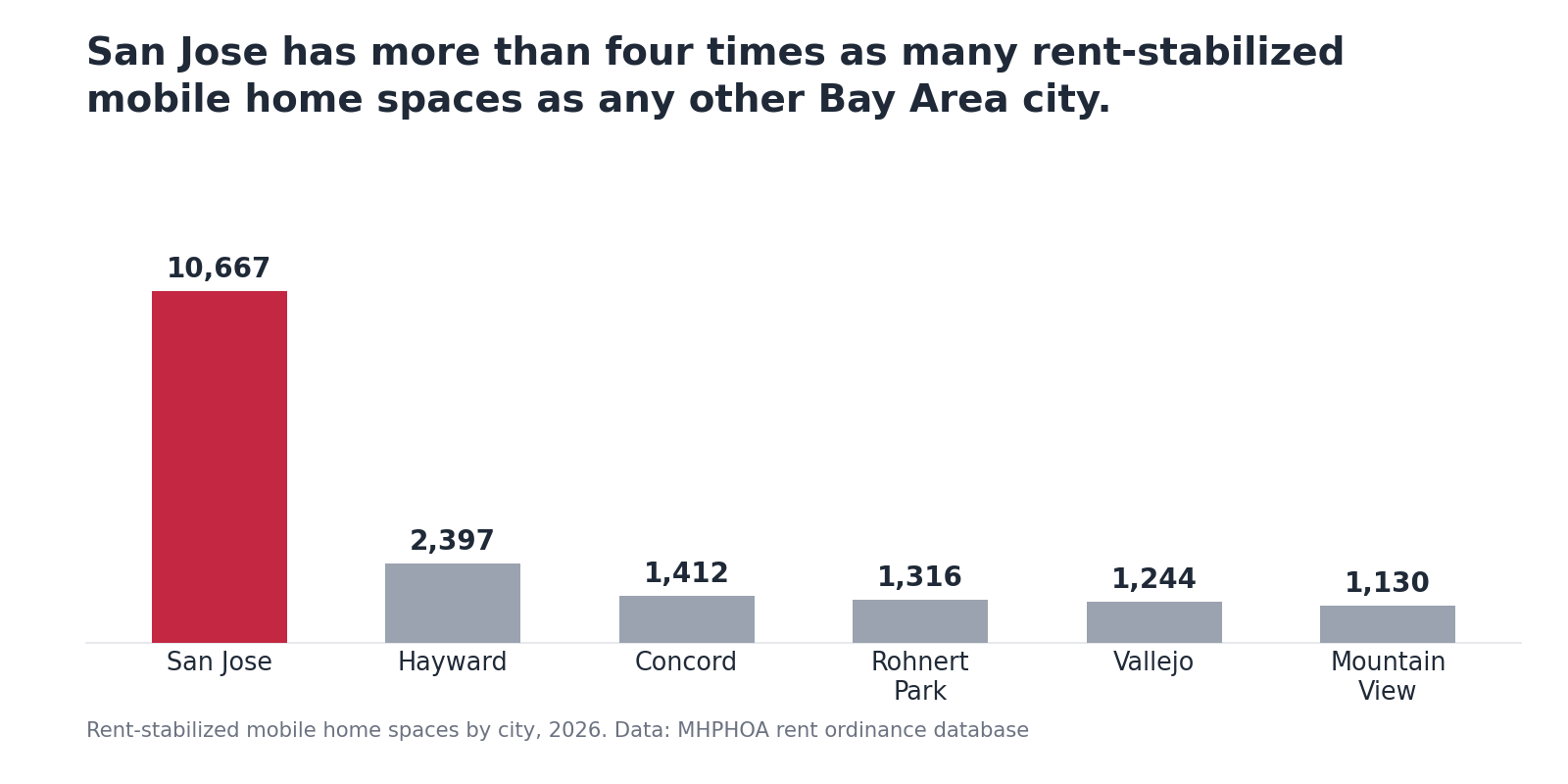
They are concentrated in the south and east of the city. Council District 7 holds 3,067 spaces and District 2 holds 2,711, which puts most of them in and around Edenvale, Seven Trees, Santa Teresa and Blossom Valley.
Those are not the neighborhoods that win our rankings. Edenvale Great Oaks, the working seam between Edenvale's residential blocks and the Great Oaks business park, scores 2.6 out of 5 overall on our data, 97th of 112 San Jose neighborhoods, with schools at 2.4 and safety at 3.0. What it has is a price of entry, and that is exactly the thing under discussion. Strip out the space rent protection and the affordability that makes these blocks work is the part that goes first.
How San Jose compares to its neighbors
Most Bay Area cities with mobile home ordinances protect rent at transfer. A few do not, and the difference is the whole question in front of the council.
| City | Stabilized spaces | Annual increase cap | Rent resets at sale? |
|---|---|---|---|
| San Jose | 10,667 | 75% CPI, 3% to 7% | No |
| Hayward | 2,397 | Lesser of 3% or 60% CPI | No |
| Concord | 1,412 | 80% CPI, 5% cap | No, capped at 10% |
| Vallejo | 1,244 | 100% CPI | Yes |
| Mountain View | 1,130 | 100% CPI, 5% cap | No |
| Petaluma | 874 | 100% CPI, 6% cap | Yes |
| Gilroy | 349 | 80% CPI, 5% cap | Yes |
Read the last column. San Jose's proposal would move it from the top group toward the bottom one, in stages. Concord is the closest model for what a capped reset looks like in practice, and the council should look at look at what happened to resale prices there.
The case for the increase, taken seriously
Park owners are not making the argument up. Parks are private infrastructure, with private sewer, water and road systems that age, and a 3% annual cap in a region where construction costs have not risen 3% in years does squeeze maintenance budgets. Commissioner Ryan Jasinsky, who manages parks and voted for the change, framed it as keeping the communities alive for another few decades. Housing Director Erik Soliván described the 10% as revenue for continuing capital costs.
The risk they are pointing at is real. Statewide, parks are closing and consolidating. Eleven California parks changed hands in October and November 2025 alone, including a 366-space park in Victorville for $33.2 million, and operators elsewhere in the Bay Area have pushed increases of 25% and higher where no ordinance stops them. A park that fails is worse for its residents than a park that raises rent.
The weakness in the case is evidentiary. The city has not published park-level financials showing which parks are actually short of money, and the fair return process that exists to prove exactly that has been used eight times in twenty years. Navarro's objection was not that park costs are imaginary. It was that nobody had shown the numbers.
What happens next, and the dates to watch
Staff are holding virtual sessions on September 14, 21 and 28, 2026, with at least one further in-person meeting in September, before the item returns to the council in the fall. No council date has been published yet.
If you own in one of these parks, the registry and the petition process are worth supporting on their own, and the phased increase is the piece to speak to. If you are thinking about buying into one, the thing to ask the seller is what the space rent is now and what it has done over the last five years, because under the current rule you are buying that number, and under the proposed one you would not be.
And if you are simply trying to work out where in San Jose your money still goes furthest, this is a reminder that the answer is rarely the listing price alone. We spend a lot of time on which San Jose neighborhoods are actually good value, and the ones with the mobile home parks are a genuine outlier: the cheapest ownership in the city, sitting on land nobody who lives there owns. The council decides this fall how much of that is left.
Sources
City of San José, Proposed Changes to the Mobilehome Rent Ordinance
City of San José, Mobilehome Rent Control
City of San José, Mobilehome Welcome Packet
San José Spotlight, Housing commissioners vote against the increase (December 2025)
San José Spotlight, Park manager advised the city on the rent increase
San José Spotlight, Residents shut out of rent increase talks (July 30, 2026)
Local News Matters, San Jose mobile home residents say they are being shut out (August 1, 2026)
MHPHOA, California mobile home rent stabilization ordinance database
All information provided on this website including but not limited to - school ratings, safety, amenities, user opinions, and property data - is for general informational purposes only. We do not guarantee its reliability, accuracy, or completeness. Users should independently verify information and consult appropriate professionals as needed. By using this website, you agree Houseberry is not responsible for actions, decisions, or consequences arising from reliance on the information provided
houseberry.com - CA DRE# 01847391
 Bay East ©2025. CCAR ©2025. bridgeMLS ©2025. Information Deemed Reliable But Not Guaranteed. This information is being provided by the Bay East MLS, or CCAR MLS, or bridgeMLS. The listings presented here may or may not be listed by the Broker/Agent operating this website. This information is intended for the personal use of consumers and may not be used for any purpose other than to identify prospective properties consumers may be interested in purchasing. Data last updated at September 18, 2026 12:00 AM