400 Divisadero: 11 Years From Car Wash to 203 Apartments
The old Touchless Car Wash site at Divisadero and Oak is finally set to break ground on 203 apartments. The eleven-year paper trail explains more about San Francisco housing than the groundbreaking does.
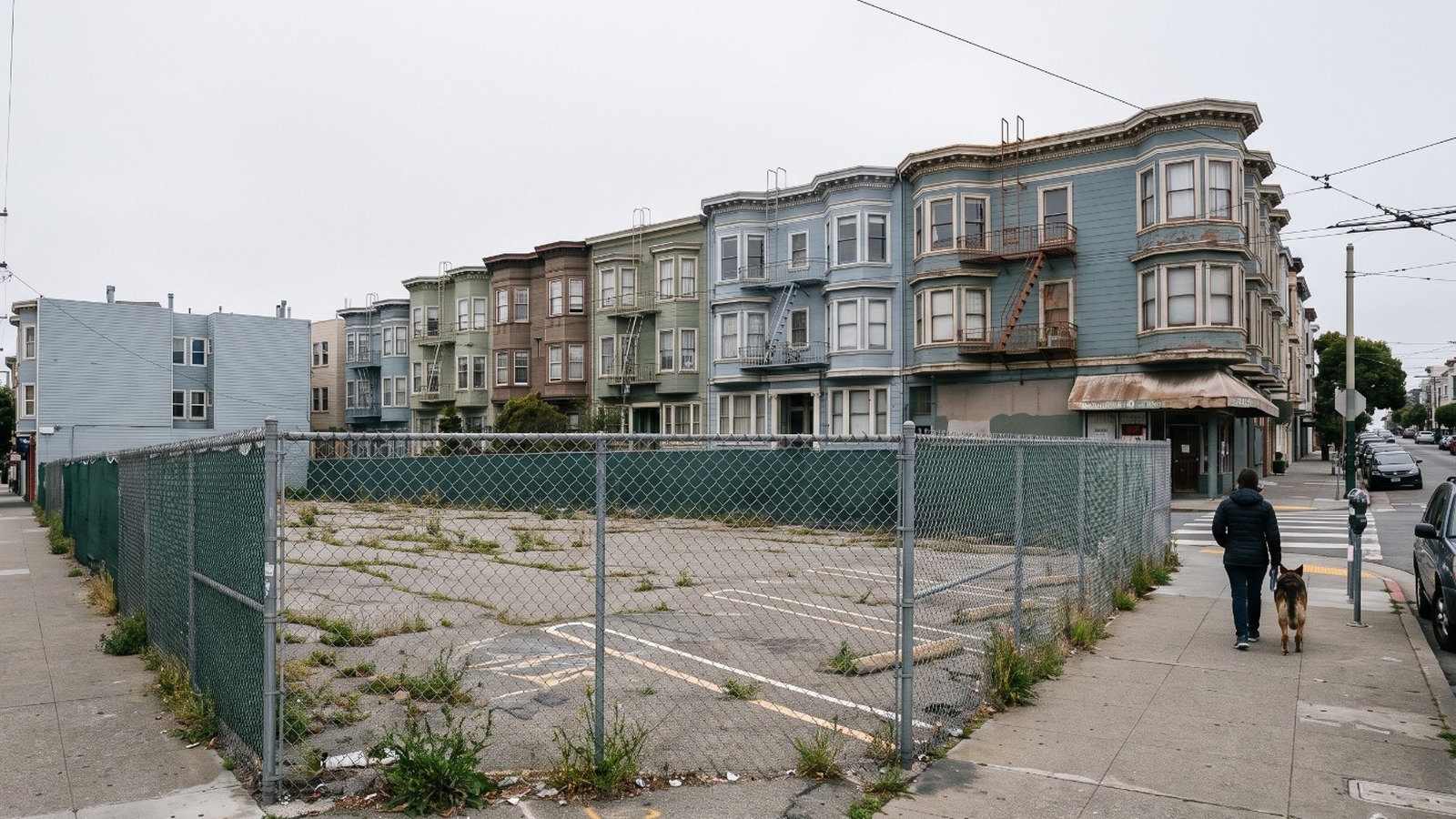
The vacant fenced lot at 400 Divisadero in San Francisco, the former car wash site approved for 203 apartments. Photo: Houseberry
The first application to put housing on the car wash lot at Divisadero and Oak was filed in June 2015. The corridor was upzoned to allow it two months later. Eleven years on, the site is a fenced rectangle of cracked asphalt, and it has now outlasted two development teams, one city purchase attempt and four separate unit counts.
The San Francisco Chronicle reported on Aug. 13, 2026 that the site is finally set to become 203 apartments, with construction starting this year. District 5 Supervisor Bilal Mahmood, who ran on this lot in 2024, called it one of the first housing projects to break ground in his district during his first term. That is worth marking. It is also worth reading the eleven-year paper trail, because the version of this building that pencils is a materially different building from the one that did not.
Note the approval route. AB 2011 makes qualifying housing on commercial corridors ministerial, which means staff check it against objective standards and sign it. No Planning Commission hearing to lose, no discretionary review to appeal. On a corner this politically loaded, that is not a small detail. Twenty-four parking spaces for 203 homes is the other tell: this is a building designed for people who will use the 24 Divisadero and the 5 Fulton, and the market clearly believes those people exist.
The corner has been approved before, at better affordability
This is the part the groundbreaking coverage tends to skip. A version of this project was approved seven years ago with nearly twice the affordable housing.
| Year | Units proposed | Below-market units | Outcome |
|---|---|---|---|
| 2015 | 152 | Not specified | Filed, then revised |
| 2017 | 177 | Not specified | Revised again |
| 2019 | 186 | 37 (20%) | Approved 5-2 on June 13, 2019. Developer walked away in 2022. |
| 2024 | 203 | 20 (about 10%) | Approved Dec. 23, 2024. Groundbreaking expected 2026. |
So the building that gets built will have 17 fewer permanently affordable homes than the building that did not, and 17 more market-rate ones. The ground-floor retail shrank too, from 8,100 square feet in the 2019 design to 1,850. I am on the side of building this. I also think you have to say plainly what eleven years of delay cost, and this is it. Every year the corner sat empty, the terms got worse for the people who most needed a unit in it.
The middle of that story is the piece most people have forgotten. Genesis, the earlier developer, gave up in October 2022, later writing that construction costs had made the project financially impractical. Then-Supervisor Dean Preston, Mayor London Breed and Supervisor Hillary Ronen agreed in the 2022 budget to earmark roughly $40 million to buy the site for fully affordable housing. The Tenderloin Neighborhood Development Corporation signed a purchase contract expecting that money. The money never arrived, and the contract expired. 4Terra bought the property in June 2024.
What actually changed between 2022 and now
The specific fix Mahmood points to is unglamorous and, if it works, genuinely useful: letting a stalled project build to the code version in effect when it first applied.
San Francisco updates its building code every three years. A project entitled in 2019 that does not start until 2026 has to be redrawn to whatever the current code says, which is a real cost on a building nobody has broken ground on. Mahmood introduced a measure in September 2025 to let projects lock in their original code vintage, and 400 Divisadero was the example he used, calling the car wash “emblematic of many” stalled sites. 4Terra’s Amir Massih estimated building to the 2016 code would save about 7 percent, or roughly $5 million, on a project pegged near $85 million. Massih’s framing was the honest one: “the closer you can get your project to construction-ready, the better shot you have of getting financing.”
Mahmood also credits work with the Mayor’s office and the Office of Economic and Workforce Development on reducing impact fees. Treat that as his account of it. What is on the record is his separate fee-deferral measure heard in September 2025, which moves impact fee payment to after occupancy rather than before construction. That is a cash-flow change, not a discount, and cash flow is exactly what kills a project trying to close a construction loan.
The citywide numbers do not yet back up the theory
If cheaper fees produced buildings, San Francisco would be building. It is not.
The city completed 405 homes in the first half of 2026, against a state obligation above 10,000 a year. About 3,300 units are under construction, down from 4,545 five years ago. The Board of Supervisors voted 9-2 on July 15, 2026 to cut the inclusionary requirement from 15 percent to 5 percent and reduce development impact fees by about two thirds. A Budget and Legislative Analyst review cited by 48hills in May found construction costs up 53.5 percent between January 2019 and December 2025 and concluded the city’s existing tax and fee incentives had not reversed the decline in building activity since 2022.
Two things follow, and they sit uncomfortably together. The July fee cuts came seven months after 400 Divisadero was already entitled, so they did not set this building’s affordability level and cannot be credited with it. And a single groundbreaking on the most politically visible vacant lot in District 5 is not evidence that the policy worked. It is evidence that this particular site finally cleared every hurdle at once. Watch the next five projects, not this one.
Nobody agrees what neighborhood this corner is in
Depending on who is writing, 400 Divisadero is in Lower Haight, NoPa, Alamo Square or just District 5. That is not pedantry, because the two neighborhoods this corner touches score very differently.
| Houseberry score | North Panhandle (NoPa) | Alamo Square |
|---|---|---|
| Overall | 4.0 of 5 (15th of 92) | 3.4 of 5 (50th of 92) |
| Safety | 4.3 | 3.6 |
| Schools | 4.4 | 2.9 |
| Amenities | 3.2 | 4.2 |
| Median home price, July 2026 | $3.08 million | $4.76 million |
4Terra markets the site as the NoPa submarket. SFYIMBY and the SF Standard call it Lower Haight. The North Panhandle side of the line scores 4.0 overall and 4.4 on schools, while Alamo Square scores 3.4 overall and 2.9 on schools but beats it on amenities, 4.2 to 3.2. Both hit 5.0 for merchant access, which is Divisadero itself doing the work. Citywide the San Francisco median sits at $2.16 million as of July 2026, so both sides of this corner are already well past it.
That is the case for 203 rentals here in one paragraph. Nobody is buying into this corner at $3.08 million, let alone $4.76 million. A building full of one-bedrooms and two-bedrooms on top of a 5.0 merchant corridor is how anyone under a certain income gets to live on a block like this at all, and 20 of those homes will be priced below market permanently. The address is the same either way. What changes is who can hold it.
What to watch next on Divisadero
The first visible sign will be demolition and environmental remediation, which on a former gas station and car wash parcel is the step that quietly runs long. After that, foundation work. The second thing to watch is 650 Divisadero, the fully affordable project approved in August 2025 a few blocks north, which is the corridor’s other flagship site and also has not broken ground.
Which is the number I keep coming back to. The city rezoned Divisadero between Haight and O’Farrell in August 2015 specifically to get housing built on lots like this one, and eleven years later neither of the corridor’s two headline sites has produced a finished home. If 400 Divisadero pours concrete this year, that finally changes. The way we look at a neighborhood at Houseberry, a corner like this is worth checking again in eighteen months rather than judging today, because the block does not settle until the building is up.
The car wash closed years ago. The fence is still there. Watch for the excavator.
Sources
San Francisco YIMBY, City Approves 400 Divisadero Street (Jan. 31, 2025)
The San Francisco Standard, A long-empty car wash lot on a prime corner (Feb. 1, 2025)
The San Francisco Standard, Touchless Car Wash still empty after 5 years (July 31, 2024)
Mission Local, How an old car wash became a key issue in S.F.’s District 5 race (Oct. 2024)
Mission Local, SF drops affordable housing requirement to 5 percent (July 14, 2026)
San Francisco Examiner, Supervisor tackles SF housing death spiral in new measure
GrowSF, Only 405 homes built in the first half of 2026 (July 31, 2026)
48hills, Cutting fees for developers has not encouraged much new housing (May 5, 2026)
Reuben, Junius & Rose, Divisadero and Fillmore NCT rezoning (Ordinance 127-15)
Map of San Francisco Neighborhoods
Loading map...
View Full Map
Top Neighborhoods in San Francisco, CA





All information provided on this website including but not limited to - school ratings, safety, amenities, user opinions, and property data - is for general informational purposes only. We do not guarantee its reliability, accuracy, or completeness. Users should independently verify information and consult appropriate professionals as needed. By using this website, you agree Houseberry is not responsible for actions, decisions, or consequences arising from reliance on the information provided
houseberry.com - CA DRE# 01847391
 Bay East ©2025. CCAR ©2025. bridgeMLS ©2025. Information Deemed Reliable But Not Guaranteed. This information is being provided by the Bay East MLS, or CCAR MLS, or bridgeMLS. The listings presented here may or may not be listed by the Broker/Agent operating this website. This information is intended for the personal use of consumers and may not be used for any purpose other than to identify prospective properties consumers may be interested in purchasing. Data last updated at September 26, 2026 12:00 AM