Atherton Townhomes: 30 Units Filed Under SB 79
A Cupertino developer filed to build 30 townhomes on a one-acre Atherton lot under SB 79. Here is what the state law forces the town to allow on its seven eligible parcels, and what Atherton can still control.
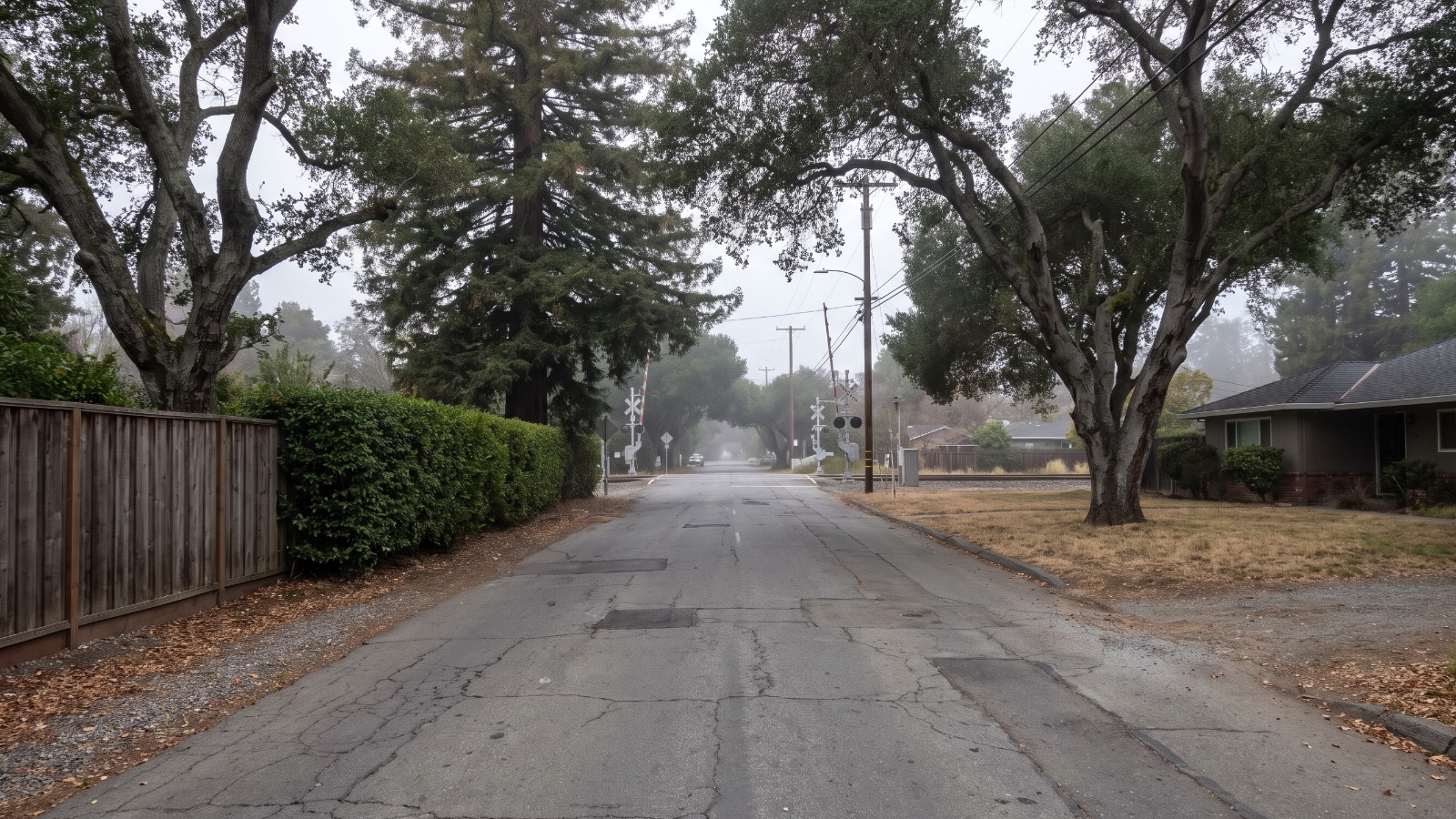
A quiet Atherton residential street running down to the Caltrain crossing near Menlo Park, the corridor that makes the proposed Atherton townhomes legal under SB 79. Photo: Houseberry
Atherton has spent about a century making sure this exact thing could not happen. No apartment buildings. Sidewalks on almost none of the streets. One-acre minimum lots, hedges tall enough to count as infrastructure, and a town council that in 2023 pulled multifamily overlay zones out of its own housing plan rather than keep arguing with the neighbors about them.
On July 9, a Cupertino developer filed to build 30 Atherton townhomes anyway.
The application from AlphaX RE Capital covers 110 Glenwood Ave, a one-acre parcel at the corner of Glenwood and Laurel with a single-family house sitting on it right now. Five buildings, three stories, up to 45 feet, 30 units, six of them deed-restricted affordable. It is legal because of Senate Bill 79, the transit-density law that took effect on July 1. And the reason SB 79 reaches this particular corner of the most expensive zip code in the country is a train platform that is not in Atherton at all.
Six of 30 is 20 percent affordable. SB 79's own floor is 7 percent extremely low income, 10 percent very low, or 13 percent lower income, whichever local rules push higher. So the project is meaningfully above the state minimum, which is worth remembering when someone at a hearing calls it a giveaway to a developer.
Atherton's SB 79 map has exactly seven parcels on it
The town did not get blindsided here. Atherton wrote its own SB 79 ordinance and passed the first reading on February 18, 2026, then sent it to the state Department of Housing and Community Development ahead of the July 1 deadline. Council also asked staff to explore an alternative transit-oriented development plan, the mechanism cities can use to shift required capacity somewhere less painful. That one did not get finished in time.
The ordinance covers seven parcels. All seven sit within a quarter mile of a pedestrian entry to the Menlo Park Caltrain station. On those seven parcels, SB 79 requires Atherton to allow buildings up to 75 feet, a density of no less than 120 units per acre, and a floor area ratio of at least 3.5. Town planner Britney Bennix said it plainly at the meeting. The law "overrides our Atherton ability to have zoning limitations for denser buildings" near the station.
Seven parcels is the entire exposure, and it exists because of geography the town cannot rezone. Caltrain permanently closed the Atherton station in December 2020 after years of weekend-only service, so the town's own stop generates nothing. Everything here flows from a platform a few blocks down the tracks in another city.
Both towns also caught a break on population. SB 79's outer band, the ring from a quarter mile out to a half mile, only applies in cities of 35,000 or more. Menlo Park is around 33,000 and Atherton is around 7,000. In a bigger city, the affected area would be a circle. Here it is seven lots.
AlphaX is asking for about a quarter of what the state would let it build
This is the part the coverage has mostly skipped, and it is the most interesting number in the file. Here is the site today, the standard SB 79 forces Atherton to allow on it, and what the developer actually asked for.
| On the site today | What SB 79 requires Atherton to allow | What AlphaX filed | |
|---|---|---|---|
| Homes on the acre | 1 | 120 or more | 30 |
| Height | 1 story | up to 75 feet | 3 stories, up to 45 feet |
| Building floor area | one house | FAR 3.5, roughly 152,000 sq ft | roughly 52,500 sq ft at the state's 1,750 sq ft average-unit cap |
| Deed-restricted affordable | 0 | 13 percent lower income floor | 6 units, 20 percent |
Read across that table and the shape of the thing is obvious. At the state's density floor, 120 homes could go on that acre. AlphaX filed for 30. At 75 feet, the buildings could be six or seven stories. AlphaX filed for three. SB 79 also caps average unit size at 1,750 square feet, which is a real constraint on anyone hoping to build Atherton-sized houses at Atherton-sized prices.
So why leave three quarters of the entitlement on the table? Two reasons worth naming out loud. Townhomes for sale are a different product than a six-story rental stack, and the buyer pool for a 1,750-square-foot attached home in Atherton is not obviously deep enough to absorb 120 of them at once. The second reason is political. A three-story project is much harder to fight in a packed council chamber than a seven-story one. Restraint is a strategy.
Here is the part opponents should sit with, though. The restraint is voluntary. The 120-unit ceiling does not disappear if this application dies. It stays on all seven parcels, waiting for a developer with less interest in being liked.
The 2023 housing element fight is the best predictor of what happens next
Atherton's regional housing needs allocation for 2023 through 2031 is 348 units, up from 93 in the prior cycle. In early 2023 the council stripped the multifamily overlay zones on El Camino Real and Valparaiso Avenue out of the plan it sent to the state, including upzoning on 17 El Camino lots, and leaned on 280 backyard accessory dwelling units instead. Stephen and Ayesha Curry sent a letter opposing upzoning near their street. One neighbor told the council, on the record, "This is over my fence and yes, I'm NIMBY." The whole thing went national for about a week.
Expect a version of that again, and expect some of it to be reasonable. Laurel Street is narrow. Nativity School's drop-off already stacks up on it. Thirty households means real cars in a place with no sidewalk to speak of. Those are specific, fixable complaints, and they deserve specific answers about the site plan rather than a lecture.
What is different this time is procedural, and it is the entire story. The 2023 fight was about a plan Atherton got to write. SB 79 is a standard Atherton has to apply. Qualifying projects can pursue streamlined ministerial approval through the SB 35 and SB 423 pathway, roughly 90 to 180 days and exempt from CEQA. Objective standards still apply. A vote on whether the town likes it does not. We walked through how unevenly that is landing across the region in our piece on how Bay Area cities split on SB 79.
And it is worth saying the quiet part. Calling a one-acre lot next to a school parking lot and an active rail corridor "neighborhood character" takes some doing. If there is a defensible place to put 30 homes in Atherton, this is the one.
Atherton scores 3.7 on amenities. Downtown Menlo Park scores 4.6.
Here is where our own data says something the news coverage does not.
Across the six Atherton neighborhoods we score, the town comes in at 4.0 overall, 4.3 on schools, 3.8 on safety, and 3.7 on amenities. Amenities is the weakest of the four, and that is not a knock on the town. It is the design. Atherton has essentially no retail, no grocery store, and almost nothing you can reach on foot. That was the point.
Half a mile away, Downtown Menlo Park scores 4.4 overall and 4.6 on amenities, with a June 2026 median around $2.77 million. Atherton's city page shows a June 2026 median near $17.31 million against a 12-month range of $9.94 million to $18.65 million, which mostly tells you how few homes change hands there in any given month.
So the feature that makes 110 Glenwood eligible for 30 townhomes is the same feature Atherton scores lowest on. Walkable everything, and it is in the next town. Santa Cruz Avenue, groceries, coffee, and a Caltrain platform are all a short walk from that corner. The rest of Atherton is nowhere near any of it.
That gap is exactly the kind of thing that disappears behind a price. A $17 million median tells you what the estates cost. It tells you nothing about whether you can walk anywhere, and outside these few blocks the honest answer in Atherton is no. Looking at the area before the address is the whole reason we built Houseberry, and this corner is a clean example of why the two answers can be so different a half mile apart.
What to watch between now and a hearing
- Whether AlphaX pursues the streamlined ministerial track or standard review. That one choice decides whether this becomes a public fight or a checklist.
- Whether HCD signs off on Atherton's ordinance as submitted, and whether the town revives its alternative TOD plan for the next housing element cycle.
- Whether a second application lands on any of the other six parcels.
That last one is the real tell. Palo Alto took seven SB 79 filings in 16 days once its window opened, which we covered in our look at the Palo Alto SB 79 rush. Atherton's window is a fraction of the size. It is still open.
Questions Atherton neighbors are already asking
Can Atherton reject the townhome project?
Not on the grounds most people expect. SB 79 turns height and density on those seven parcels into an objective standard rather than a local preference, and the town's own planner told council the law overrides Atherton's zoning limits near the station. Atherton can apply objective standards, review the site plan, and enforce what its code actually requires. What it cannot do is vote the density down because the neighborhood does not want it.
Where exactly is the site?
110 Glenwood Ave, at the corner of Glenwood Avenue and Laurel Street on Atherton's southeast edge near Nativity School. It is one of seven Atherton parcels sitting inside a quarter mile of a pedestrian entrance to the Menlo Park Caltrain station. Atherton's own former station, a mile up the line, closed in 2020 and does not count.
Would 30 townhomes lower Atherton home values?
There is no reason to expect 30 homes on a single acre to move a market where the median sale runs into eight figures. Atherton pricing is driven by land, lot size, and school access, none of which change here. The likelier outcome is not a price drop but a new price tier. An Atherton address well under $4 million is currently close to nonexistent, and 30 of them would create a comparison set the town has never had.
Are more SB 79 projects coming to Atherton?
Six other parcels qualify under the same ordinance, so more filings are possible. The scale is limited by geography rather than by politics, which is a genuinely new situation for this town. Anything outside that quarter-mile ring still runs through Atherton's normal rules.
Sources
- The Almanac: Developer proposes 30-unit Atherton townhome project using new state law
- Citizen Portal: Atherton introduces SB 79 ordinance for parcels near the Menlo Park Caltrain station
- Citizen Portal: Atherton staff outlines SB 79 impacts and council explores an alternative TOD plan
- The Almanac: New state law allows 75-foot housing near the Menlo Park Caltrain station
- Holland & Knight: Gov. Newsom signs SB 79, unlocking higher residential density near transit
- Coblentz: Upzoning under SB 79, approval pathways and standards
- The Almanac: Atherton guts most of multifamily housing from the plan it sent to the state
- Caltrain: Service changes and the permanent closure of Atherton Station
All information provided on this website including but not limited to - school ratings, safety, amenities, user opinions, and property data - is for general informational purposes only. We do not guarantee its reliability, accuracy, or completeness. Users should independently verify information and consult appropriate professionals as needed. By using this website, you agree Houseberry is not responsible for actions, decisions, or consequences arising from reliance on the information provided
houseberry.com - CA DRE# 01847391
 Bay East ©2025. CCAR ©2025. bridgeMLS ©2025. Information Deemed Reliable But Not Guaranteed. This information is being provided by the Bay East MLS, or CCAR MLS, or bridgeMLS. The listings presented here may or may not be listed by the Broker/Agent operating this website. This information is intended for the personal use of consumers and may not be used for any purpose other than to identify prospective properties consumers may be interested in purchasing. Data last updated at September 15, 2026 12:00 AM