Why Bay Area Cities Are Rewriting Their Zoning Codes
A state deadline on July 1 and a stack of new housing laws pushed a dozen Bay Area cities to rewrite their zoning in the same few months of 2026. Here is what changed, city by city, and what it means for your block.

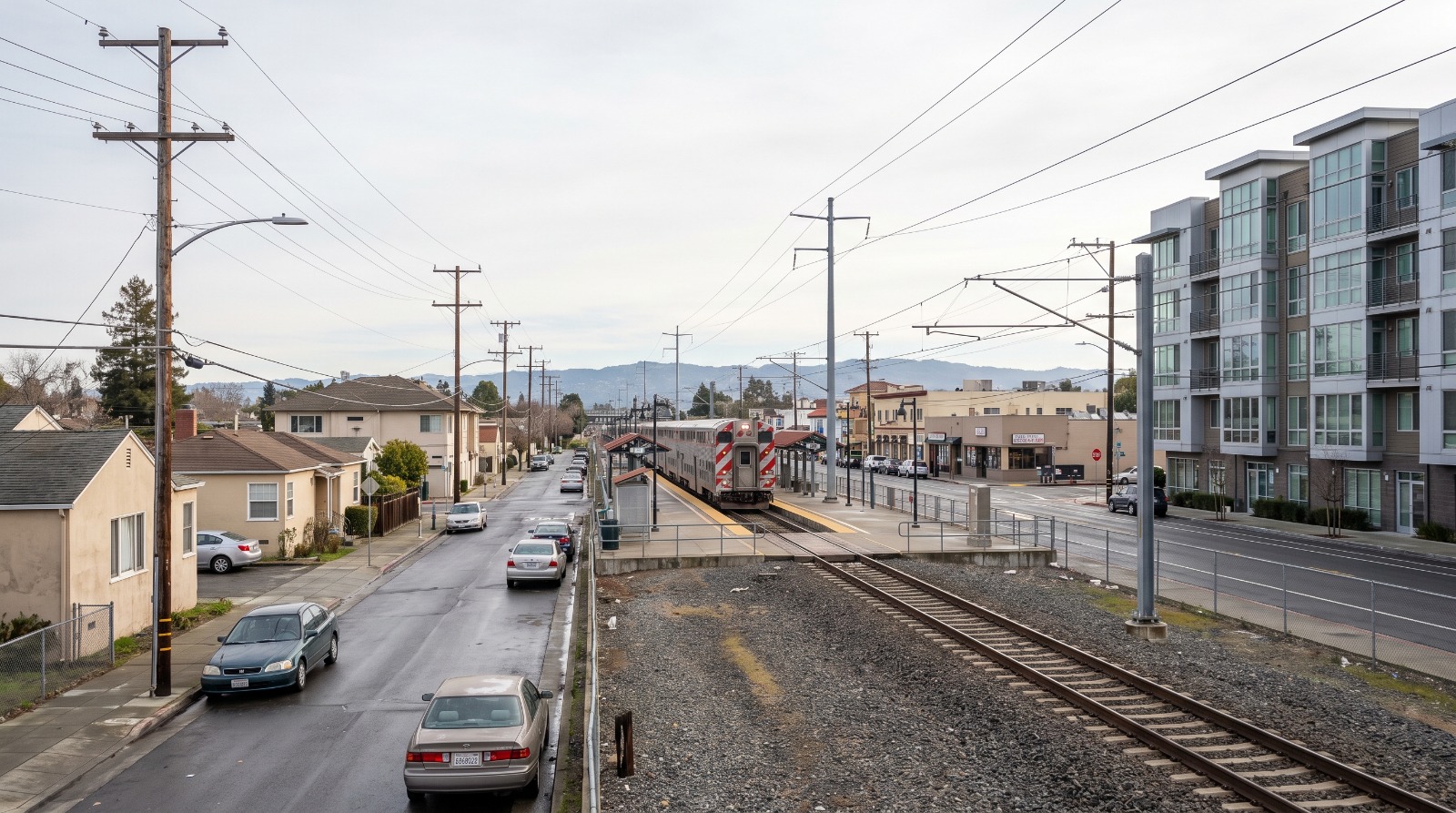
A Bay Area transit corridor where older homes meet a new apartment building, the kind of block reshaped by 2026 zoning changes. Photo: Houseberry
Something unusual happened across the Bay Area this year. City after city sat down and rewrote its own zoning code, mostly within the same few months. Redwood City passed more than 20 amendments on July 13. San Jose adopted a rezoning ordinance in March. Palo Alto and Mountain View spent the spring reworking theirs. Berkeley had already ended single-family-only zoning last summer. Put them on a calendar and it stops looking like a run of unrelated local decisions and starts looking like what it is, a coordinated scramble driven from Sacramento.
If you are trying to buy or sell a home here, this matters more than it sounds. The rules that govern what can be built on the lot next door, and on the lot you are bidding on, are being rewritten in real time, and they are not landing the same way in every city. Here is what is driving the 2026 zoning changes across the Bay Area, who did what, and what it means for the block you actually care about.
The July 1 deadline that set everything off
The single biggest force is SB 79, the transit-density law that took effect July 1, 2026. It overrides local zoning to allow taller, denser housing within about a half mile of major transit stops, and in the Bay Area it applies across four counties, Alameda, San Francisco, San Mateo, and Santa Clara. The catch that lit the fuse is a deadline. SB 79's state defaults apply automatically unless a city adopts its own approved plan first. Miss July 1 without a local ordinance, and the state's version takes over.
That turned an abstract state law into a hard municipal deadline, and cities responded the way anyone responds to a deadline. All at once, at the last minute.
What actually changed, city by city
Here is the wave in one place.
| City | The 2026 zoning move | When |
|---|---|---|
| Redwood City | Over 20 code amendments: detached ADU cap on multifamily lots raised from 2 to 8, parking minimums cut, hearings dropped for whole project types | July 13, 2026 |
| San Jose | Ordinance 31316 implementing SB 79 through industrial employment hub carve-outs across 56 transit stations, plus a citywide general-plan alignment | March 17, 2026 |
| Palo Alto | Rezoning transit areas to roughly half of SB 79 capacity to buy a delay, plus a historic-site exemption | Spring 2026 |
| Mountain View | An R3 multifamily zoning update and a transit-oriented alternative plan for SB 79 | Feb to June 2026 |
| Berkeley | Middle Housing Ordinance ends single-family-only zoning citywide, up to 8 units on a standard lot | June 27, 2025 |
| Sunnyvale | Rezoned 27 properties for ADUs and about 30 acres of land to meet its state housing target | Jan 28, 2025 |
| San Francisco | Building its own SB 79 alternative on top of the new Family Zoning Plan | Spring 2026 |
| Oakland | Council split over whether to use SB 79 delay provisions or comply immediately | 2026 |
Most cities are not defying the state. They are steering it
Read that list and you might expect a revolt. There isn't one, or not much of one. The dominant move is subtler and more interesting. Cities are rewriting their codes on purpose so they control the terms.
San Jose used industrial-hub exemptions to route density toward areas like North San Jose rather than its leafy interior. Palo Alto is rezoning just enough, to about half of SB 79's capacity, to qualify for a delay that pushes full compliance out for years. Los Angeles pulled a similar move down south, and the governor called it out publicly. Every one of those defensive plays is still a code rewrite. That is why the wave is bigger than the pro-housing headlines suggest. The cities fighting the law and the cities embracing it are both rewriting their zoning, just toward different ends.
Not every rewrite sticks, either. Beverly Hills submitted an alternative plan and the state's housing department rejected it in May. A League of California Cities lobbyist put the planners' problem bluntly, saying many do not have the information they need to even get started. Passing a law is fast. Rezoning a city to match it, and getting the state to sign off, is slow and messy.
SB 79 is only the top of the stack
SB 79 gets the attention, but it landed on top of a pile of other reforms that all hit at once, which is the real reason planning departments are underwater.
Last summer, the state rewrote CEQA, the environmental review law long used to slow or block housing. AB 130 and SB 131, signed June 30, 2025, exempted most infill housing on lots under 20 acres from that review entirely. Then came the 2026 ADU laws, which made backyard units faster and cheaper to permit. And on July 13, the same evening Redwood City was voting, the governor signed AB 179, a budget bill that cuts the fees on affordable projects and folds state housing money into a single office.
Stack CEQA relief, transit upzoning, easier ADUs, and cheaper affordable financing on top of one another, and you get the current moment. The state stopped nudging and started setting deadlines, and cities had to rewrite their rulebooks to keep up.
What this means if you are buying or selling
For an ordinary buyer or homeowner, the honest read is not that prices are about to drop. Almost none of this stack touches the price of an existing market-rate home directly. What it changes is what a given piece of land is allowed to become, and that can move value well before a single new building appears.
Two similar houses a few blocks apart can now carry very different futures depending on which side of a half-mile transit line they sit on, or whether their city complied with SB 79, carved itself out, or bought a delay. A lot that can suddenly host a fourplex or a cluster of ADUs is worth more than an identical-looking lot that cannot. That latent development value is exactly the kind of thing that never shows up in a listing photo and rarely shows up in the asking price right away.
This is the lens we bring at Houseberry. The neighborhood around a home, and the rules now being rewritten over it, often decide more than the house itself. If you are weighing a purchase in a city that just reworked its code, it pays to know how its neighborhoods actually compare on schools, safety, value, and transit access, rather than assuming the zoning under your feet will look the same in five years. It probably will not.
What to watch over the next year
The rewriting is not finished. Over the next twelve to eighteen months, the state will certify some of these local plans and bounce others back, the way it did to Beverly Hills. The first real lawsuits over SB 79 are widely expected now that the deadline has passed, though none had been filed as of this spring. And the gap between what is newly legal and what actually gets built will start to show, because rezoning a parcel and financing a building on it are very different things.
For now, the takeaway is simple. If you are shopping the Bay Area, do not assume the zoning map you see today is the one that will govern your block tomorrow. In 2026, that map is a moving target, and the city you buy in decided this year which direction it moves.
A few common questions
What is forcing Bay Area cities to change their zoning in 2026?
Mostly SB 79, the transit-density law effective July 1, 2026. Its state rules apply automatically unless a city adopts its own approved plan first, so cities rushed to rewrite local zoning before the deadline. A stack of other 2025 and 2026 laws on CEQA, ADUs, and housing finance added to the pressure.
Does this mean home prices will fall?
Not directly. These laws target supply, process, and affordable financing, not the price of existing market-rate homes. Any price effect is slow and indirect, and it depends on homes actually getting built, which takes years.
How do I know what my city did?
Look at whether it adopted its own SB 79 plan, carved out exemptions, or is using a delay. The outcome on the ground differs by city. Our city-by-city SB 79 explainer is a good starting map.
Sources
- Houseberry: SB 79 is live, Bay Area cities are split
- CalMatters: How Bay Area cities are implementing SB 79
- Governor of California: CEQA reforms to build more housing, AB 130 and SB 131
- Governor of California: More Housing, Faster, AB 179
- Redwood City Pulse: Redwood City OKs over 20 amendments
- Houseberry: California's 2026 ADU laws
The Houseberry Research Team is Houseberry's reporting team: Bay Area real estate analysts, data specialists and longtime local market watchers. Every day we check the public record: building permits, city council and planning agendas, county recorder filings, state housing bills, police incident data and school results. Then we tie each story to what it means for specific neighborhoods, using Houseberry's own neighborhood data on prices, appreciation, safety, schools and amenities. Questions or corrections: Contact us.
All information provided on this website including but not limited to - school ratings, safety, amenities, user opinions, and property data - is for general informational purposes only. We do not guarantee its reliability, accuracy, or completeness. Users should independently verify information and consult appropriate professionals as needed. By using this website, you agree Houseberry is not responsible for actions, decisions, or consequences arising from reliance on the information provided
houseberry.com - CA DRE# 01847391
 Bay East ©2025. CCAR ©2025. bridgeMLS ©2025. Information Deemed Reliable But Not Guaranteed. This information is being provided by the Bay East MLS, or CCAR MLS, or bridgeMLS. The listings presented here may or may not be listed by the Broker/Agent operating this website. This information is intended for the personal use of consumers and may not be used for any purpose other than to identify prospective properties consumers may be interested in purchasing. Data last updated at October 23, 2026 12:00 AM