Belle Haven Got 8 New Homes. The Gap Is 1.8 Million
Menlo Park approved eight permanently affordable townhomes in Belle Haven. The vote is small. The gap between Belle Haven and the rest of the city is not.
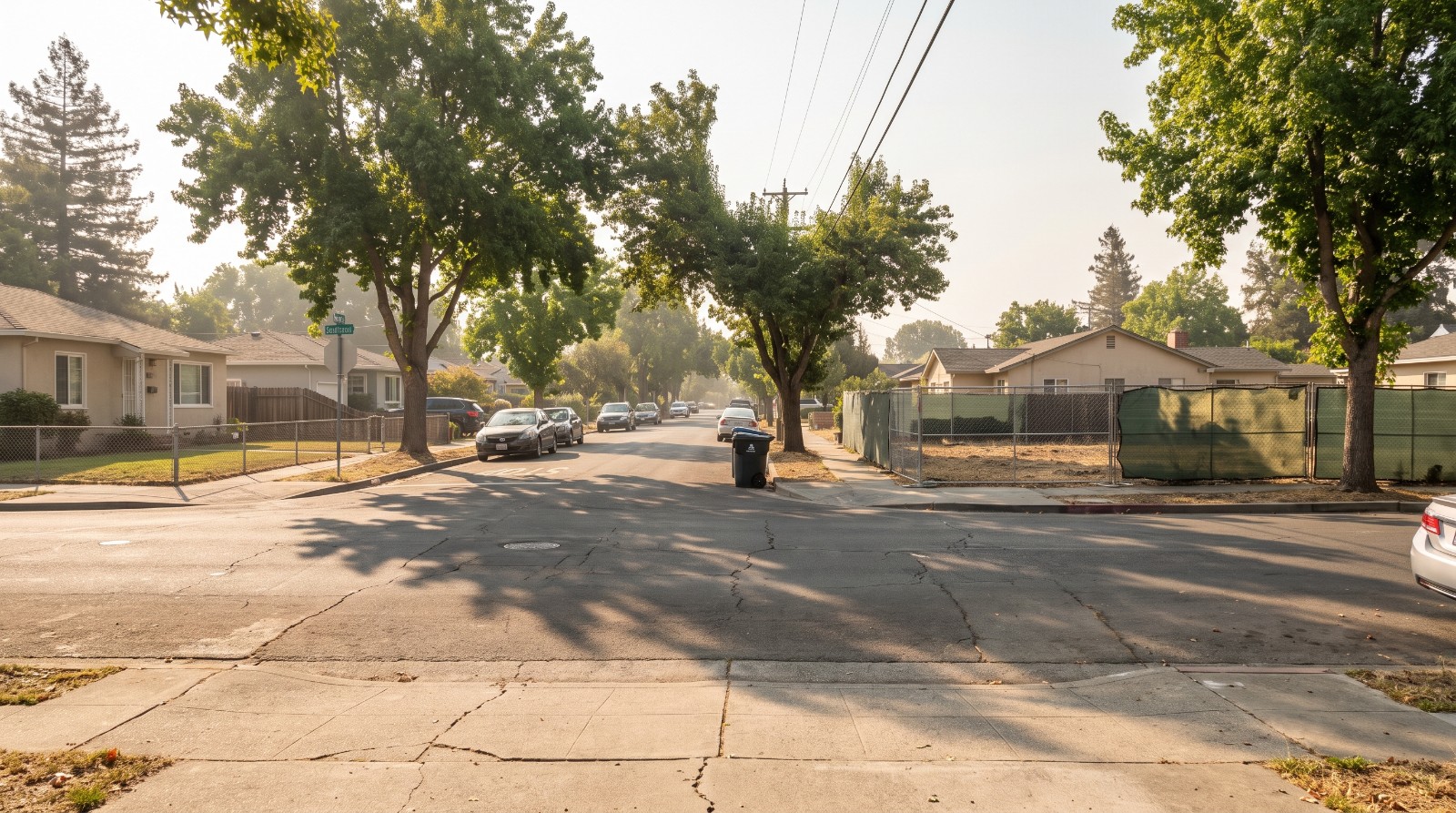
A residential street of single-story postwar homes in the Belle Haven neighborhood of Menlo Park, California, with a vacant infill lot mid-block. Photo: Houseberry
Pierce Road is a short, flat street on the bay side of Highway 101, one block from the Belle Haven Community Center and less than a mile from Meta's headquarters. Two adjacent parcels there, 335 and 355, have been sitting vacant. On Tuesday the Menlo Park City Council cleared the last approvals for eight permanently affordable townhomes on that lot, all of them for households earning up to 80 percent of area median income, all of them for sale rather than rent.
The council also turned down Habitat for Humanity's request to waive development and permitting fees, which is where this story stops being a ribbon-cutting and starts being interesting.
The real question a family asks about Belle Haven is not whether eight townhomes are good news. It is whether Belle Haven is a place they can get into at all, and what they are getting into. Those are two separate questions and the answers point in different directions.
What the council approved, and what it declined
Laurel Landing is eight townhome condominiums across two three-story buildings on a 0.35-acre site, about 13,076 square feet of gross floor area and eight parking spaces. The unit mix is three two-bedrooms, three three-bedrooms, and two four-bedrooms, averaging roughly 1,255 square feet, which is a genuinely family-sized program rather than the studios that usually get counted as affordable housing wins. TCA Architects designed it. MidPen Housing owns the land. Construction is scheduled to start in December 2026 and finish in summer 2028.
The Planning Commission approved the use permit, architectural control, and the below-market-rate housing agreement on July 13, 2026. The council's job on August 11 was the major subdivision and a density bonus fee concession, per the city's own project page.
Menlo Park has already put 3.6 million dollars into this from its below-market-rate housing fund, allocated back in January 2025 to help Habitat buy the land. That works out to 450,000 dollars of city money per home, which the city itself describes as its largest per-unit allocation to any project so far. And then the council declined the fee waiver, worth somewhere between 596,000 dollars by the city's math and 944,000 by Habitat's, asking Habitat to come back closer to certificate of occupancy. Mayor Betsy Nash put it plainly: it would be wiser to wait until the end when the fee is due.
That is a defensible position for a city with a tight budget. It is also a city arguing over 600,000 dollars on a project it has already handed 3.6 million, on a timeline that stretches into 2028. Habitat separately lost 1.5 million dollars from the Stanford Affordable Housing Fund, which was rescinded because the project did not have enough units at a deep enough affordability level. Eight homes is a small target for that many funders to be circling.
The number that explains Belle Haven
Belle Haven's median sale price was about 1.31 million dollars in July 2026. Menlo Park's citywide median was about 3.13 million in June 2026. That is a gap of roughly 1.8 million dollars inside one city of 33,000 people, and it is the single fact that explains almost everything else about this neighborhood.
| Measure | [Belle Haven](https://www.houseberry.com/Neighborhood/Belle-Haven-Menlo-Park/) | [Menlo Park citywide](https://www.houseberry.com/City/Menlo-Park-CA/) |
|---|---|---|
| Median sale price | 1.31 million dollars (July 2026) | 3.13 million dollars (June 2026) |
| Overall score | 2.4 out of 5 | 3.8 out of 5 |
| School score | 2.5 out of 5 | 4.1 out of 5 |
| Safety score | 2.1 out of 5 | 3.5 out of 5 |
Those are our scores, and the shape of them matters as much as the levels. Belle Haven ranks 14th of the 15 Menlo Park neighborhoods we score, ahead of only Bayfront. Its prices have been climbing steadily, from about 1.27 million in August 2025 through a 1.38 million peak in June 2026, so this is not a neighborhood being left behind. It is a neighborhood being priced up while its scores stay put, which is a specific and uncomfortable pattern.
For a household at 80 percent of area median income, the arithmetic is brutal. San Mateo County's 2026 area median income for a family of four is 200,800 dollars, so 80 percent is about 160,640. At today's rates, that income does not reach a 1.31 million dollar house without a subsidy roughly the size of the one the city just provided. A Habitat home is not a discount. It is the only version of this address that pencils.
The school question parents actually ask
Belle Haven scores 2.5 out of 5 on schools. Central Menlo, four miles west, scores 4.7. That 2.2-point spread is the widest school gap inside any single city we cover on the Peninsula, and you can see the whole ladder on our Menlo Park school rankings, where nine neighborhoods sit at 4.5 or higher and Belle Haven and Bayfront sit alone at the bottom.
The reason is a district line, not a distance. Belle Haven's elementary students are in Ravenswood City School District, headquartered in East Palo Alto, which enrolled 2,432 students in 2025-26 across a service area that includes some of the highest-poverty census tracts in San Mateo County. Most of the rest of Menlo Park feeds Menlo Park City School District. Two districts, one city, one freeway between them.
I want to be careful here, because a low school score is not a verdict on a school, a teacher, or a child. It is a summary of state testing outcomes in a district serving a very different student population than the one four miles west, and it correlates with household income more tightly than with anything happening in a classroom. What it does tell a buyer is that the school question in Belle Haven requires actual research, including the district's transfer options, rather than a glance at a number. Call the district before you decide anything.
The safety score deserves the same caution. Belle Haven at 2.1 is genuinely lower than the Menlo Park average, and it is also a neighborhood that has been the subject of investment, a rebuilt community center and library, and steady price growth. Both things are true at once.
Eight homes against a 1.8 million dollar gap
Here is the honest downside, and it is not small. Eight townhomes will not move a market. They will not close a 1.8 million dollar price gap, will not change a school score, and will not offset the pressure that a decade of Meta expansion put on a neighborhood that was working-class long before anyone called it a tech submarket. Belle Haven has watched a lot of investment arrive that was not for the people already living there.
What eight permanently affordable ownership units do accomplish is narrower and still worth something. They convert a vacant substandard lot into eight families with deeds, in a neighborhood where the alternative on that parcel was nothing. Ownership is the mechanism that lets a household stay through the next price cycle rather than get moved by it. And the units are big, which means they are for families rather than for the single-occupancy math that lets cities claim credit without housing anyone's kids.
The thing that should bother anyone watching Peninsula housing is the ratio. Eight homes required a 3.6 million dollar city subsidy, a rescinded 1.5 million dollar grant, a planning commission hearing, a council hearing, a lot merger, a vesting tentative map, and a fee fight, and it will take until summer 2028 to deliver. Menlo Park has a ballot initiative in the works that critics say would make that process harder. If eight homes are this expensive to produce, the gap does not close.
How to actually think about this if you are shopping Belle Haven
Treat Belle Haven as its own market rather than a discounted version of Menlo Park, because that is what it is. The price is roughly 42 percent of the citywide median, and the scores tell you honestly what you are trading for that. Some of what you are trading is fixable by research, like the school question. Some of it is not, like the freeway.
The way we look at it when we compare neighborhoods, a gap that wide inside one city is usually the most informative thing on the page. It tells you the city line is not the unit of analysis. The neighborhood is. Pull up Belle Haven's full profile next to Central Menlo's before you decide whether the price difference is a bargain or a warning, because for different households it is genuinely both.
Sources
- Menlo Park council green-lights affordable townhome project despite budget woes, The Almanac, August 12, 2026
- 335-355 Pierce Road (Laurel Landing), City of Menlo Park project page
- Menlo Park Pierce Road project, Habitat for Humanity Greater San Francisco
- Affordable Townhomes Proposed at 355 Pierce Road, Menlo Park, San Francisco YIMBY
- Ravenswood City Elementary district profile, Ed-Data
- Houseberry neighborhood data, Belle Haven and the Menlo Park city guide
Belle Haven Got 8 New Homes. The Gap Is 1.8 Million
Menlo Park approved eight permanently affordable townhomes in Belle Haven. The vote is small. The gap between Belle Haven and the rest of the city is not.
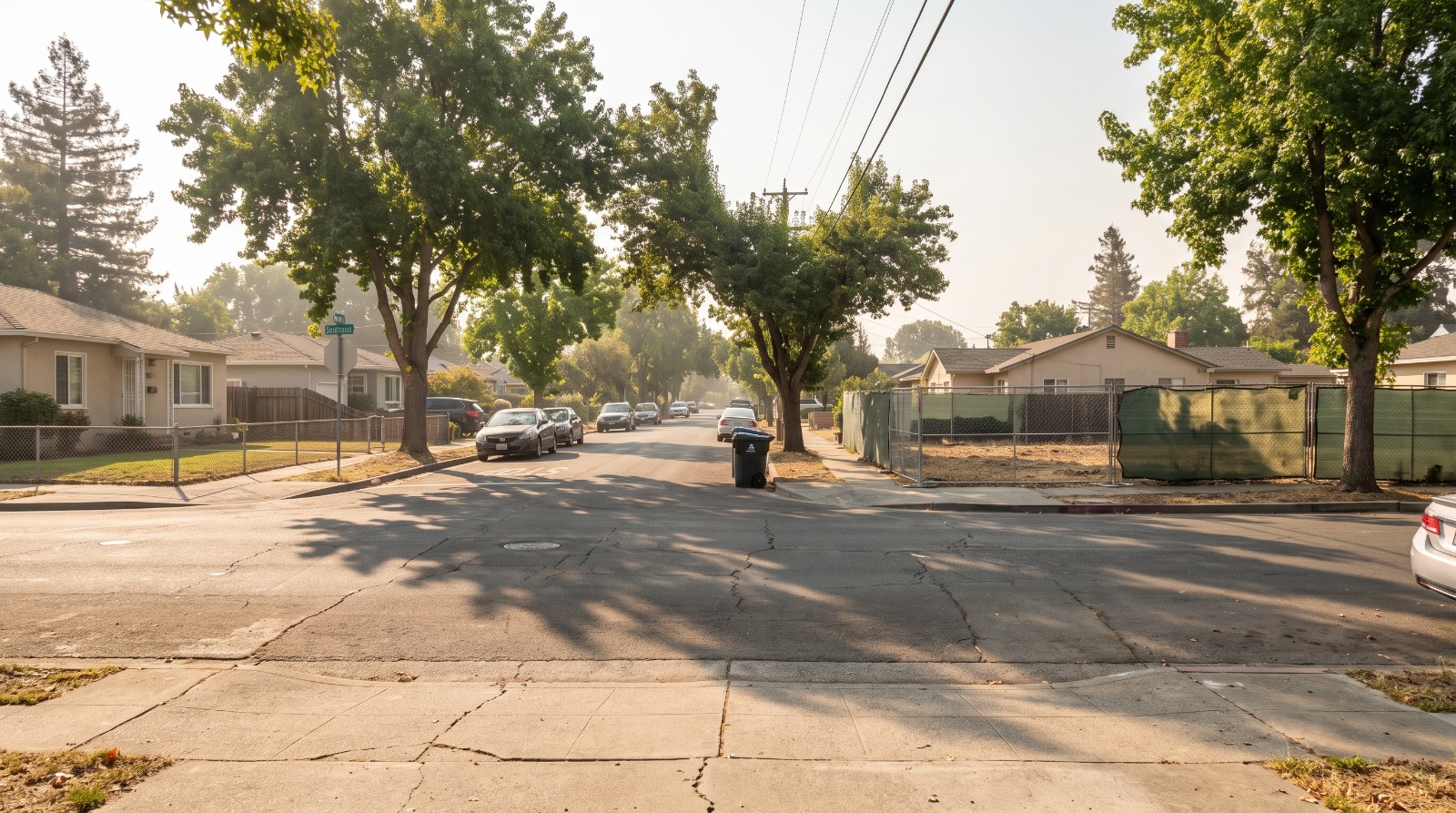
A residential street of single-story postwar homes in the Belle Haven neighborhood of Menlo Park, California, with a vacant infill lot mid-block. Photo: Houseberry
Pierce Road is a short, flat street on the bay side of Highway 101, one block from the Belle Haven Community Center and less than a mile from Meta's headquarters. Two adjacent parcels there, 335 and 355, have been sitting vacant. On Tuesday the Menlo Park City Council cleared the last approvals for eight permanently affordable townhomes on that lot, all of them for households earning up to 80 percent of area median income, all of them for sale rather than rent.
The council also turned down Habitat for Humanity's request to waive development and permitting fees, which is where this story stops being a ribbon-cutting and starts being interesting.
The real question a family asks about Belle Haven is not whether eight townhomes are good news. It is whether Belle Haven is a place they can get into at all, and what they are getting into. Those are two separate questions and the answers point in different directions.
What the council approved, and what it declined
Laurel Landing is eight townhome condominiums across two three-story buildings on a 0.35-acre site, about 13,076 square feet of gross floor area and eight parking spaces. The unit mix is three two-bedrooms, three three-bedrooms, and two four-bedrooms, averaging roughly 1,255 square feet, which is a genuinely family-sized program rather than the studios that usually get counted as affordable housing wins. TCA Architects designed it. MidPen Housing owns the land. Construction is scheduled to start in December 2026 and finish in summer 2028.
The Planning Commission approved the use permit, architectural control, and the below-market-rate housing agreement on July 13, 2026. The council's job on August 11 was the major subdivision and a density bonus fee concession, per the city's own project page.
Menlo Park has already put 3.6 million dollars into this from its below-market-rate housing fund, allocated back in January 2025 to help Habitat buy the land. That works out to 450,000 dollars of city money per home, which the city itself describes as its largest per-unit allocation to any project so far. And then the council declined the fee waiver, worth somewhere between 596,000 dollars by the city's math and 944,000 by Habitat's, asking Habitat to come back closer to certificate of occupancy. Mayor Betsy Nash put it plainly: it would be wiser to wait until the end when the fee is due.
That is a defensible position for a city with a tight budget. It is also a city arguing over 600,000 dollars on a project it has already handed 3.6 million, on a timeline that stretches into 2028. Habitat separately lost 1.5 million dollars from the Stanford Affordable Housing Fund, which was rescinded because the project did not have enough units at a deep enough affordability level. Eight homes is a small target for that many funders to be circling.
The number that explains Belle Haven
Belle Haven's median sale price was about 1.31 million dollars in July 2026. Menlo Park's citywide median was about 3.13 million in June 2026. That is a gap of roughly 1.8 million dollars inside one city of 33,000 people, and it is the single fact that explains almost everything else about this neighborhood.
| Measure | [Belle Haven](https://www.houseberry.com/Neighborhood/Belle-Haven-Menlo-Park/) | [Menlo Park citywide](https://www.houseberry.com/City/Menlo-Park-CA/) |
|---|---|---|
| Median sale price | 1.31 million dollars (July 2026) | 3.13 million dollars (June 2026) |
| Overall score | 2.4 out of 5 | 3.8 out of 5 |
| School score | 2.5 out of 5 | 4.1 out of 5 |
| Safety score | 2.1 out of 5 | 3.5 out of 5 |
Those are our scores, and the shape of them matters as much as the levels. Belle Haven ranks 14th of the 15 Menlo Park neighborhoods we score, ahead of only Bayfront. Its prices have been climbing steadily, from about 1.27 million in August 2025 through a 1.38 million peak in June 2026, so this is not a neighborhood being left behind. It is a neighborhood being priced up while its scores stay put, which is a specific and uncomfortable pattern.
For a household at 80 percent of area median income, the arithmetic is brutal. San Mateo County's 2026 area median income for a family of four is 200,800 dollars, so 80 percent is about 160,640. At today's rates, that income does not reach a 1.31 million dollar house without a subsidy roughly the size of the one the city just provided. A Habitat home is not a discount. It is the only version of this address that pencils.
The school question parents actually ask
Belle Haven scores 2.5 out of 5 on schools. Central Menlo, four miles west, scores 4.7. That 2.2-point spread is the widest school gap inside any single city we cover on the Peninsula, and you can see the whole ladder on our Menlo Park school rankings, where nine neighborhoods sit at 4.5 or higher and Belle Haven and Bayfront sit alone at the bottom.
The reason is a district line, not a distance. Belle Haven's elementary students are in Ravenswood City School District, headquartered in East Palo Alto, which enrolled 2,432 students in 2025-26 across a service area that includes some of the highest-poverty census tracts in San Mateo County. Most of the rest of Menlo Park feeds Menlo Park City School District. Two districts, one city, one freeway between them.
I want to be careful here, because a low school score is not a verdict on a school, a teacher, or a child. It is a summary of state testing outcomes in a district serving a very different student population than the one four miles west, and it correlates with household income more tightly than with anything happening in a classroom. What it does tell a buyer is that the school question in Belle Haven requires actual research, including the district's transfer options, rather than a glance at a number. Call the district before you decide anything.
The safety score deserves the same caution. Belle Haven at 2.1 is genuinely lower than the Menlo Park average, and it is also a neighborhood that has been the subject of investment, a rebuilt community center and library, and steady price growth. Both things are true at once.
Eight homes against a 1.8 million dollar gap
Here is the honest downside, and it is not small. Eight townhomes will not move a market. They will not close a 1.8 million dollar price gap, will not change a school score, and will not offset the pressure that a decade of Meta expansion put on a neighborhood that was working-class long before anyone called it a tech submarket. Belle Haven has watched a lot of investment arrive that was not for the people already living there.
What eight permanently affordable ownership units do accomplish is narrower and still worth something. They convert a vacant substandard lot into eight families with deeds, in a neighborhood where the alternative on that parcel was nothing. Ownership is the mechanism that lets a household stay through the next price cycle rather than get moved by it. And the units are big, which means they are for families rather than for the single-occupancy math that lets cities claim credit without housing anyone's kids.
The thing that should bother anyone watching Peninsula housing is the ratio. Eight homes required a 3.6 million dollar city subsidy, a rescinded 1.5 million dollar grant, a planning commission hearing, a council hearing, a lot merger, a vesting tentative map, and a fee fight, and it will take until summer 2028 to deliver. Menlo Park has a ballot initiative in the works that critics say would make that process harder. If eight homes are this expensive to produce, the gap does not close.
How to actually think about this if you are shopping Belle Haven
Treat Belle Haven as its own market rather than a discounted version of Menlo Park, because that is what it is. The price is roughly 42 percent of the citywide median, and the scores tell you honestly what you are trading for that. Some of what you are trading is fixable by research, like the school question. Some of it is not, like the freeway.
The way we look at it when we compare neighborhoods, a gap that wide inside one city is usually the most informative thing on the page. It tells you the city line is not the unit of analysis. The neighborhood is. Pull up Belle Haven's full profile next to Central Menlo's before you decide whether the price difference is a bargain or a warning, because for different households it is genuinely both.
Sources
- Menlo Park council green-lights affordable townhome project despite budget woes, The Almanac, August 12, 2026
- 335-355 Pierce Road (Laurel Landing), City of Menlo Park project page
- Menlo Park Pierce Road project, Habitat for Humanity Greater San Francisco
- Affordable Townhomes Proposed at 355 Pierce Road, Menlo Park, San Francisco YIMBY
- Ravenswood City Elementary district profile, Ed-Data
- Houseberry neighborhood data, Belle Haven and the Menlo Park city guide
All information provided on this website including but not limited to - school ratings, safety, amenities, user opinions, and property data - is for general informational purposes only. We do not guarantee its reliability, accuracy, or completeness. Users should independently verify information and consult appropriate professionals as needed. By using this website, you agree Houseberry is not responsible for actions, decisions, or consequences arising from reliance on the information provided
houseberry.com - CA DRE# 01847391
 Bay East ©2025. CCAR ©2025. bridgeMLS ©2025. Information Deemed Reliable But Not Guaranteed. This information is being provided by the Bay East MLS, or CCAR MLS, or bridgeMLS. The listings presented here may or may not be listed by the Broker/Agent operating this website. This information is intended for the personal use of consumers and may not be used for any purpose other than to identify prospective properties consumers may be interested in purchasing. Data last updated at September 26, 2026 12:00 AM