Box Just Committed to Redwood City Through 2040
Box extended its downtown Redwood City headquarters lease to 2040 and handed back two floors. The lease itself is public, and the numbers in it say more than the headline did.

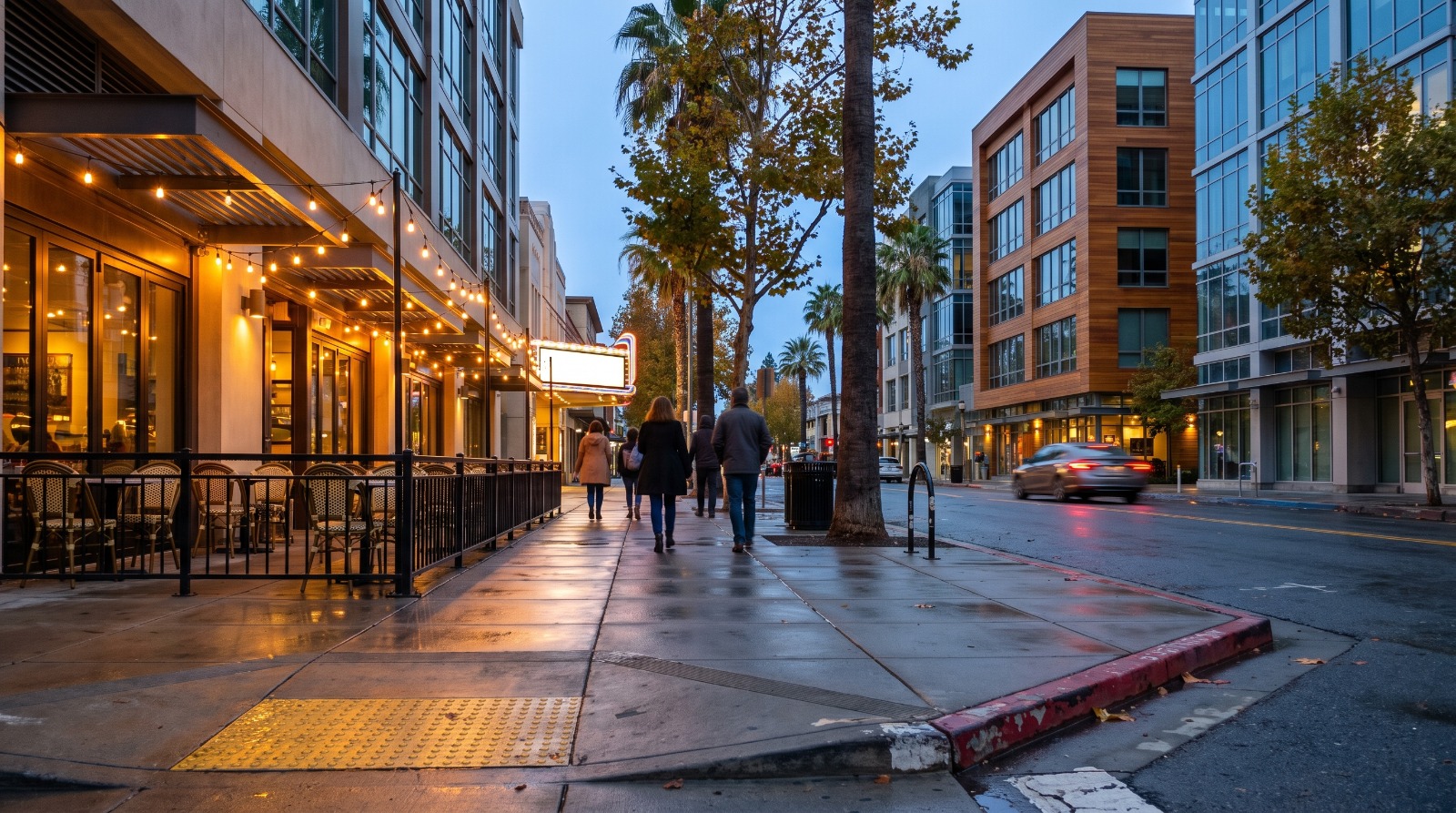
Downtown Redwood City at dusk near Theatre Row, blocks from the Crossing/900 campus where Box extended its headquarters lease through 2040. Photo: Houseberry
$7.55 a square foot a month, rising to $10.45 by 2040. That is what Box agreed to pay for its downtown Redwood City headquarters in a lease amendment it executed on August 21 and filed with the SEC five days later. The extended term runs twelve years, from July 1, 2028 through June 30, 2040, across 242,935 square feet at Kilroy’s Crossing/900, down from the 283,062 the company occupies today.
The coverage led with $283 million and the 40,000 square feet Box is giving back. Both are accurate. Neither is the story. The story is that a public software company just signed a fourteen-year commitment to a downtown carrying the highest office vacancy rate on the Peninsula.
The numbers that matter:
- Twelve years, starting July 2028 and running to June 2040, with two five-year options on top
- 242,935 square feet, down 40,127 from today, giving back the fourth and fifth floors
- $312.4 million in gross base rent across the term
- Less a $29.0 million rent abatement, which is where the reported $283 million comes from
Where the $283 million comes from
Adding up the rent table in the filing and subtracting the free rent.
The exhibit prints a twelve-year schedule starting at $7.55 per square foot per month and stepping up every year to $10.45 in the final year. Sum it and the gross base rent is $312,365,308. The same document names a base rent abatement of $29,038,279, applied across the first fifteen calendar months and part of the sixteenth. Subtract and it works out to $283.3 million, which matches the reported figure to within a tenth of a percent. That arithmetic is ours rather than the filing’s, but it reconciles cleanly.
Fifteen months of free rent on a twelve-year deal is a large landlord concession. It is the price Kilroy paid to hold its anchor tenant through 2040 in a submarket where Kidder Mathews put total office vacancy at 37.4 percent in the second quarter of 2026.
Shrinking and staying are not the same decision
Box has been at Crossing/900 since 2015 and it has been getting smaller the whole time.
The original 2014 lease took the entire campus, 334,000 square feet across two buildings on Jefferson Avenue and Middlefield Road. Today the company holds 283,062. From July 2028 it holds 242,935. That is 27 percent off the peak footprint across what will be a quarter century at one address.
Read that as hybrid work catching up with a company that employed 2,912 people worldwide as of January 31, 2026, not as a company edging toward the exit. Companies edging toward the exit do not sign to 2040 and they do not take two renewal options. Box is also not the only one committing here. Revolution Medicines was reported on August 21 to be in advanced talks for roughly 700,000 square feet at Pacific Shores Center, the former Google campus Farallon is assembling on the Redwood City bayfront. Advanced talks are not a signed lease, and should not be counted as one.
Redwood City has 2.35 jobs for every home
This is where an office lease becomes a housing story.
A city-commissioned study by Economic and Planning Systems, presented to the Planning Commission in September 2022, found Redwood City had 2.35 jobs per housing unit as of 2019, fifth or sixth highest among San Mateo County’s twenty cities. Between 2002 and 2019 the city’s jobs grew 40 percent while its housing units grew 5.7 percent. Only about 10 percent of the people who work in Redwood City live in Redwood City.
On the supply side, the city has permitted 1,321 homes toward a 2023 to 2031 state obligation of 4,588. That is 29 percent of the target with five years left to run. So a fourteen-year anchor commitment lands on a city that has spent two decades adding jobs faster than it adds places to sleep. Nobody at Box or Kilroy is responsible for that. It is still what decides what this deal means to a buyer.
What the price ladder actually looks like
Here is the range inside a short bike ride of that office, plus the two cities a Caltrain stop away, using each neighborhood’s most recent monthly median rather than a headline average.
| Place | Median home price | Houseberry overall score |
|---|---|---|
| Redwood Village, Redwood City | $1.20M (July 2026) | 3.0 |
| Friendly Acres, Redwood City | $1.43M (June 2026) | 3.4 |
| Redwood Shores, Redwood City | $2.38M (July 2026) | 4.5 |
| Redwood City, citywide | $2.30M (July 2026) | 3.5 |
| San Mateo, citywide | $2.21M (June 2026) | 3.5 |
| San Carlos, citywide | $2.82M (July 2026) | 3.7 |
The line to look at twice is Redwood Village. It is the cheapest neighborhood in the city, and it went from $855,870 in August 2025 to $1.2 million in July 2026. Redwood Shores, the top-ranked neighborhood in the city at 4.5 overall, went essentially nowhere across the same twelve months. The bottom of the ladder is moving and the top is flat, which is what it looks like when people who work downtown get squeezed out of the best-scoring pocket and bid up the entry tier instead. You can see the whole set on our Redwood City neighborhood rankings, against a citywide median of $2.30 million.
What this does and does not mean
It does not mean Redwood City prices rise because Box signed. One lease does not move a housing market, and this one does not even begin for twenty-two months.
What it does mean is durability. If you were weighing downtown Redwood City against a cheaper city further out, the employment base you were betting on just got a fourteen-year floor under one of its anchors, in a downtown where 37 percent office vacancy made that anything but obvious. That is worth something to somebody signing a thirty-year mortgage. It is worth nothing to somebody trying to time the next twelve months, and it does not offset the broader Peninsula slowdown we wrote about in July.
The honest downside is on the supply side, and it is not small. A city permitting 29 percent of its housing target while locking in jobs to 2040 is choosing to export its housing problem to whoever commutes in. Whether that changes depends on projects like 910 Marshall, where 258 feet was proposed on a block zoned for 92, rather than on anything in a lease amendment.
If you are shopping the Peninsula around this employer, start with the ladder above and check what each neighborhood is actually within a bike ride of. The office headlines will keep coming. The commute and the price gap are what you live with.
Sources
- Box, Inc. Seventh Amendment to Office Lease, SEC filing exhibit 10.2, August 2026
- The Registry, Box extends its Redwood City headquarters lease through 2040
- Kidder Mathews, Peninsula office market report, Q2 2026
- Cushman and Wakefield, San Mateo County office and research space marketbeat, Q2 2026
- The Registry, Revolution Medicines in talks at Pacific Shores Center
- Redwood City Pulse, the jobs and housing imbalance study
- City of Redwood City, jobs and housing ratio study session
- Walking Redwood City, the 2025 housing element annual progress report
- Stock Analysis, Box employee counts by fiscal year
- San Mateo Daily Journal, the original 334,000 square foot Crossing/900 lease
The Houseberry Research Team is Houseberry's reporting team: Bay Area real estate analysts, data specialists and longtime local market watchers. Every day we check the public record: building permits, city council and planning agendas, county recorder filings, state housing bills, police incident data and school results. Then we tie each story to what it means for specific neighborhoods, using Houseberry's own neighborhood data on prices, appreciation, safety, schools and amenities. Questions or corrections: Contact us.
All information provided on this website including but not limited to - school ratings, safety, amenities, user opinions, and property data - is for general informational purposes only. We do not guarantee its reliability, accuracy, or completeness. Users should independently verify information and consult appropriate professionals as needed. By using this website, you agree Houseberry is not responsible for actions, decisions, or consequences arising from reliance on the information provided
houseberry.com - CA DRE# 01847391
 Bay East ©2025. CCAR ©2025. bridgeMLS ©2025. Information Deemed Reliable But Not Guaranteed. This information is being provided by the Bay East MLS, or CCAR MLS, or bridgeMLS. The listings presented here may or may not be listed by the Broker/Agent operating this website. This information is intended for the personal use of consumers and may not be used for any purpose other than to identify prospective properties consumers may be interested in purchasing. Data last updated at October 13, 2026 12:00 AM