El Dorado County eases vacation rental rules on 5-acre lots
El Dorado County supervisors take a first vote Tuesday on rules that would drop the 500-foot vacation rental buffer for West Slope parcels of five acres or more, open detached guest houses to short-term rentals and tighten enforcement.

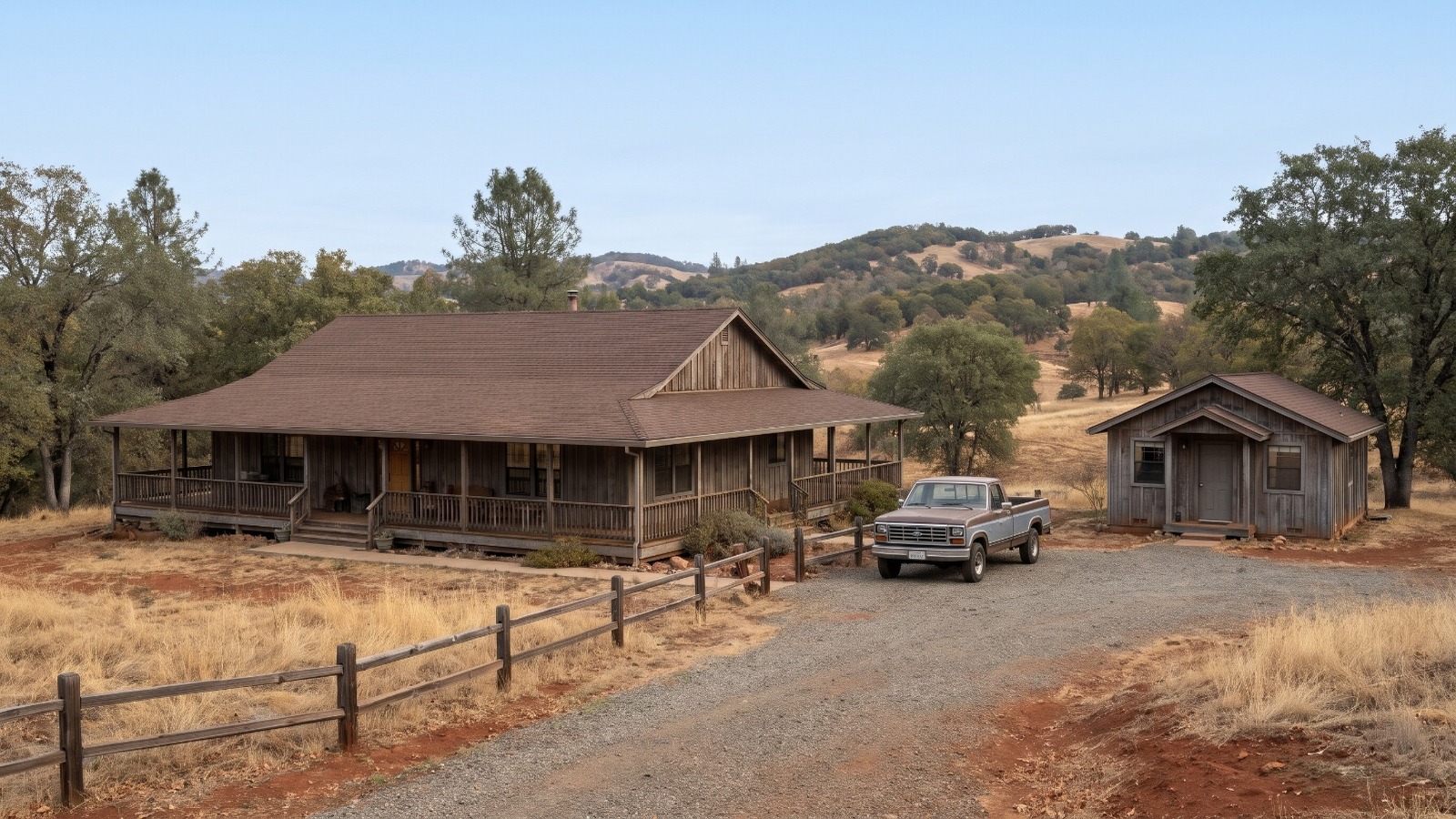
AI-generated view of a foothill ranch house and detached guest cottage on a large rural parcel in El Dorado County Photo: Houseberry
If you own five acres of oak woodland outside Shingle Springs, El Dorado County may soon let you rent your house to weekend visitors even if a neighbor already does. On Tuesday, Nov. 17, the Board of Supervisors takes a first vote on Ordinance 5274, which rewrites the county's vacation rental rules for the West Slope, everything outside the Lake Tahoe Basin.
The change most owners will feel is the end of the 500-foot buffer for big parcels. Today no vacation rental permit can be issued within 500 feet of another one, measured from the property lines. Under the draft, that buffer would no longer apply to parcels of five acres or more on the West Slope. A second vote is set for Dec. 8, and the rules would take effect in January 2027.
This touches the county's growing hill suburbs as well as its ranches. El Dorado Hills, unincorporated and governed by these county rules, has 22 neighborhoods scored by Houseberry, with typical home prices from about $710,000 in Carson Creek to about $1.13 million in Highland View as of September 2026.
Why the buffer broke on big lots
The county added the 500-foot buffer around every permitted rental in 2021, according to its ordinance page. It was written with Tahoe's dense cabin streets in mind. On the West Slope it ran into geometry.
A square five-acre parcel is about 467 feet on a side, by our arithmetic. Measure 500 feet out from its lines and the buffer reaches past the whole neighboring parcel. One permitted rental could lock out every large property around it, even when the houses sat a quarter mile apart. Owners told supervisors as much at a South Lake Tahoe meeting in September 2025, South Tahoe Now reported, when the county had issued only 17 West Slope permits and had 13 on a wait list. The Tahoe Basin had 762 permits under a 900 cap and 203 people waiting.
The board split the two regions into separate tracks that day. An ad hoc committee of Supervisors Ferrero and Turnboo held a public forum in Placerville on March 4, 2026, ran a survey and brought its recommendations back on Aug. 18. Tuesday's presentation turns those into ordinance language.
What changes, rule by rule
| West Slope rule | Today | Under Ordinance 5274 |
|---|---|---|
| 500-foot buffer, parcels of 5+ acres | Applies | Does not apply |
| 500-foot buffer, hosted rentals | Applies | Removed |
| Detached guest house rentals | Not allowed | Allowed countywide |
| Occupancy | 2 per bedroom | 2 per bedroom plus 2 |
| Children not counted | Under 6 | Under 13 |
| Fire or fireworks violation | 30-minute fix window | Immediate violation |
The guest house change may matter more than the buffer. Until now the county ordinance banned short-term rentals in detached guest houses and other accessory structures. The draft strikes that language, so a separate cottage behind the main house could be rented countywide, Tahoe included. Accessory dwelling units and junior units built under state or county streamlined approval rules stay off limits. The state lets owners build those quickly because they are meant to be housing, and the county is keeping them that way.
Hosted rentals, where the owner or a long-term tenant lives on site, also loosen on the West Slope. They lose the 500-foot buffer and the cap on how many bedrooms can be rented. Occupancy there would be two guests per bedroom, not counting the owner's room.
The ordinance pairs every loosening with a tightening, and the tightening applies countywide.
Enforcement no longer has to wait for a neighbor to complain. The county could inspect any permitted rental with 48 hours' notice. Advertising an unpermitted rental becomes a violation on its own, and a property manager caught running one can lose the right to manage any permitted rental in the county for 12 months. Trash left out after guests leave counts against the owner.
Fire gets its own rule. Most violations still come with a 30-minute window for the host to fix the problem before a citation. Grills, fireplaces and fireworks would not. In a county that burned in the 2021 Caldor Fire, we think that is the most important line in the draft.
Not every supervisor is on board. An Oct. 8 newsletter from Supervisor Lori Parlin's District IV office called removing the buffer on large West Slope parcels the most concerning change. It said the committee leaned on a single listening session and one survey with mixed results, and it relayed residents' worries about noise, neighborhood character and renting remote homes in fire country. Supervisor Ferrero declined Parlin's request for more outreach, the newsletter said, arguing that most comments favored looser rules.
Our view: the large-parcel change is overdue. A buffer that keeps two houses a quarter mile apart from both renting is not protecting anyone's street, and the county's own permit counts show how little the West Slope has used the program. The real risk is the one Parlin names, fire, and the no-grace-period rule is a direct answer to it. The guest house change deserves more scrutiny than it has gotten, because a cottage that earns more as a weekend rental is a cottage nobody rents to a teacher for a year.
What owners should do before January
If you own five acres or more on the West Slope and were turned away by the buffer, the draft adds an appeal path for people denied or revoked because of ordinance changes, with 15 days to ask the department director for review. Renewal timing changes too: applications would be due no sooner than 90 days and no later than 15 business days before a permit expires.
If you are buying in El Dorado Hills, Cameron Park or Shingle Springs, check whether the parcels next door are five acres or more. Most of El Dorado Hills is suburban tract land well under that, from Carson Creek, where Houseberry puts the typical home at about $710,000 in September 2026, up to the bigger lots on the hills. Those are the ones that could become rentals next year. Houseberry's El Dorado Hills safety ranking and neighborhood pages like Highland View, where the typical home held near $1.13 million through September, are a good place to start comparing.
Sources
- El Dorado County Board of Supervisors, Nov. 17, 2026, item 26-1805: Ordinance 5274 presentation
- El Dorado County: West Slope VHR public engagement
- El Dorado County: VHR ordinance information
- South Tahoe Now: Supervisors receive VHR update, Oct. 1, 2025
- El Dorado County District IV newsletter, Oct. 8, 2026
The Houseberry Research Team is Houseberry's reporting team: Bay Area real estate analysts, data specialists and longtime local market watchers. Every day we check the public record: building permits, city council and planning agendas, county recorder filings, state housing bills, police incident data and school results. Then we tie each story to what it means for specific neighborhoods, using Houseberry's own neighborhood data on prices, appreciation, safety, schools and amenities. Questions or corrections: Contact us.
Map of El Dorado Hills Neighborhoods
Loading map...
View Full Map
Top Neighborhoods in El Dorado Hills, CA



All information provided on this website including but not limited to - school ratings, safety, amenities, user opinions, and property data - is for general informational purposes only. We do not guarantee its reliability, accuracy, or completeness. Users should independently verify information and consult appropriate professionals as needed. By using this website, you agree Houseberry is not responsible for actions, decisions, or consequences arising from reliance on the information provided
houseberry.com - CA DRE# 01847391
 Bay East ©2025. CCAR ©2025. bridgeMLS ©2025. Information Deemed Reliable But Not Guaranteed. This information is being provided by the Bay East MLS, or CCAR MLS, or bridgeMLS. The listings presented here may or may not be listed by the Broker/Agent operating this website. This information is intended for the personal use of consumers and may not be used for any purpose other than to identify prospective properties consumers may be interested in purchasing. Data last updated at November 18, 2026 12:00 AM