A $65M Listing and the Priciest Homes in San Francisco
A $65 million Pacific Heights compound just listed, second only to San Francisco's $71 million record. Here is where the most expensive homes in San Francisco really sit, and what a number like that does and does not mean.

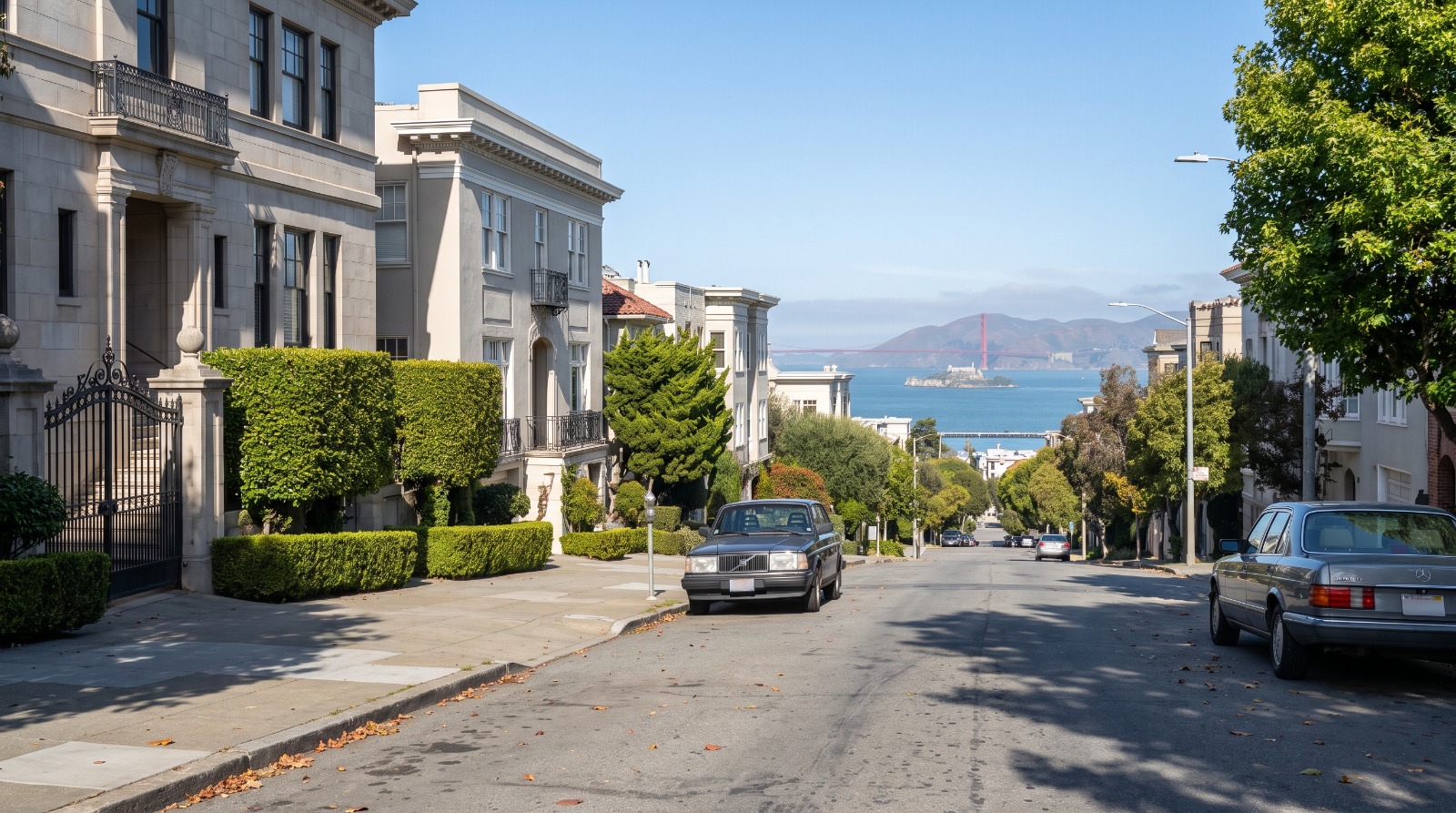
Grand mansions on the Pacific Heights Gold Coast above the San Francisco Bay, home to the most expensive homes in San Francisco. Photo: Houseberry
A Pacific Heights compound just hit the market for 65 million dollars, and if it sells anywhere near that, it will be the second most expensive home ever sold in San Francisco. The only deal that would still beat it is the 71 million dollar purchase Laurene Powell Jobs made two years ago, four blocks away. So this listing is a useful excuse to look at where the most expensive homes in San Francisco actually sit, and what a number like 65 million does and does not tell you about everyone else's market.
The home is at 2940 Pacific Avenue, and it went up for sale on July 17, 2026, first reported by The Real Deal. The asking price is 65 million. For scale, that is more than fourteen times the neighborhood median on our Pacific Heights neighborhood page, and Pacific Heights is already one of the priciest neighborhoods in the city.
What 65 million buys at 2940 Pacific
The property is unusual even for this stretch. It runs the full block, from Broadway through to Pacific Avenue, on about four tenths of an acre, which is a lot of land for San Francisco. The main house is roughly 11,150 square feet with four bedrooms, and there is a separate 4,823-square-foot guest house, plus a media room, a sport court, and a central courtyard planted with lemon and lime trees.
The sellers are Nicola Miner, a daughter of the late Oracle co-founder Robert Miner, and her husband, the novelist and producer Robert Mailer Anderson. They assembled three vacant lots on the site back in 1999 for about 5 million dollars and spent roughly 25 million and several years building the compound. Miner told The Real Deal it had become too much house for two people now that their children are grown, and the listing agent, Ronda Priestner of Compass, described the pricing on this stretch as unprecedented.
Where it lands on San Francisco's record ladder
Put 2940 Pacific next to the biggest San Francisco home sales on record and the pattern jumps out. Almost every one is within a few blocks of it, on Broadway, Pacific, or Vallejo, on the same Pacific Heights hilltop.
| Price | Address | Neighborhood | Year | Sale or listing |
|---|---|---|---|---|
| $71M | 2840 Broadway | Pacific Heights | 2024 | Sale (city record) |
| $65M | 2940 Pacific Ave | Pacific Heights | 2026 | Listing |
| $56M | 2898 Vallejo St | Pacific Heights | 2026 | Sale |
| $43.5M | 2920 Broadway | Pacific Heights | 2021 | Sale |
| $42M | 2930 Broadway | Pacific Heights | 2025 | Sale |
| $39M | 2920 Broadway | Pacific Heights | 2018 | Sale |
| $38.5M | 855 Chestnut assemblage | Russian Hill | 2025 | Sale |
| $30M | 260 Seacliff St | Sea Cliff | 2025 | Sale |
| $29.15M | 2799 Broadway | Pacific Heights | 2024 | Sale |
The record itself is the 71 million dollar, off-market purchase of 2840 Broadway by Laurene Powell Jobs in July 2024, per the San Francisco Standard. The most expensive completed sale since then was 2898 Vallejo Street, which traded off-market for about 56 million dollars in April 2026, according to NBC Bay Area. Before Powell Jobs reset the ceiling, the record was 2920 Broadway at 43.5 million in 2021, the same house that had set the prior record at 39 million in 2018, as SFist documented. Recent buyers on the list include Sam Altman and Eric Schmidt, per the SF Standard's 2025 tally, which tells you who is actually clearing these prices.
Why this one hilltop sets the record every time
The blocks of Broadway roughly between Divisadero and Lyon get called the Gold Coast, or Billionaires' Row, and the nicknames are earned. The lots are big by city standards, they sit high on the hill, and they look north over unobstructed views of the bay, Alcatraz, the Golden Gate Bridge, and the Marin hills. That combination is rare in San Francisco, which is why old money and tech money keep bidding each other up on the same few streets.
Our data lines up with the reputation. Houseberry ranks Pacific Heights 21st of 92 San Francisco neighborhoods overall, with a neighborhood median around 4.5 million over the year through mid-2026. Sit with that for a second. Even the typical Pacific Heights home is a fraction of these trophy sales, which is the real lesson of a 65 million dollar listing. The very top of the market runs on its own logic, mostly detached from what the rest of the city is doing. If you want the full spread, you can see San Francisco neighborhoods ranked by price and where Pacific Heights lands among them.
What a 65 million dollar listing does and does not mean
First, it is an asking price, not a sale. Trophy homes list high and can sit, so 65 million is an opening position, not a done deal. Second, it does signal a top end that is heating back up, and the 56 million dollar Vallejo Street sale a few months earlier points the same way. Third, and most important for anyone not shopping at this level, it says almost nothing about the wider San Francisco market. The forces pushing ordinary homes over asking are a separate story, one we got into in how far over asking SF homes are going in 2026. A record-chasing listing on Billionaires' Row and a bidding war on a two-bedroom in the Sunset are two different weather systems that happen to share a city.
San Francisco luxury home questions
What is the most expensive home ever sold in San Francisco?
The record is 2840 Broadway in Pacific Heights, bought by Laurene Powell Jobs for about 71 million dollars in July 2024. The 65 million dollar listing at 2940 Pacific would rank second if it sells near ask.
Where is Billionaires' Row in San Francisco?
It is the stretch of Broadway in Pacific Heights, roughly between Divisadero and Lyon streets, sometimes called the Gold Coast. Nearly every record San Francisco home sale of the last decade sits on or near it.
Is the San Francisco luxury market up in 2026?
At the very top, yes. A 56 million dollar off-market sale in April 2026 and this 65 million dollar listing both point to a stronger high end. That does not automatically hold for mid-priced homes, which follow their own rules.
How does Pacific Heights compare to the rest of San Francisco?
It is one of the most expensive neighborhoods in the city and ranks 21st of 92 overall on Houseberry, strong on prestige and views. You can weigh it against how San Francisco neighborhoods rank on schools, safety, amenities, and value.
For the handful of people who can bid on 2940 Pacific, the only real comps are the other trophies on the hill. For everyone else, the useful takeaway is the opposite of aspirational. The number that decides how a home actually lives is rarely the biggest one in the headline, which is why we spend our time comparing neighborhoods on the things you use every day rather than the ones that make the news.
Sources
The Houseberry Research Team is Houseberry's reporting team: Bay Area real estate analysts, data specialists and longtime local market watchers. Every day we check the public record: building permits, city council and planning agendas, county recorder filings, state housing bills, police incident data and school results. Then we tie each story to what it means for specific neighborhoods, using Houseberry's own neighborhood data on prices, appreciation, safety, schools and amenities. Questions or corrections: Contact us.
All information provided on this website including but not limited to - school ratings, safety, amenities, user opinions, and property data - is for general informational purposes only. We do not guarantee its reliability, accuracy, or completeness. Users should independently verify information and consult appropriate professionals as needed. By using this website, you agree Houseberry is not responsible for actions, decisions, or consequences arising from reliance on the information provided
houseberry.com - CA DRE# 01847391
 Bay East ©2025. CCAR ©2025. bridgeMLS ©2025. Information Deemed Reliable But Not Guaranteed. This information is being provided by the Bay East MLS, or CCAR MLS, or bridgeMLS. The listings presented here may or may not be listed by the Broker/Agent operating this website. This information is intended for the personal use of consumers and may not be used for any purpose other than to identify prospective properties consumers may be interested in purchasing. Data last updated at October 18, 2026 12:00 AM