Oakland Coliseum Development: What It Does to Home Values
The Coliseum sale has not closed and no building permits exist. Here is what a $3 to $5 billion phased project realistically does to East Oakland home values, and when.
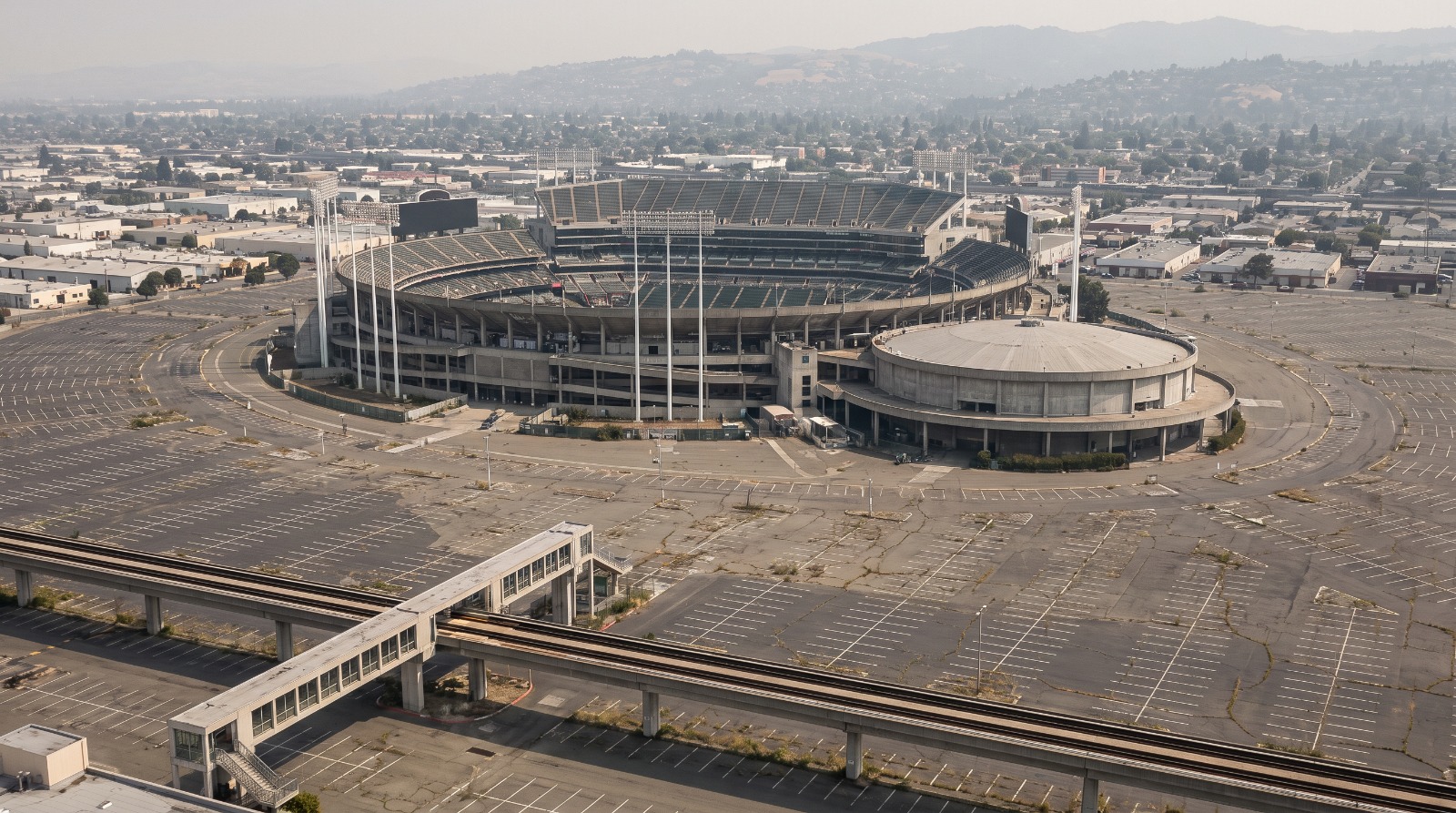
The Oakland Coliseum complex and its empty parking lots seen from above, with the BART guideway and the East Oakland flatlands behind it. Photo: Houseberry
$374,520. That is the median home price in the Coliseum neighborhood as of June 2026, and it is 62 percent below Oakland's citywide median of $977,450 from May. On August 7 The Oaklandside published an interview with the financier behind the Coliseum redevelopment, who said the deal is on track and described a phased build worth $3 billion to $5 billion.
Both of those things can be true, and neither of them changes what a house next to the site is worth this decade. The short version: the sale has not closed, no building permit exists, and the closest comparable projects took 15 to 25 years to produce their first residents. If you are thinking about buying near the Coliseum, buy on what is there in 2026.
What has actually closed, and what has not
Almost every account of this deal, including our own July piece on the restructured $110 million agreement, uses the word sale. The city's own project page is more careful, and it is worth reading the ledger before reading the interview.
| Item | Status as of August 2026 |
|---|---|
| City of Oakland's 50 percent, $125 million total | Council approved restructured terms in July 2026. Closing targeted September 2026 to January 30, 2027. Not closed. |
| The $15 million top-up above the $110 million base | Contingent on the buyer obtaining building permits, which do not exist |
| Alameda County and the A's 50 percent | Non-binding term sheet approved May 28, 2026. Not closed. |
| Payments received to date | $5 million deposit against a $110 million obligation, per January 2026 reporting |
| About $340 million of Coliseum bond debt | Fully retired, stadium in February 2025 and arena in January 2026 |
| Entitlements, unit count, building permits, groundbreaking | None. Unit count pending a specific development plan. |
The buyer is Oakland Acquisition Company, a joint venture of the African American Sports and Entertainment Group and Loop Capital, the Chicago investment bank whose founder and CEO gave the August interview. Oak View Group takes the arena, which was carved out in the July restructuring. The 112-acre site splits into a 9-acre arena parcel and a 103-acre stadium parcel.
So when the financier says the deal is on track, read that as a statement about an escrow with a January 30, 2027 outside date. It is not a statement about a shovel. The $15 million tranche is keyed to permits precisely because the parties know how far away permits are.
What the neighborhoods next door cost right now
Every neighborhood ringing the site trades far below the city. This is the baseline any future claim about value uplift has to be measured against.
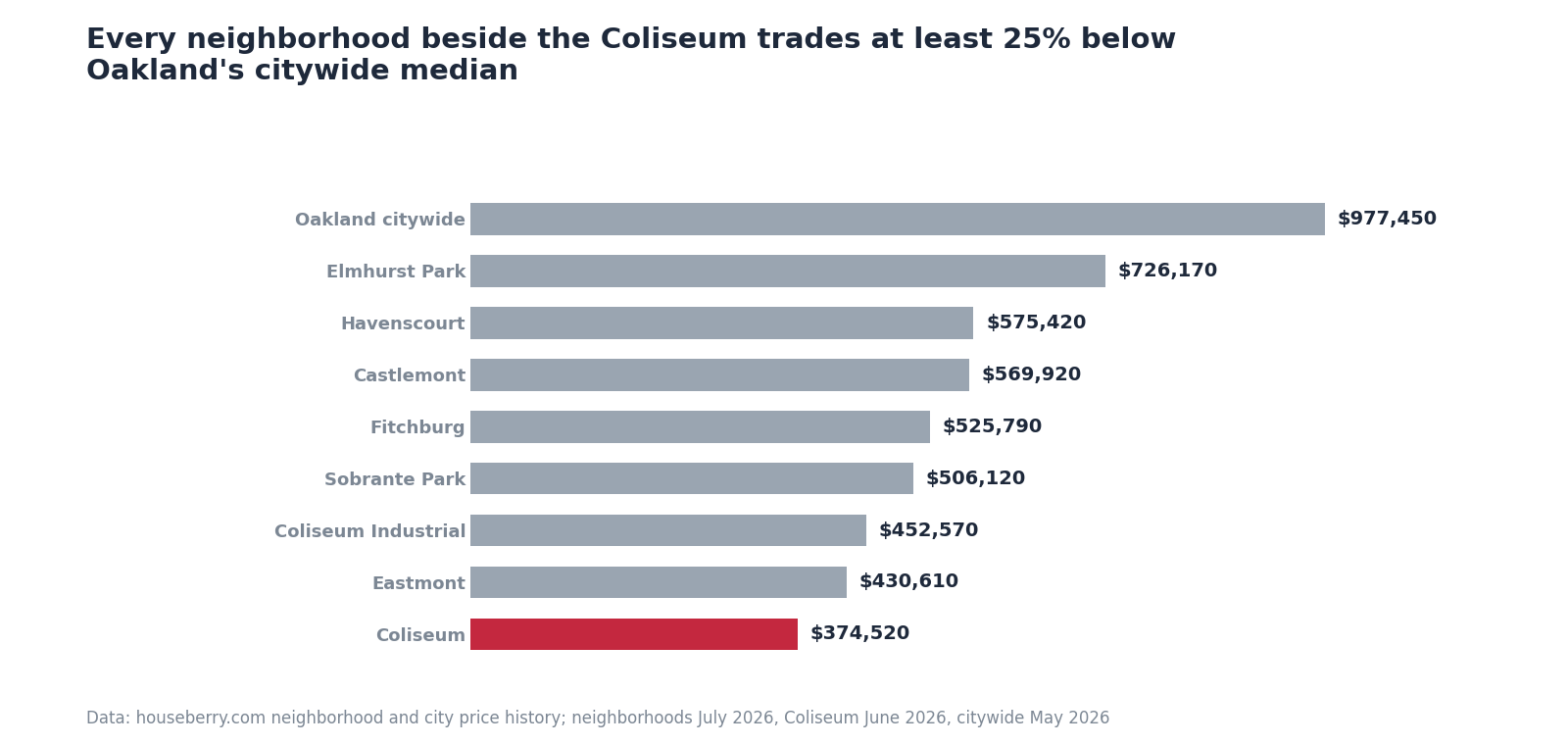
Prices above come from each neighborhood's 12-month price history, July 2026 except Coliseum, whose series ends in June, and the citywide figure, which ends in May. Elmhurst Park at $726,170 is the top of the local range. Eastmont at $430,610 and Coliseum at $374,520 are the bottom. Rockridge, five miles north, was $2,090,000 in July. That is a 5.6 to 1 spread inside one city.
The scores tell you why, and they do not point where the project points. Across the Coliseum-adjacent neighborhoods, amenities scores run 2.3 to 3.2 against an Oakland average of 3.6, so the gap a stadium-and-entertainment district would close is the smallest one on the board. The school scores run 1.1 to 1.7 against a citywide 2.1, and Eastmont sits at 1.2 out of 5, last of all 130 Oakland neighborhoods. A land transaction has never moved a school score. That is the largest gap and the purchase agreement does not touch it.
How long these things actually take in the Bay Area
The phasing language in the interview implies a decade-plus. The regional record says longer, and there are three sites within 15 miles that settle the question.
| Project | Plan or agreement | First residents | Elapsed |
|---|---|---|---|
| Mission Bay, San Francisco (303 acres) | First proposed 1981, redevelopment plan adopted 1998 | 1,079 of 6,000 planned units occupied by 2005 | 24 years from proposal, 7 from plan adoption |
| Candlestick Point and Hunters Point Shipyard (about 700 acres) | Development agreement 2010 | First roughly 700 net-new homes not expected until 2030 | 20 years, with build-out into the 2040s |
| Treasure Island (about 400 acres) | Entitlements 2011, planning from the 1990s | Phase one opened July 2026 with 148 condos of about 8,000 planned | 15 years to 2 percent of the plan |
Treasure Island is the one to sit with. Fifteen years after entitlement, on a site with a single public landowner and no environmental litigation to speak of, phase one is 148 condominiums. The Coliseum site has 112 acres, an unresolved hazardous-waste allocation, no specific development plan, and a buyer that has paid $5 million of $110 million. Oakland also has Candlestick two counties' worth of experience away showing what happens when the money gets complicated.
The research on stadium districts is not encouraging
The most careful study of the closest American analog found nothing. A 2022 synthetic-control analysis of Truist Park and The Battery in Cobb County, Georgia concluded that property appreciation near the stadium mirrored regional trends and showed no net benefit attributable to the project, while costing county taxpayers about $15 million a year. The complex did not turn a profit for the county until 2025, eight years after opening.
The broader literature is consistent and modest. Sports facilities show a positive but sharply distance-decaying effect on nearby residential values, and standard regression methods overstate it. One 2021 study found the immediately adjacent ring can go slightly negative, which is the traffic, the noise and the parking. Nobody in this literature is finding the 30 percent windfall that gets promised at press conferences.
Then there is the noise floor, which is the argument I find most convincing and which nobody covering this deal has made.
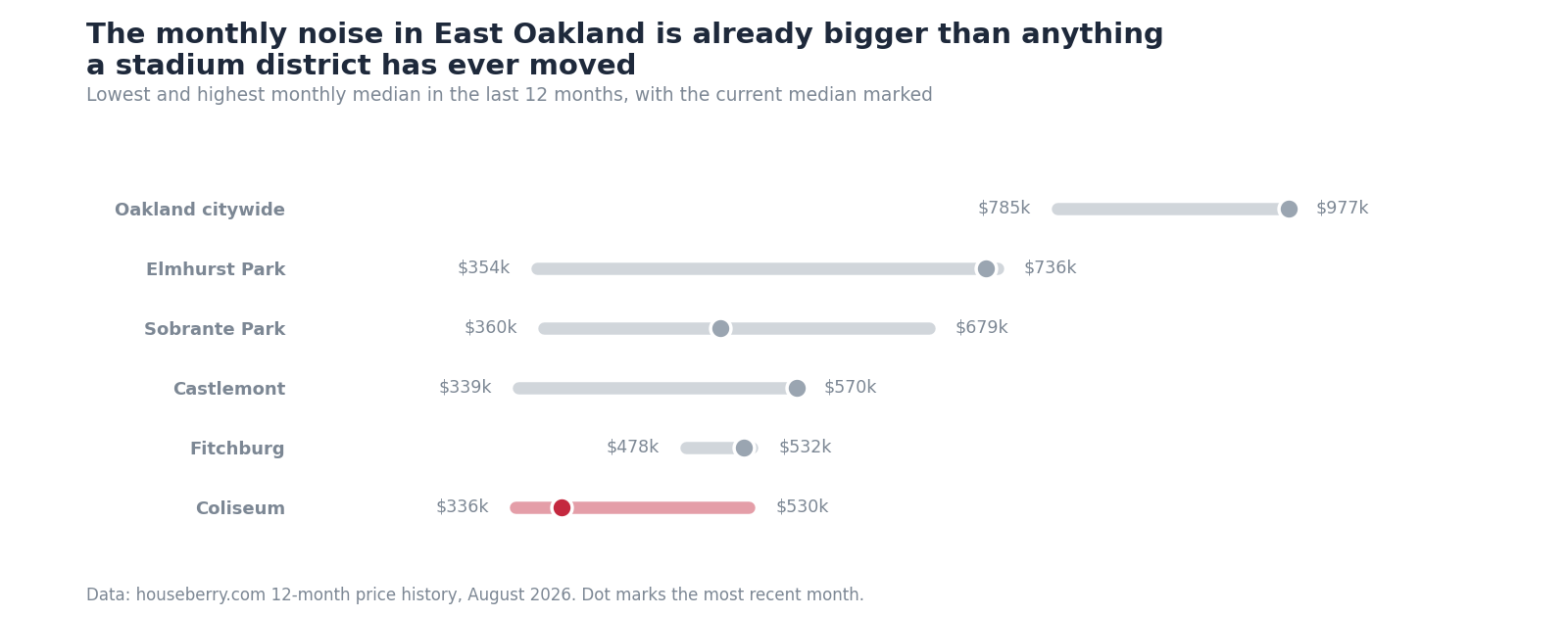
In the last 12 months, with zero entitlements and zero construction, Elmhurst Park's median moved up 48.6 percent, Eastmont's 16 percent, Castlemont's 14.8 percent, Sobrante Park's down 11.4 percent, and Coliseum's down 16.8 percent in one month. Oakland citywide appreciated 0 percent over the same period. These are thin, low-volume submarkets where a handful of sales moves the median. The ordinary month-to-month noise here is already larger than any effect the research attributes to a stadium district. If you see East Oakland prices move between now and 2030 and someone tells you it is the Coliseum, they cannot know that, and neither can I.
What this does and does not mean
It does mean something. Three years ago the site had three owners, a departed baseball team, and $340 million of bond debt against it. That debt is now fully retired, the arena has an operator with a real events business, and if the escrow closes, 112 acres get a single owner for the first time in decades. The city also sheds roughly $6 million a year in operating subsidy and picks up 6 percent of gross ticket sales. Those are real, near-term, and worth having.
It does not mean a groundbreaking, a permit, a confirmed unit count, a signed community benefits agreement, a school improvement, or a price signal. The affordability terms in the deal, at least 25 percent of residential units at 60 percent of area median income and at least 10 percent at 30 percent, are conditions on units that get built. Zero units are under construction. The roughly 4,000-unit figure from the July 2025 county vote is the only housing number ever put on the record, and the city page still lists unit count as pending.
Questions people are actually asking
Is the Oakland Coliseum sale final?
No. The city council approved restructured terms in July 2026, but the city's own project page lists closing as targeted for September 2026 through January 30, 2027. The county half is at the non-binding term sheet stage. As of January 2026, $5 million had been paid against a $110 million obligation.
Will the Coliseum project raise home prices near the site?
Not measurably this decade, on the available evidence. Comparable Bay Area megaprojects took 15 to 25 years to deliver their first residents, and peer-reviewed work on stadium districts finds effects that are small, fade quickly with distance, and can be negative immediately adjacent.
Should I buy near the Oakland Coliseum in 2026?
Buy it for what it is today, which is genuinely cheap housing with BART at the door. The Coliseum neighborhood's June 2026 median was $374,520 and it scores 2.6 for safety and 1.7 for schools. If those numbers work for you now, the project is upside you are not paying for. If they do not, a rendering will not fix them.
How many affordable homes will actually get built?
Unknown. The binding terms set percentages, not counts: at least 25 percent of residential units at 60 percent of area median income and at least 10 percent at 30 percent. Twenty-five percent of zero is zero until a specific development plan exists.
The bottom line
A $3 to $5 billion phased project is a genuinely good thing for a part of Oakland that has been used as a parking lot for 60 years, and I hope it closes. But the way we look at neighborhoods, the inputs that move a place are schools, safety, transit and price, and three of those four are already knowable today. The Coliseum-adjacent neighborhoods have BART, prices between $374,000 and $726,000, safety scores in the low twos, and the worst school scores in a 130-neighborhood city.
Nothing in the August interview changed any of those four numbers. When a permit gets filed, that will be the first news that does.
Sources
- City of Oakland, Coliseum Redevelopment Project page, updated July 2026
- The Oaklandside, “The money man behind Oakland's blockbuster Coliseum deal speaks out,” August 7, 2026
- CBS News Bay Area, Alameda County supervisors approve selling their Coliseum share, July 22, 2025
- Oakland Report, on the payment record and the county buyback, January 13, 2026
- Atlas Premier, on the retirement of about $340 million in Coliseum bond debt, February 2026
- SPUR, “A railyard neighborhood on the rise: Mission Bay,” August 2005
- Candlestick Point redevelopment status, July 2026
- San Francisco YIMBY, phase one of the Treasure Island redevelopment opens, July 17, 2026
- J.C. Bradbury, synthetic-control study of Truist Park and Cobb County, 2022
- Feng and Humphreys, Journal of Sports Economics, on sports facilities and residential property values
- Annals of Regional Science, on negative externalities for property immediately adjacent to a new stadium, 2021
- Houseberry, Oakland city guide and price history
All information provided on this website including but not limited to - school ratings, safety, amenities, user opinions, and property data - is for general informational purposes only. We do not guarantee its reliability, accuracy, or completeness. Users should independently verify information and consult appropriate professionals as needed. By using this website, you agree Houseberry is not responsible for actions, decisions, or consequences arising from reliance on the information provided
houseberry.com - CA DRE# 01847391
 Bay East ©2025. CCAR ©2025. bridgeMLS ©2025. Information Deemed Reliable But Not Guaranteed. This information is being provided by the Bay East MLS, or CCAR MLS, or bridgeMLS. The listings presented here may or may not be listed by the Broker/Agent operating this website. This information is intended for the personal use of consumers and may not be used for any purpose other than to identify prospective properties consumers may be interested in purchasing. Data last updated at September 25, 2026 12:00 AM