San Jose Rents Jumped 11 Percent. Oakland Did Not
San Jose and Oakland are an hour apart and moving in opposite directions. Here is what the 985 dollar monthly gap between them actually buys.
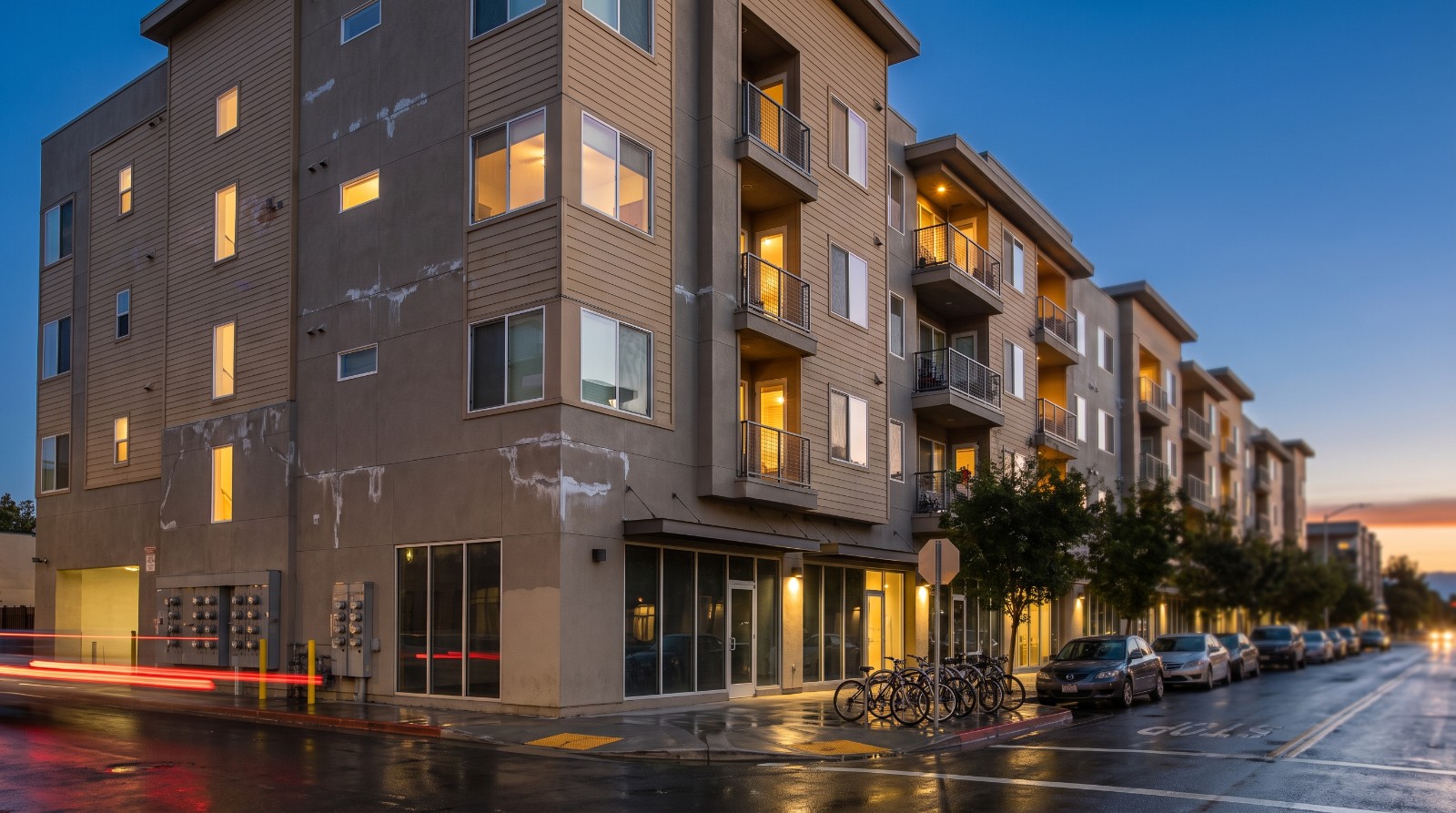
A mid-rise apartment building with lit windows on a downtown San Jose street at dusk, illustrating rising San Jose rents in 2026. Photo: Houseberry
A two-bedroom apartment in San Jose has a median asking rent of about 3,580 dollars as of August 2026, up roughly 12 percent from a year ago. The same unit in Oakland is about 2,595 dollars, up about 3 percent. Two cities an hour apart on the same freeway, and one of them is having a completely different year.
The gap is now about 985 dollars a month on a two-bedroom, or 11,820 dollars over a twelve-month lease. That is the number to hold onto, because everything else in this post is an argument about whether it is worth paying.
Where the two cities actually sit right now
Side by side, the divergence is cleaner in the two-bedroom market than the one-bedroom market, and that is a clue about who is moving. Figures below are Zumper's rolling 30-day medians as of mid-August 2026.
| Measure (Zumper, August 2026) | San Jose | Oakland |
|---|---|---|
| Median one-bedroom rent | 2,683 dollars | 1,999 dollars |
| One-bedroom, year over year | up about 3 percent | down about 3 percent |
| Median two-bedroom rent | 3,580 dollars | 2,595 dollars |
| Two-bedroom, year over year | up about 12 percent | up about 3 percent |
San Jose's one-bedroom market is close to flat. Its two-bedroom market is the one running, which points at households sharing or upsizing rather than at solo renters bidding each other up. Oakland's one-bedroom is actually cheaper than it was a year ago in nominal terms.
Neither city is the story of 2026 though. San Francisco is. The city's median one-bedroom hit 4,180 dollars in July 2026 and the two-bedroom crossed 6,020 dollars, the highest two-bedroom median in the country, passing New York. Those are up about 23 and 26 percent year over year. That is not a Bay Area rental market. That is three markets stacked on top of each other, and we already covered the bottom two rungs when we looked at the SF to Oakland rent gap in July.
What 985 dollars a month actually buys
This is where our own data says something the rent reports cannot. If you pay the San Jose premium, you are buying schools and safety. You are not buying amenities, because on that measure the two cities are identical.
| Houseberry city score | [San Jose](https://www.houseberry.com/City/San-Jose-CA/) | [Oakland](https://www.houseberry.com/City/Oakland-CA/) |
|---|---|---|
| Overall | 3.3 out of 5 | 2.5 out of 5 |
| Schools | 3.1 out of 5 | 2.3 out of 5 |
| Safety | 3.7 out of 5 | 2.8 out of 5 |
| Amenities | 3.2 out of 5 | 3.2 out of 5 |
Schools and safety are each about 0.8 to 0.9 points apart. Amenities are dead even at 3.2. So 11,820 dollars a year buys a renter roughly one point of school score, one point of safety score, and exactly zero improvement in walkable access to the things people actually do on a Saturday. For a household without school-age kids, that is a very expensive trade.
It also averages over enormous internal variation, which is the part that should change how anyone uses these numbers. San Jose has 112 neighborhoods in our rankings and they run from 4.3 down to the low twos. A renter comparing the top of the San Jose list against the Oakland hills is having a different conversation than a renter comparing East San Jose against Temescal. City-level medians are a starting point and a terrible finishing point.
Two datasets disagree about Oakland, and the disagreement is the interesting part
Zumper has Oakland flat to slightly down. Apartment List has Oakland up nearly 5 percent year over year as of June 2026, and ranked it the second-fastest rent growth among the 100 largest US cities. Those cannot both be describing the same thing.
They are not. Zumper tracks asking rents on listed units on a rolling 30-day basis, which reacts fast and swings with whatever mix of buildings happens to be advertising. Apartment List models the full stock with a repeat-rent methodology that is slower and smoother. When a market is turning, the two methods disagree by design, and Oakland looks exactly like a market that is turning: Apartment List also put Oakland's vacancy rate at 4.5 percent, its lowest since 2017.
The reasonable read is that Oakland is flat on the way up rather than flat on the way down. A city does not hit its tightest vacancy in eight years and then stay cheap. If you are choosing Oakland to save 985 dollars a month, price in that the gap is more likely to narrow than widen over the next year.
What this does and does not mean
It does mean the cheap-Bay-Area-adjacent-city play is getting thinner. Oakland spent several years as the obvious answer to San Francisco rent, and the vacancy number says that answer is being taken.
It does not mean San Jose is overpriced. A 12 percent jump in two-bedroom asking rents against a 3 percent one-bedroom move is a mix story as much as a demand story, and asking rents are not the same as what people actually sign. It also does not mean either city is a good buy or a bad buy, because rent trends and purchase prices have been moving independently all year. Oakland's median home price was about 974,000 dollars in July 2026, which is up from a March low near 785,000, so the buy side there is doing its own thing entirely.
And it does not mean much at all for one specific renter, because nobody rents a city. The thing worth doing before signing anything is comparing the actual neighborhoods on both ends of a commute, which is the habit we built Houseberry around: look hard at the area before you fall for the address. The best-value San Jose neighborhoods are a more useful list than the San Jose median will ever be.
Common questions
How much more expensive is San Jose than Oakland right now?
About 684 dollars a month on a one-bedroom and about 985 dollars a month on a two-bedroom as of August 2026, using Zumper medians. Over a year that is roughly 8,200 dollars and 11,800 dollars respectively.
Are San Jose rents still rising in 2026?
Yes, but unevenly. Two-bedroom medians are up about 12 percent year over year as of August 2026, while one-bedroom medians are up only about 3 percent. The overall San Jose figure is around 11 percent.
Are Oakland rents going down?
Oakland one-bedroom asking rents are down about 3 percent year over year per Zumper, but Apartment List shows Oakland up nearly 5 percent with vacancy at 4.5 percent, the lowest since 2017. Flat is the safest description, with the risk skewed toward increases.
Why is San Francisco so much more expensive than both?
San Francisco's median two-bedroom reached 6,020 dollars in July 2026, up about 26 percent year over year, driven by AI-sector hiring concentrated in the city. San Jose and Oakland are both absorbing spillover from that, at very different speeds.
Sources
- Average Rent in San Jose, CA and Rent Price Trends, Zumper, August 2026
- Average Rent in Oakland, CA and Rent Price Trends, Zumper, August 2026
- San Francisco median 2-bedroom rent soars to 6,000 a month, CBS Bay Area, July 2026
- Oakland rents are growing again, Apartment List data via Yahoo Finance, June 2026
- Houseberry city guides for San Jose and Oakland
San Jose Rents Jumped 11 Percent. Oakland Did Not
San Jose and Oakland are an hour apart and moving in opposite directions. Here is what the 985 dollar monthly gap between them actually buys.
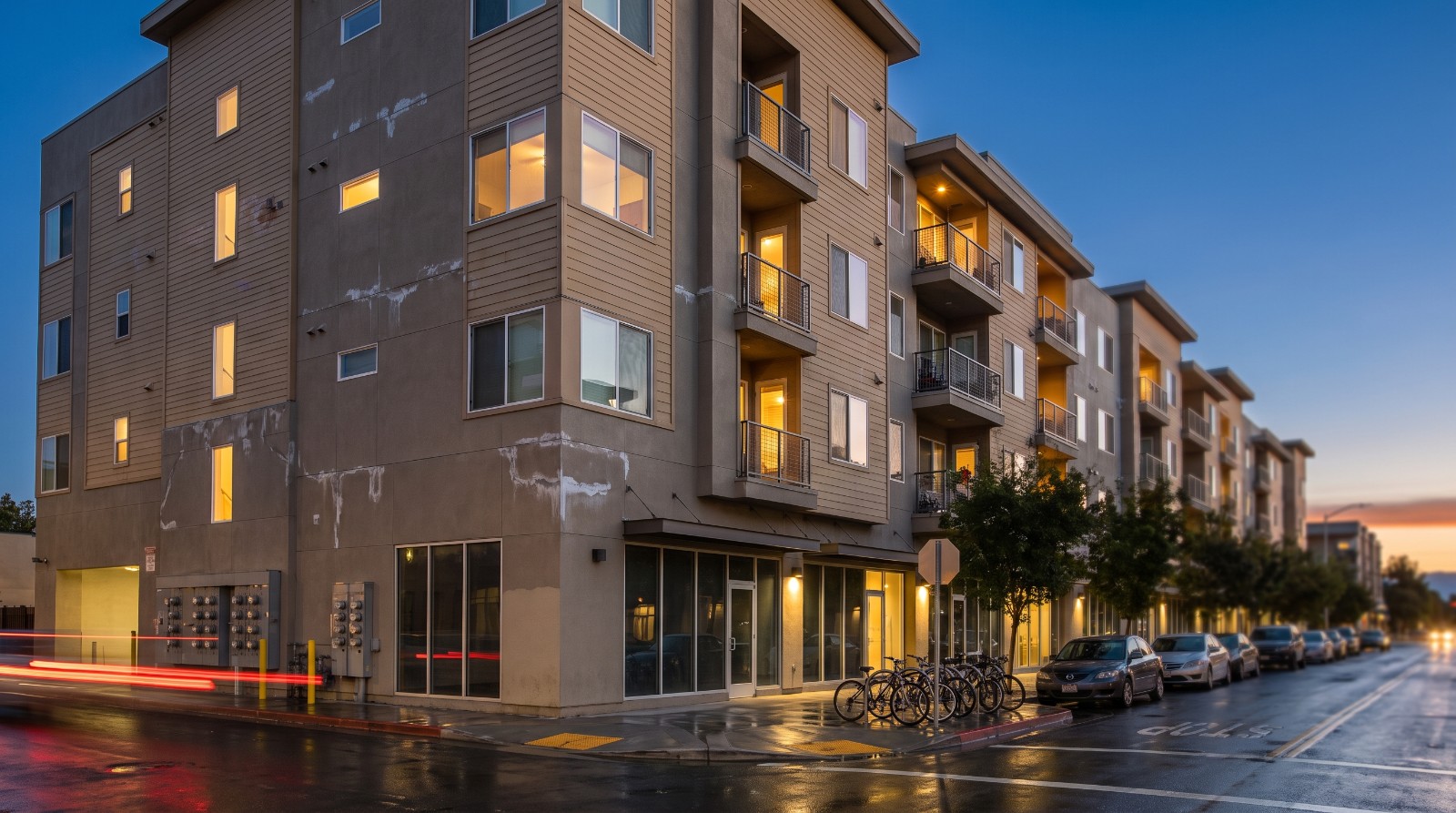
A mid-rise apartment building with lit windows on a downtown San Jose street at dusk, illustrating rising San Jose rents in 2026. Photo: Houseberry
A two-bedroom apartment in San Jose has a median asking rent of about 3,580 dollars as of August 2026, up roughly 12 percent from a year ago. The same unit in Oakland is about 2,595 dollars, up about 3 percent. Two cities an hour apart on the same freeway, and one of them is having a completely different year.
The gap is now about 985 dollars a month on a two-bedroom, or 11,820 dollars over a twelve-month lease. That is the number to hold onto, because everything else in this post is an argument about whether it is worth paying.
Where the two cities actually sit right now
Side by side, the divergence is cleaner in the two-bedroom market than the one-bedroom market, and that is a clue about who is moving. Figures below are Zumper's rolling 30-day medians as of mid-August 2026.
| Measure (Zumper, August 2026) | San Jose | Oakland |
|---|---|---|
| Median one-bedroom rent | 2,683 dollars | 1,999 dollars |
| One-bedroom, year over year | up about 3 percent | down about 3 percent |
| Median two-bedroom rent | 3,580 dollars | 2,595 dollars |
| Two-bedroom, year over year | up about 12 percent | up about 3 percent |
San Jose's one-bedroom market is close to flat. Its two-bedroom market is the one running, which points at households sharing or upsizing rather than at solo renters bidding each other up. Oakland's one-bedroom is actually cheaper than it was a year ago in nominal terms.
Neither city is the story of 2026 though. San Francisco is. The city's median one-bedroom hit 4,180 dollars in July 2026 and the two-bedroom crossed 6,020 dollars, the highest two-bedroom median in the country, passing New York. Those are up about 23 and 26 percent year over year. That is not a Bay Area rental market. That is three markets stacked on top of each other, and we already covered the bottom two rungs when we looked at the SF to Oakland rent gap in July.
What 985 dollars a month actually buys
This is where our own data says something the rent reports cannot. If you pay the San Jose premium, you are buying schools and safety. You are not buying amenities, because on that measure the two cities are identical.
| Houseberry city score | [San Jose](https://www.houseberry.com/City/San-Jose-CA/) | [Oakland](https://www.houseberry.com/City/Oakland-CA/) |
|---|---|---|
| Overall | 3.3 out of 5 | 2.5 out of 5 |
| Schools | 3.1 out of 5 | 2.3 out of 5 |
| Safety | 3.7 out of 5 | 2.8 out of 5 |
| Amenities | 3.2 out of 5 | 3.2 out of 5 |
Schools and safety are each about 0.8 to 0.9 points apart. Amenities are dead even at 3.2. So 11,820 dollars a year buys a renter roughly one point of school score, one point of safety score, and exactly zero improvement in walkable access to the things people actually do on a Saturday. For a household without school-age kids, that is a very expensive trade.
It also averages over enormous internal variation, which is the part that should change how anyone uses these numbers. San Jose has 112 neighborhoods in our rankings and they run from 4.3 down to the low twos. A renter comparing the top of the San Jose list against the Oakland hills is having a different conversation than a renter comparing East San Jose against Temescal. City-level medians are a starting point and a terrible finishing point.
Two datasets disagree about Oakland, and the disagreement is the interesting part
Zumper has Oakland flat to slightly down. Apartment List has Oakland up nearly 5 percent year over year as of June 2026, and ranked it the second-fastest rent growth among the 100 largest US cities. Those cannot both be describing the same thing.
They are not. Zumper tracks asking rents on listed units on a rolling 30-day basis, which reacts fast and swings with whatever mix of buildings happens to be advertising. Apartment List models the full stock with a repeat-rent methodology that is slower and smoother. When a market is turning, the two methods disagree by design, and Oakland looks exactly like a market that is turning: Apartment List also put Oakland's vacancy rate at 4.5 percent, its lowest since 2017.
The reasonable read is that Oakland is flat on the way up rather than flat on the way down. A city does not hit its tightest vacancy in eight years and then stay cheap. If you are choosing Oakland to save 985 dollars a month, price in that the gap is more likely to narrow than widen over the next year.
What this does and does not mean
It does mean the cheap-Bay-Area-adjacent-city play is getting thinner. Oakland spent several years as the obvious answer to San Francisco rent, and the vacancy number says that answer is being taken.
It does not mean San Jose is overpriced. A 12 percent jump in two-bedroom asking rents against a 3 percent one-bedroom move is a mix story as much as a demand story, and asking rents are not the same as what people actually sign. It also does not mean either city is a good buy or a bad buy, because rent trends and purchase prices have been moving independently all year. Oakland's median home price was about 974,000 dollars in July 2026, which is up from a March low near 785,000, so the buy side there is doing its own thing entirely.
And it does not mean much at all for one specific renter, because nobody rents a city. The thing worth doing before signing anything is comparing the actual neighborhoods on both ends of a commute, which is the habit we built Houseberry around: look hard at the area before you fall for the address. The best-value San Jose neighborhoods are a more useful list than the San Jose median will ever be.
Common questions
How much more expensive is San Jose than Oakland right now?
About 684 dollars a month on a one-bedroom and about 985 dollars a month on a two-bedroom as of August 2026, using Zumper medians. Over a year that is roughly 8,200 dollars and 11,800 dollars respectively.
Are San Jose rents still rising in 2026?
Yes, but unevenly. Two-bedroom medians are up about 12 percent year over year as of August 2026, while one-bedroom medians are up only about 3 percent. The overall San Jose figure is around 11 percent.
Are Oakland rents going down?
Oakland one-bedroom asking rents are down about 3 percent year over year per Zumper, but Apartment List shows Oakland up nearly 5 percent with vacancy at 4.5 percent, the lowest since 2017. Flat is the safest description, with the risk skewed toward increases.
Why is San Francisco so much more expensive than both?
San Francisco's median two-bedroom reached 6,020 dollars in July 2026, up about 26 percent year over year, driven by AI-sector hiring concentrated in the city. San Jose and Oakland are both absorbing spillover from that, at very different speeds.
Sources
- Average Rent in San Jose, CA and Rent Price Trends, Zumper, August 2026
- Average Rent in Oakland, CA and Rent Price Trends, Zumper, August 2026
- San Francisco median 2-bedroom rent soars to 6,000 a month, CBS Bay Area, July 2026
- Oakland rents are growing again, Apartment List data via Yahoo Finance, June 2026
- Houseberry city guides for San Jose and Oakland
All information provided on this website including but not limited to - school ratings, safety, amenities, user opinions, and property data - is for general informational purposes only. We do not guarantee its reliability, accuracy, or completeness. Users should independently verify information and consult appropriate professionals as needed. By using this website, you agree Houseberry is not responsible for actions, decisions, or consequences arising from reliance on the information provided
houseberry.com - CA DRE# 01847391
 Bay East ©2025. CCAR ©2025. bridgeMLS ©2025. Information Deemed Reliable But Not Guaranteed. This information is being provided by the Bay East MLS, or CCAR MLS, or bridgeMLS. The listings presented here may or may not be listed by the Broker/Agent operating this website. This information is intended for the personal use of consumers and may not be used for any purpose other than to identify prospective properties consumers may be interested in purchasing. Data last updated at September 26, 2026 12:00 AM