Saratoga Is Studying 132 Townhomes on Marshall Lane
Saratoga sent a Draft EIR for 132 townhomes at Marshall Lane and Quito Road to the state on September 10, 2026. Here is what the filing proposes, the law that lets it ignore the zoning, and why it landed in the cheapest corner of the city.
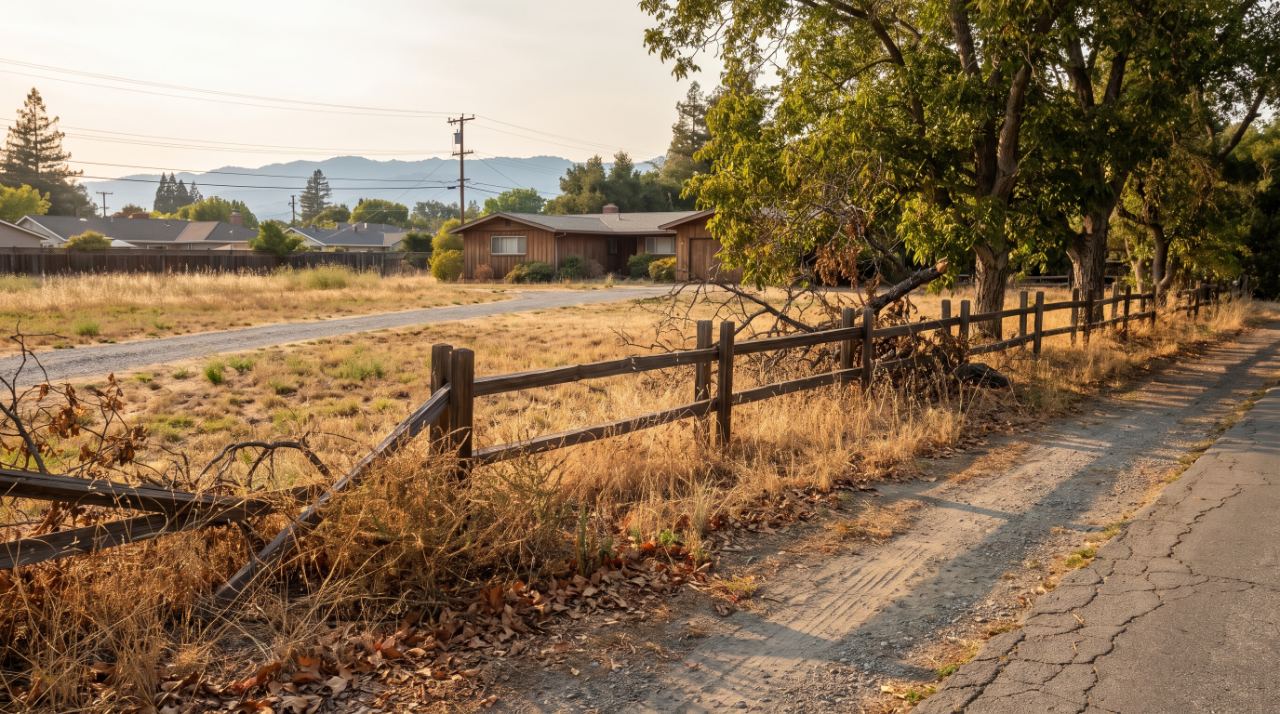
Open grassy parcel behind a split-rail fence on Marshall Lane in Saratoga, the site studied for 132 townhomes. Photo: Houseberry
On September 10 the City of Saratoga sent a Draft Environmental Impact Report to the State Clearinghouse in Sacramento, filed as SCH 2025100481. The project it studies is 132 three-story attached townhomes on 9.84 acres at 18500 and 18520 Marshall Lane, just west of Quito Road, on land zoned for lots of 40,000 square feet.
That is roughly twelve times the density the zoning contemplates, in a city that adds almost no housing at all. Public comment closes October 26, 2026. As far as we can find, no outlet has written a word about it.
So here is the word about it.
What is being proposed on those two parcels?
One hundred thirty-two attached townhomes in 22 buildings of six units each, all three stories, on APNs 397-02-110 and 397-02-111 at the Marshall Lane and Quito Road corner. Homes run from a 1,275 square foot two-bedroom to a 2,268 square foot four-bedroom.
Ten of them would be deed restricted for extremely low income households. That is the single most consequential number in the file, and the next section explains why.
The site work is not modest. The Draft EIR studies removing up to 71 trees, 52 of them protected, with roughly 202 replacements planted. Parking comes to 298 vehicle spaces and 24 bike spaces. One 24-foot driveway off Marshall Lane serves the site, plus a second access reserved for emergency vehicles.
Geography matters here more than usual. This is the far northeast shoulder of Saratoga, the flat pocket where the city runs into Campbell and San Jose, not the hillside Saratoga people picture. Quito Road carries real traffic, Highway 85 is a couple of minutes away, and the blocks around the site are single-story ranch houses on deep lots rather than gated estates. Of every place in Saratoga a 132-unit townhome project could turn up, this is the least improbable one.
| Item | What the filing says |
|---|---|
| Address and parcels | 18500 and 18520 Marshall Lane, Saratoga. APNs 397-02-110 and 397-02-111 |
| Site | 9.84 gross acres at Marshall Lane and Quito Road |
| Homes proposed | 132 attached townhomes, three stories, 22 buildings of six units |
| Density | About 13.4 homes per gross acre |
| Unit sizes | 1,275 sq ft two-bedrooms up to 2,268 sq ft four-bedrooms |
| Below market | 10 units restricted to extremely low income households |
| Parking and trees | 298 vehicle spaces. Up to 71 trees removed, 52 protected, about 202 replanted |
| Zoning and land use | R-1-40,000 single family, Residential Very Low Density |
| Applicant | Marshall Lane Owner, LLC |
| Status | Draft EIR received September 10, 2026. Comments due October 26, 2026 |
Nothing in that table is a rendering or a rumor. It is the project description the city sent to the state.
How does 132 townhomes clear a 40,000 square foot minimum lot?
Through SB 330 and the Housing Accountability Act, which together bar a city from applying its own zoning to a qualifying housing project while its housing element is out of compliance. The Notice of Preparation says it in one flat sentence: the project is being processed pursuant to SB 330 and the Housing Accountability Act. Saratoga files it on the city's own builder's remedy projects page as project number 7.
The timeline is what made it possible. Saratoga's sixth-cycle housing element was certified roughly 18 months after the state's January 2023 deadline, and applications piled up in the gap. Mayor Belal Aftab told San Jose Spotlight in August 2025 that the city was facing more than 20 builder's remedy applications. Marshall Lane is one of them.
The ten affordable units are where the file gets interesting. AB 1893, effective January 1, 2025, reset the builder's remedy affordability thresholds to 13 percent lower income, 10 percent very low income, or 7 percent extremely low income. Ten extremely low income homes out of 132 is 7.6 percent. That mix is not a round number because it was never meant to be a round number.
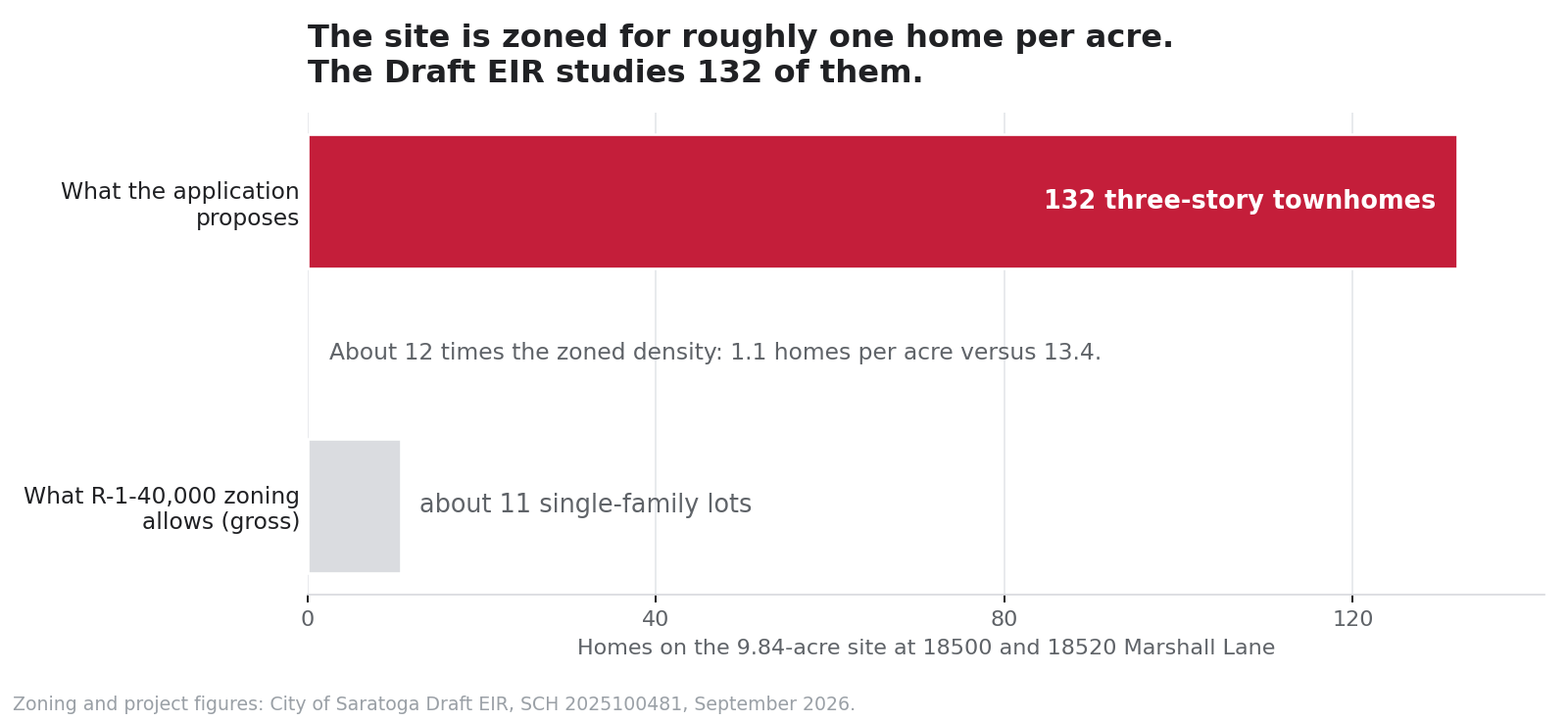
R-1-40,000 means a minimum lot of 40,000 square feet, a shade under an acre. Spread across 9.84 gross acres that is about 11 lots before a single street is subtracted. The application asks for 132 homes. Both numbers are correct, and the distance between them is the entire fight.
Why Quito, and not anywhere else in Saratoga?
Because it is the corner of the city where the land math works, and our own numbers say so bluntly. Houseberry's Quito neighborhood covers the narrow north-south strip along Quito Road that the site fronts, and its median sale price was about $385,800 in August 2026. The Saratoga citywide median that same month was $4.33 million. Montalvo, on the other side of town, was $10.02 million.
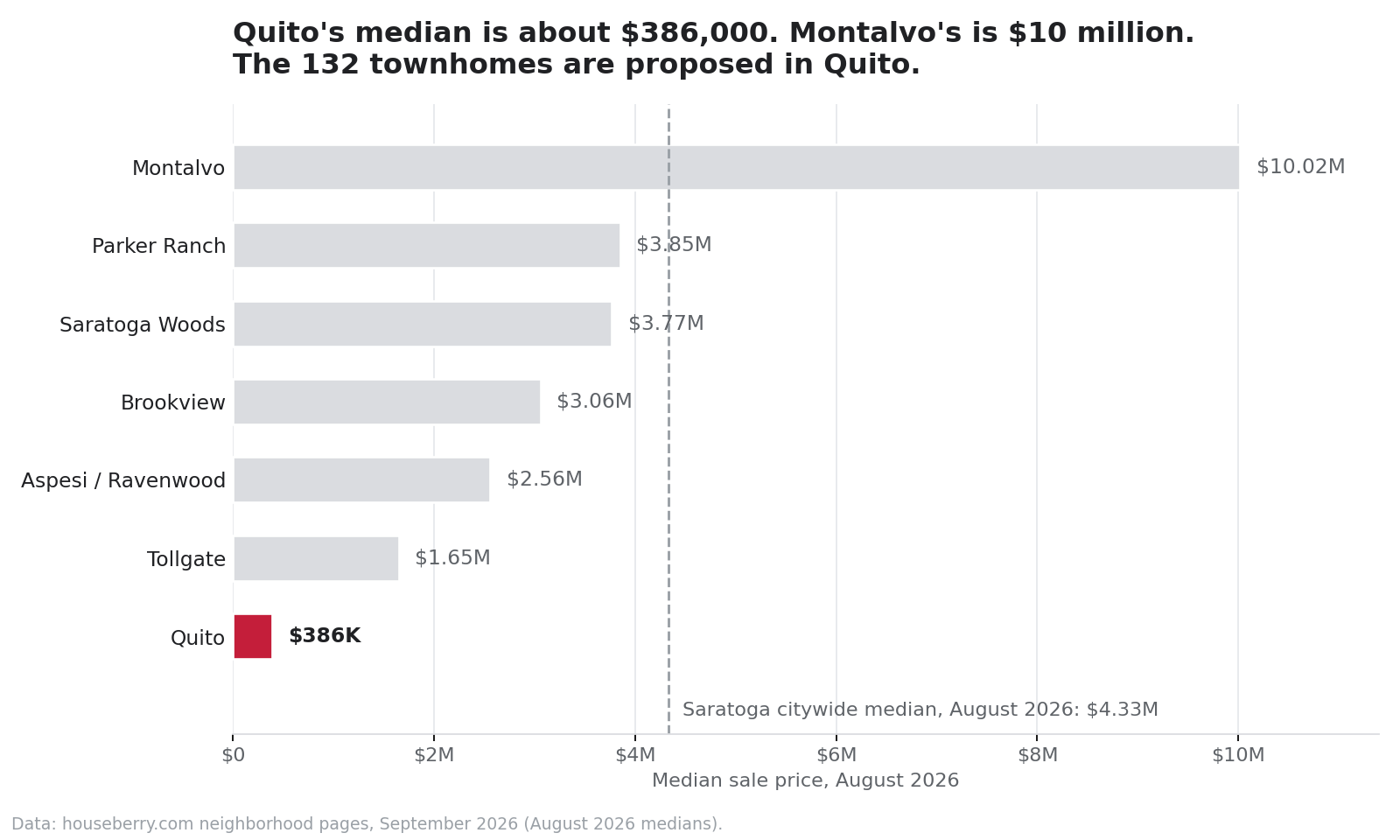
Read the Quito figure carefully before you repeat it. A median under $400,000 in a city where the typical sale clears $4 million tells you the sale pool there is small and tilted toward attached homes, not that acre lots off Quito Road are trading for condo money. What it reliably tells you is where the least expensive door into Saratoga is.
The scores line up with that. Quito ranks 22nd of the 28 Saratoga neighborhoods we score, at 3.9 out of 5 overall, with a 4.7 for schools and a 3.2 for amenities. Good schools, thin walkability, and the cheapest land in a very expensive city.
That last part is the pattern worth naming. A builder's remedy project goes where a developer can assemble land at a price 132 units will support, and in a city of estate lots that means the least expensive edge of it. So the one place Saratoga is studying real density is the one place that was already the most attainable. The objections you will hear will be about traffic and trees. The thing actually being decided is whether Saratoga's most affordable pocket is also the only one asked to change.
For the record, we think it should get built, and we have said the same about 137 townhomes on Kifer Road in Sunnyvale. A hundred and thirty-two for-sale homes in a district like this one is exactly the kind of housing the region stopped producing twenty years ago.
Which school would these homes feed?
Marshall Lane Elementary, and it is a Campbell Union School District school, not a Saratoga district one. It sits a short walk from the site on Marilyn Lane and enrolled 414 students in grades K through 5 in the 2025-26 school year.
Buyers get this wrong constantly. A Saratoga mailing address in this pocket does not put a kindergartner in a Saratoga Union school, and the attendance boundary matters far more to a family than the city line does. It is one of the reasons we treat schools as a neighborhood attribute rather than a city one.
Schools is also one of the 20 subjects the Draft EIR lists for study, which means Campbell Union's capacity at Marshall Lane is now formally on the record. If you have a stake in that school, the comment period is the moment to put a number in front of the city.
What does the EIR admit it cannot fix?
Three things, by its own account. The Draft EIR summary filed with the state finds significant and unavoidable cumulative impacts on vehicle miles traveled, on emergency response and evacuation, and on wildfire evacuation.
Those are the city's own findings, not an opposition talking point, and they deserve to be taken seriously. Evacuation capacity on a street network built for about eleven houses is a fair question to ask of a project proposing 132.
The VMT finding is more a Saratoga problem than a Marshall Lane problem. A city with no rail station and thin bus service will generate miles per household no matter what gets built there, and an EIR has no tool to fix that from one 9.84-acre site.
The honest weak spot is the affordability. Ten extremely low income homes out of 132 is the legal minimum to keep the project protected, not a serious affordable housing program. It is a real ten households, and it is also the floor.
What happens before October 26?
Comments on the Draft EIR are due October 26, 2026, and that is the only date on the calendar right now. After that the city responds in writing, a Final EIR gets certified, and only then does anything go to a hearing.
Nothing is approved. No design review, no subdivision map, no vote. Unit counts and site plans move between draft and certification more often than they hold.
The city has run one public meeting on this already. A scoping session was held at the Joan Pisani Community Center on October 23, 2025, when the only paper on file was a Notice of Preparation and almost nobody outside the immediate blocks knew the project existed. The document that came out of it is now public, and six weeks is not long to read an EIR.
What we would watch: whether the comment letters concentrate on evacuation, where the document is already conceding ground, whether the ten extremely low income units survive into the final plan, and whether Saratoga tries to bargain the count down. The state has been steadily narrowing that room, most recently with bills like SB 1116 on lot splits.
If you are shopping the Quito side of Saratoga, this is the kind of thing worth knowing before you write an offer rather than after you move in. It is also why we spend more time on the area than on the address. Look at the neighborhood, then find the house.
Sources
- CEQAnet, City of Saratoga, 18500 and 18520 Marshall Lane Townhome Project, SCH 2025100481
- CEQAnet, Draft EIR document record, received September 10, 2026, review period through October 26, 2026
- City of Saratoga, Builder's Remedy Projects
- City of Saratoga, project page for 7. Marshall Lane
- Allen Matkins, Now Effective: Builder's Remedy 2.0 (AB 1893)
- San Jose Spotlight, Saratoga housing development catches residents off guard, August 2025
- Ed-Data, Marshall Lane Elementary, Campbell Union School District
- Houseberry, Quito neighborhood price history and scores
- Houseberry, Saratoga city price history
Map of Saratoga Neighborhoods
Loading map...
View Full Map
Top Neighborhoods in Saratoga, CA


All information provided on this website including but not limited to - school ratings, safety, amenities, user opinions, and property data - is for general informational purposes only. We do not guarantee its reliability, accuracy, or completeness. Users should independently verify information and consult appropriate professionals as needed. By using this website, you agree Houseberry is not responsible for actions, decisions, or consequences arising from reliance on the information provided
houseberry.com - CA DRE# 01847391
 Bay East ©2025. CCAR ©2025. bridgeMLS ©2025. Information Deemed Reliable But Not Guaranteed. This information is being provided by the Bay East MLS, or CCAR MLS, or bridgeMLS. The listings presented here may or may not be listed by the Broker/Agent operating this website. This information is intended for the personal use of consumers and may not be used for any purpose other than to identify prospective properties consumers may be interested in purchasing. Data last updated at September 13, 2026 12:00 AM