The East Bay Neighborhoods the Market Underrates in 2026
Most East Bay neighborhoods cost more than their Houseberry scores justify. A small set cost less. Here is who they are and why the market overlooked them.

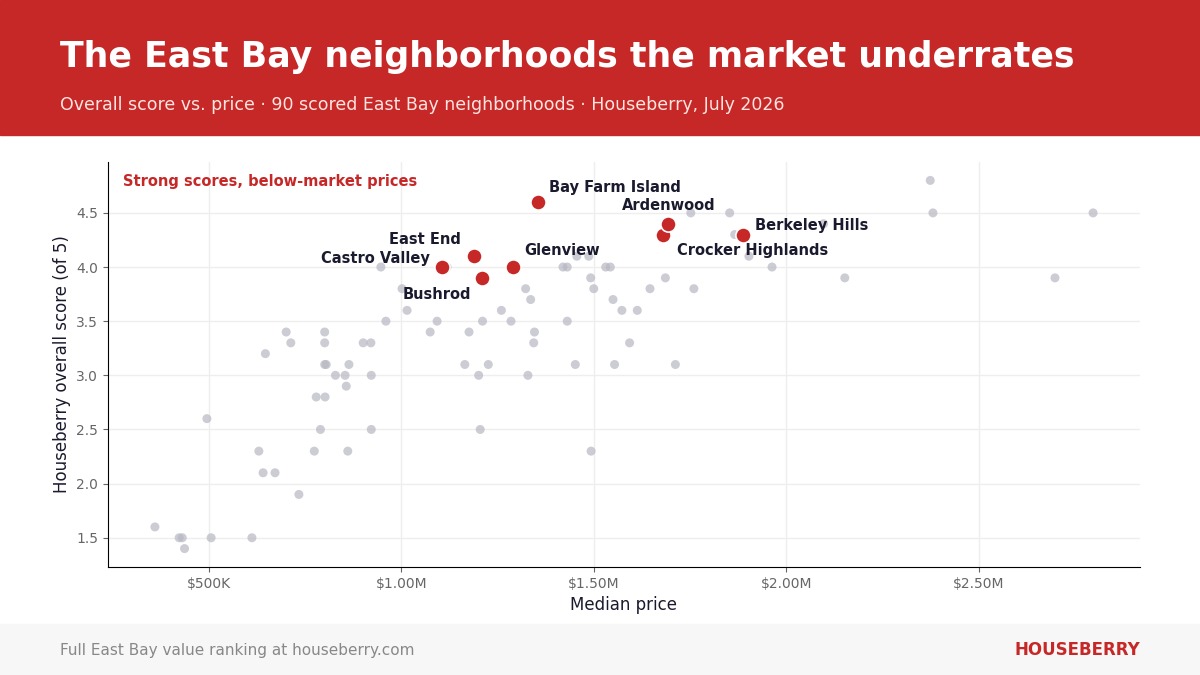
Scatter chart of Houseberry overall score versus price for 90 East Bay neighborhoods, with eight underrated East Bay neighborhoods highlighted in red Photo: Houseberry
In the East Bay you can pay $2.8 million for a neighborhood that Houseberry scores 3.9 out of 5, or $1.36 million for Bay Farm Island, which scores 4.6. Same region, same July 2026 market, a spread of nearly two million dollars on quality that runs the wrong way. That gap is the whole story here. Across the 90 East Bay neighborhoods we score with neighborhood-level data, the market more often overpays than underpays, and a small set of places are priced below what their own schools, safety, and amenities scores would justify.
Plot every scored East Bay neighborhood on two axes, price and overall score, and the cloud tilts the way you would expect. More money usually buys a better score. The interesting part is the scatter around that line. Fifty-three of the 90 neighborhoods are priced above what Houseberry's value model says they are worth, and only 37 sit below. The market, in other words, is more often paying a premium than finding a deal. The eight neighborhoods in the table below are the clearest exceptions: a strong overall score of 3.9 or better paired with a market price under their modeled value. They are not cheap in absolute terms. They are underpriced relative to what they deliver, which is a more useful thing to know.
East Bay neighborhoods priced below their modeled value (Houseberry, July 2026)
| Neighborhood | Overall | Safety | Median price | Value gap |
|---|---|---|---|---|
| Bushrod, Oakland | 3.9 | 3.9 | $1.21M | $288K under |
| Bay Farm Island, Alameda | 4.6 | 4.9 | $1.36M | $211K under |
| Ardenwood, Fremont | 4.4 | 4.3 | $1.69M | $124K under |
| Berkeley Hills, Berkeley | 4.3 | 4.8 | $1.89M | $68K under |
| East End, Alameda | 4.1 | 3.9 | $1.19M | $51K under |
| Crocker Highlands, Oakland | 4.3 | 4.9 | $1.68M | $24K under |
| Glenview, Oakland | 4.0 | 4.8 | $1.29M | $14K under |
| Castro Valley | 4.0 | 4.7 | $1.11M | $4K under |
Value gap is Houseberry's modeled worth minus market price. Prices are the site's July 2026 snapshot.
Islands hide in plain sight
Bay Farm Island, in Alameda, is the sharpest case. It scores 4.6 overall and 4.9 for safety, the second-best overall mark in the entire East Bay set, and the market prices it $211,000 below its modeled value. Part of the reason is literal geography. Bay Farm sits across the estuary from the rest of Alameda, reached by a bridge, with no BART on the island and a commute that adds a step. Buyers working the Rockridge and Piedmont open houses rarely drift out to a place they have to mean to visit. What they miss is a quiet grid around Godfrey Park and Tillman Park with the Corica Park golf course folded into it. Its neighbor across the water, East End, scores 4.1 with the group's highest amenities mark at 4.4, and it too trades about $51,000 under value. Discovery friction is a real pricing force, and islands have the most of it.
A name a decade out of date
North Oakland's Bushrod is the one the market has already begun to correct, which makes it the most instructive. Houseberry's value model puts it $288,000 under, the widest gap in the East Bay, and yet its price is up 20.5 percent over the trailing period, the fastest appreciation on this list. (Housekeeping note: the site currently lists it as "Brushrod," a data typo we are fixing. The neighborhood is Bushrod, named for Bushrod Park.) It is a flat, bike-friendly rectangle between Telegraph Avenue and Adeline Street, streets like Dover and Shafter lined with Craftsman bungalows, a short walk to the Telegraph restaurant corridor. For years its reputation ran a full renovation cycle behind the reality on the ground. That appreciation number is what a reputation catching up to the data looks like in real time.
Overshadowed by a famous neighbor
Some neighborhoods are underpriced mostly because they stand next to a more famous one. Crocker Highlands, east of Lake Merritt in Oakland, scores 4.3 overall and 4.9 for safety, with early-1900s homes on curving streets like Paramount and Sunnyhills and Lakeshore's shops a few minutes down the hill. It prices about $24,000 under value while the marquee names a mile away, Rockridge among them, command a premium for a similar daily life. Glenview, along the same hills, tells a near-identical story: a 4.8 safety score, a price $14,000 under value, and 10.7 percent appreciation as buyers priced out of the headline neighborhoods work their way over. Proximity to a brand-name neighborhood is worth something, but the market tends to overpay for the address and underpay for the one next door that scores just as well.
The scores buyers do not check until later
Ardenwood, in Fremont, posts a perfect 5.0 school score alongside a 4.4 overall, and it trades $124,000 under modeled value. School quality is the factor buyers most often discover late, after the price is set and a first child is on the way, which means it is chronically underweighted at the moment of purchase. East End's 4.1 school score does the same quiet work in Alameda. A neighborhood whose strongest number shows up on a report card rather than in a listing photo tends to be one the market has not fully paid for.
The hills discount
Berkeley Hills scores 4.8 for safety with Tilden Park at the back door, and still sits $68,000 under value with 6.4 percent appreciation. Hillside neighborhoods carry two costs the score does not show: wildfire insurance that has grown expensive and hard to place, and a commute that winds downhill before it reaches a freeway or a train. Those frictions are real, and they are part of why the discount exists. They also tend to get priced in more heavily than the math requires, which leaves a gap for a buyer who was going to pay the insurance anyway.
You can see the same pattern for yourself in Houseberry's full East Bay value ranking, which sorts every neighborhood by the gap between price and modeled worth.
What "undervalued" does not mean
A discount is not a promise. Several of these neighborhoods show soft recent prices, which is part of why the gap is open in the first place. Bay Farm Island is down 7.7 percent, Crocker Highlands 10.4 percent, and East End 10.5 percent over the trailing period. The value figure is a modeled gap between price and what the scores support, not a forecast, and a neighborhood can stay underpriced for years if the reason buyers avoid it does not change. Some of those reasons are real quality tradeoffs rather than pure oversight. Bushrod's school score is 3.8, below its other marks, and Glenview's is 3.1. Reading the value gap without reading the factor scores underneath it is how a deal turns into a lesson.
Where the gap goes from here
The tell is the appreciation column. Where a reputation has started to catch up to the data, prices are already moving: Bushrod at 20.5 percent, Glenview at 10.7, Berkeley Hills at 6.4. Where the story has not spread yet, prices are flat or soft, and that is where the discount still lives: Bay Farm Island, Crocker Highlands, East End. Mispricing that comes from reputation lag corrects itself on a delay, because information about schools and safety and amenities spreads slowly and eventually shows up in the price. No market moves in a straight line, and rates and insurance can widen these gaps as easily as close them. But the direction of travel for a neighborhood that scores well and prices low is usually up, and the East Bay is full of them right now.
How we ranked these
Houseberry scores roughly 90 East Bay neighborhoods that have neighborhood-level data on four factors, overall, schools, safety, and amenities, each on a 0 to 5 scale, and runs a value model comparing each neighborhood's market price to the price its attributes would support. The figures here are as of July 2026. We excluded neighborhoods carrying only city-level fallback data, since a citywide median cannot speak to a single neighborhood. "Underrated" here means a specific, checkable thing: an overall score of 3.9 or higher paired with a market price below modeled value. The full, sortable data lives on Houseberry's East Bay value ranking and safety ranking.
Frequently asked questions
What is the most undervalued East Bay neighborhood in 2026?
By Houseberry's value model, Bushrod in North Oakland has the widest gap, priced about $288,000 below its modeled value as of July 2026. It also shows the fastest appreciation of this group at 20.5 percent, a sign the market is already closing the gap.
Is Alameda a good place to buy in 2026?
Alameda holds two of the East Bay's most underpriced neighborhoods, Bay Farm Island (4.6 overall, $211,000 under value) and East End (4.1 overall, $51,000 under). Both score well on safety and amenities and trade below modeled value, though recent prices have been soft, which is part of why the discount exists.
Which East Bay neighborhoods have the best safety scores for the price?
Crocker Highlands and Bay Farm Island both score 4.9 for safety on Houseberry's index while pricing below modeled value, and Glenview and Berkeley Hills both score 4.8. Safety scores describe relative, data-based context rather than a guarantee.
Does undervalued mean the price will go up?
No. The value figure is a modeled gap between the current price and what a neighborhood's scores support, not a forecast. Some undervalued neighborhoods have negative recent appreciation, and a discount can persist for as long as the reason buyers avoid a place stays in place.
Compare them yourself
The fastest way to use any of this is to stop reading and start comparing. Open the East Bay on Houseberry's map to see these neighborhoods next to their pricier neighbors, or sort the full East Bay value ranking to find the next gap before the market does.
The Houseberry Research Team is Houseberry's reporting team: Bay Area real estate analysts, data specialists and longtime local market watchers. Every day we check the public record: building permits, city council and planning agendas, county recorder filings, state housing bills, police incident data and school results. Then we tie each story to what it means for specific neighborhoods, using Houseberry's own neighborhood data on prices, appreciation, safety, schools and amenities. Questions or corrections: Contact us.
All information provided on this website including but not limited to - school ratings, safety, amenities, user opinions, and property data - is for general informational purposes only. We do not guarantee its reliability, accuracy, or completeness. Users should independently verify information and consult appropriate professionals as needed. By using this website, you agree Houseberry is not responsible for actions, decisions, or consequences arising from reliance on the information provided
houseberry.com - CA DRE# 01847391
 Bay East ©2025. CCAR ©2025. bridgeMLS ©2025. Information Deemed Reliable But Not Guaranteed. This information is being provided by the Bay East MLS, or CCAR MLS, or bridgeMLS. The listings presented here may or may not be listed by the Broker/Agent operating this website. This information is intended for the personal use of consumers and may not be used for any purpose other than to identify prospective properties consumers may be interested in purchasing. Data last updated at October 23, 2026 12:00 AM