Concord's 900-Home Coast Guard Site Takes Its Next Step
Concord's council picked the former Coast Guard housing site back up this week. Here is what 59 acres off Haleakala Street would become, and how it stacks up against the Naval Weapons Station plan.
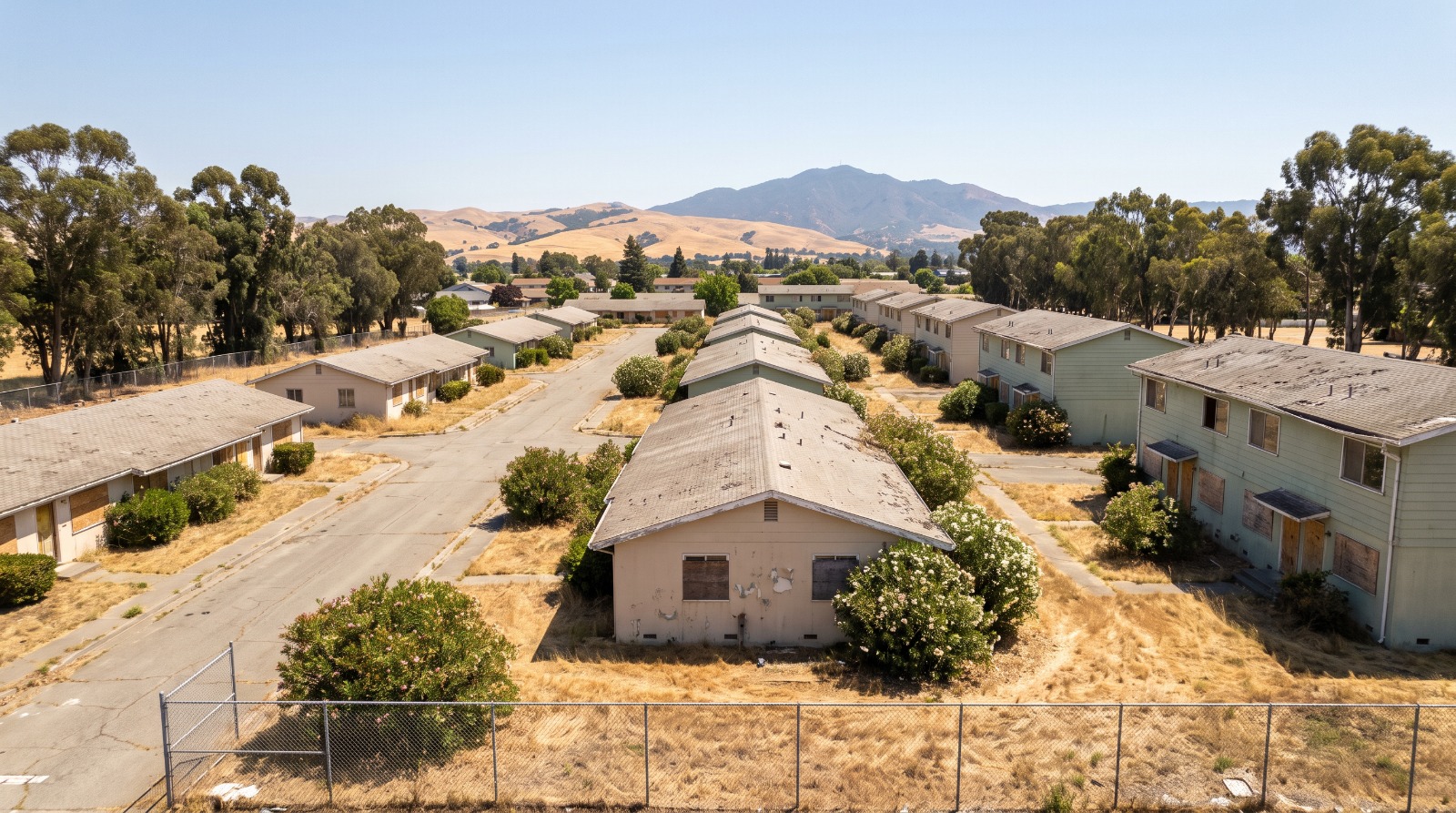
Vacant former Coast Guard housing off Haleakala Street in Concord, the 59-acre site proposed for roughly 900 homes, with Mount Diablo behind. Photo: Houseberry
Fifty-nine acres of empty military housing sit off Haleakala Street in north Concord. Three hundred sixty-six units of it, vacant, slowly losing its gutters to the weather since the Coast Guard left. On Tuesday the city council picked the redevelopment of that site back up, and Claycord reported the item as the next step on a roughly 900-home plan.
Which quietly makes Concord the East Bay city with the most new housing actually in motion, and this is only its second-biggest project.
What is actually proposed on Haleakala Street
The site is 3295 Haleakala Street, bought at a 2021 federal auction for about $58.4 million by Q Villages LLC, a team led by Las Vegas developers Eddie Haddad and Georges Maalouf. The current concept, as reported by The Real Deal and Contra Costa News, breaks down like this:
- Roughly 940 total dwelling units on 59.4 acres
- 409 detached homes and 403 townhomes
- 56 accessory dwelling units
- 72 deed-restricted affordable multifamily units
- Replacing 366 vacant military units, 286 apartments and 80 duplexes
- Two former housing areas, Victory Village to the south and Quinault Village to the north
- A short distance from the North Concord and Martinez BART station
The count has been moving. A January 2025 version of this project was 714 units. The February 2026 concept was in the 800 to 900 range, with the city noting the number would change before a formal application. The team is now describing roughly 900 primary homes plus the ADUs. Nobody should treat 940 as final.
The zoning is the thing standing in the way
Here is the part that gets skipped in the headlines. The site carries use restrictions that limit it to military housing, so nothing gets built until Concord rezones it. City staff have said plainly that they are not ready for project approval, and as of the spring reporting no formal application had been filed.
So be precise about what is confirmed and what is not. Confirmed: the site, the ownership, the general scope, the rezoning requirement, and that the council is engaged again this week. Not yet confirmed: a filed application, an environmental review, a general plan amendment, or any entitlement vote. This is a project at the feedback stage, not the ribbon-cutting stage.
That said, if you are looking for an easy yes in the East Bay, it is hard to design one better than this. The land is flat. It is already served by roads and utilities. It already held 366 homes. It is near BART, and it is not adjacent to anybody's back fence. The honest debate here is about how many homes and how tall, not whether housing belongs on a former housing site.
The one number we would push on is the affordable share. Seventy-two deed-restricted units out of roughly 940 is under 8 percent. Concord just committed to 25 percent affordable on its other big site. That gap is going to come up at a hearing, and it should.
Concord already approved 12,272 homes. This is the one that finishes first.
On May 27, 2026, the council voted unanimously to approve a financial agreement with the Navy that finally unlocked the former Naval Weapons Station: 12,272 homes, 3,068 of them affordable, on 2,225 acres with more than 800 acres of parks, with Brookfield paying the Navy $628 million over close to thirty years. We covered that one in detail when it happened, in Concord Naval Weapons Station Plan: 12,272 Homes Approved.
It is a genuinely enormous plan. It is also five phases over roughly thirty years, and phase one is not expected to break ground until around 2030.
Set the two side by side and the Coast Guard site looks like the near-term story. Fifty-nine acres with existing infrastructure and one rezoning between it and an application can plausibly deliver finished homes years before the Navy site pours its first foundation. Nine hundred homes people can move into this decade is worth more to the local market than twelve thousand they cannot.
What it changes for anyone comparing East Bay cities
Concord's median sits at about $794,790 as of June 2026 on our Concord city data. Compare that to Walnut Creek at roughly $1.53 million in June 2026 and Lafayette at about $1.7 million in May 2026. Concord is close to half of Walnut Creek, one BART stop down the same line.
That gap is not free, and we are not going to pretend otherwise. Concord scores 2.8 overall on our scale against Walnut Creek's 3.6, with a 2.5 school score against Walnut Creek's 4.2. You can see how that plays out block by block in the Concord neighborhood rankings, where Crystal Ranch scores 4.3 and other pockets sit under 2.5. Citywide averages hide an enormous amount in a place this varied.
What 940 mostly-new detached homes and townhomes would add is something Concord currently has very little of: recent construction. The housing stock here is overwhelmingly mid-century, which is part of why the price gap exists in the first place. And the site's location near BART puts it in the same category as Downtown Concord, the part of the city built for leaving the car parked.
We would not tell anyone to buy in Concord today on the strength of a project with no application filed. We would tell them that if they are already comparing Concord against Walnut Creek or Pleasant Hill, the pipeline is now a real variable in that comparison rather than a rumor.
The filed application is the next real milestone
Watch for four things, roughly in this order. A formal application with a locked unit count. A general plan amendment and rezoning to strip the military-housing restriction. A CEQA notice of preparation, which is when traffic and infrastructure concerns get their formal airing. And the affordable percentage, which is the number most likely to move between now and a vote.
None of that happens quickly. Entitlement on a site this size runs in years, not months. But a council that unanimously cleared a 12,000-home agreement in May is not a council looking for reasons to say no to 900 homes on an abandoned housing tract, and that context matters more than any single agenda item.
Sources
- Claycord, Concord council to consider next step for 900-home former Coast Guard redevelopment
- Contra Costa News, project could bring 900 homes to former Coast Guard site
- The Real Deal, Vegas developers progress with Coast Guard housing plans
- Patch, Concord's housing push gains speed while the mega project stalls
- The Real Deal, Concord approves Brookfield deal for Navy station homes
- Houseberry city and neighborhood data for Concord and Walnut Creek
All information provided on this website including but not limited to - school ratings, safety, amenities, user opinions, and property data - is for general informational purposes only. We do not guarantee its reliability, accuracy, or completeness. Users should independently verify information and consult appropriate professionals as needed. By using this website, you agree Houseberry is not responsible for actions, decisions, or consequences arising from reliance on the information provided
houseberry.com - CA DRE# 01847391
 Bay East ©2025. CCAR ©2025. bridgeMLS ©2025. Information Deemed Reliable But Not Guaranteed. This information is being provided by the Bay East MLS, or CCAR MLS, or bridgeMLS. The listings presented here may or may not be listed by the Broker/Agent operating this website. This information is intended for the personal use of consumers and may not be used for any purpose other than to identify prospective properties consumers may be interested in purchasing. Data last updated at September 13, 2026 12:00 AM