Fillmore Street Revitalization: What the Panic Gets Wrong
One investor now owns most of a three-block stretch of Upper Fillmore, and the neighborhood is being told to be afraid. Here is what the numbers and the history actually say.
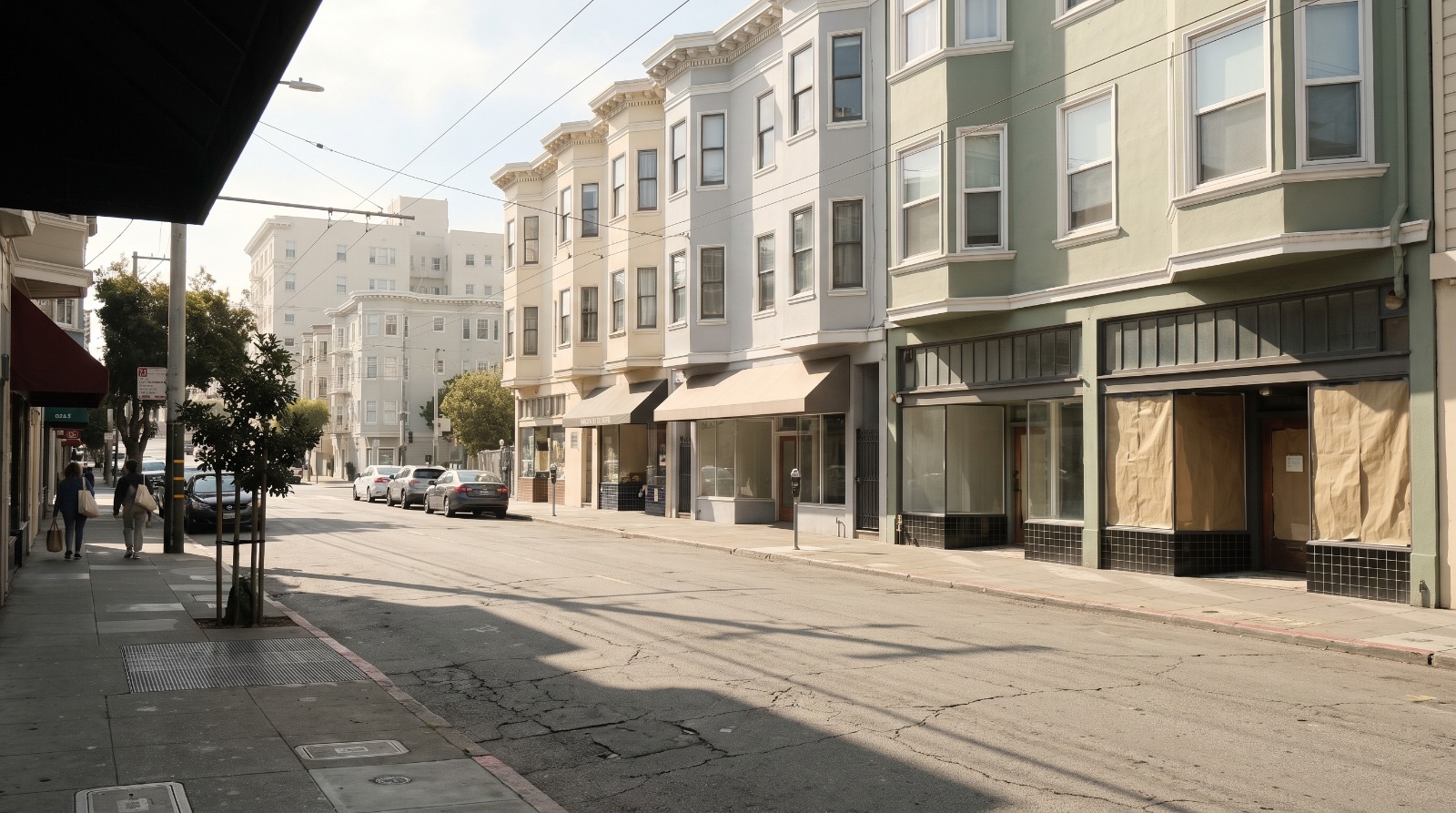
Storefronts and bay-windowed buildings along the Upper Fillmore Street retail corridor in San Francisco's Pacific Heights. Photo: Houseberry
The question I keep hearing from people who live near Fillmore Street is a version of the same worry: should I be nervous that one person now owns my shopping street? My answer is no, and it gets easier to say every few months. The Fillmore Street revitalization funded by venture capitalist Neil Mehta has put at least eight buildings on a three-block stretch under a single owner since January 2024. What has followed is a Michelin-starred chef taking the old Starbucks, a Korean barbecue restaurant going into a room that sat dark for a year, and a movie theater closed since 2020 finally moving toward reopening.
Three things are worth holding onto before the rest of this.
- Nobody is being condemned. Every one of these buildings was bought at market price from a willing seller, and several had been sitting empty for years.
- The commercial strip is the single strongest thing three different neighborhoods share. Pacific Heights, Lower Pacific Heights and Western Addition all score 5.0 out of 5 on nearby merchants in our data, and Fillmore is a big part of why.
- The Fillmore has already survived one genuine hostile takeover. It was run by the city with eminent domain, and it displaced more than 14,000 people.
What one investor actually bought
Mehta's group has funded the purchase of at least eight buildings on the blocks between Pine and Clay, plus the Clay Theater, starting in January 2024. The most recent closed in August 2026: 2035-2047 Fillmore, a 1926 building, for about $8.6 million. It had been vacant since 2022 and was first offered publicly that year at $8 million after more than fifty years in the same hands. Nobody was pushed out of it. There was nobody in it.
The number that convinced me this is not a normal real estate play is the spread. Hoodline reported the group is buying at roughly a 5.25 percent cap rate and re-leasing at around 3 percent. In plain terms, they are paying more for these buildings than the rent they intend to charge can justify. A landlord trying to make money does the opposite.
Mehta, who wrote that he was born a block from Fillmore Street and is raising his daughters there, says he donated his entire interest to a nonprofit and takes no profit. The stated rules are below-market leases, local operators, and no chain or formula retail. So far the tenant list matches the rules. Chef Pim Techamuanvivit of Kin Khao and Nari is planning a Thai noodle restaurant at 2222 Fillmore, the old Starbucks. Monami, a Korean barbecue restaurant from the SSAL team, is going into 2001 Fillmore this fall.
The corridor is the best thing three neighborhoods share
Upper Fillmore is not one neighborhood's shopping street. It is the seam between three, and our scores show how differently those three are doing.
| Neighborhood | Amenities score | SF amenities rank | Median price, July 2026 |
|---|---|---|---|
| Pacific Heights | 5.0 / 5 | 1st of 92 | $11.22M |
| Lower Pacific Heights | 3.4 / 5 | 41st of 92 | $4.98M |
| Western Addition | 3.0 / 5 | 69th of 92 | $3.62M |
Here is the part that matters. All three of those neighborhoods score a full 5.0 on nearby merchants. What separates them is curb appeal and public space, where Pacific Heights scores 5.0, Lower Pacific Heights scores 3.0 and Western Addition scores 2.0. Papered-over windows and dark awnings are a curb appeal problem before they are anything else, and curb appeal is the score that moves when a block starts looking abandoned.
Treat the price column carefully. Pacific Heights sells so few homes in a given month that its median swung between $6.7 million and $11.22 million over the past year, against $2.16 million citywide. The point is not the exact figure. It is that the households on either side of this street, from Lower Pacific Heights to Western Addition, have an enormous amount riding on whether these three blocks feel alive.
The Fillmore already had a hostile takeover, and the city ran it
The phrase that stuck to this project is "hostile takeover," used by Aaron Peskin in 2024, while he was still the sitting supervisor leading the opposition. I understand why it lands. I also think it is the wrong words for this, because the Fillmore has a real one to compare against.
Under the Western Addition A-1 plan, the redevelopment agency cleared 44 blocks and displaced roughly 4,000 people by the mid-1960s. A-2 added about 60 more blocks and pushed out somewhere between 10,000 and 13,000 more by 1970. Those were forced sales under eminent domain, aimed at a Black business district that people called the Harlem of the West. That is what a hostile takeover of a neighborhood looks like. It is not a private buyer paying above-market for an empty building and calling a restaurant.
Peskin's response in October 2024 was temporary zoning controls requiring city approval before a legacy business tenant is removed, passed unanimously and written to run 18 months. He left the Board of Supervisors on January 8, 2025. The rules were always a pause button, not a plan for the street. And a pause button does not fill a storefront.
What is honestly bad about this
Plenty, and the people worried about it are not imagining things.
Ten-Ichi, a Japanese restaurant on the street since 1978, closed. So did Noosh, Apizza, Alice + Olivia and the Starbucks. La Mediterranee, open since 1979, only got a four-year lease extension after the fight went public. In April 2026 the upstairs tenants at 2001 Fillmore, including a hair salon, an aesthetician and a milliner, were given about five weeks to clear out for the Monami build. Small offices above a shop are exactly the kind of tenancy nobody writes press releases about.
Then there is the paperwork. The San Francisco Chronicle reported it could find no federal tax record of the nonprofit Mehta says holds his interest, and the entity has no website. When the entire moral case for a project rests on "I take no profit," that claim should be verifiable by anyone with an afternoon and a search box. It is not yet.
And single ownership is a real risk even when the owner is generous. One person's taste now sets what the street sells. If the plan changes hands, the neighborhood has no vote. That is a fair thing to be uneasy about, and it is a different objection than the one being shouted.
What I would watch on Fillmore
The Clay Theater is the honest scoreboard. The Historic Preservation Commission unanimously endorsed the renovation on April 1, 2026, with plans for a restored auditorium, more than 500 screenings a year, an all-day cafe and a small cinema bookstore. The team said completion in early 2027. A neighborhood movie house that has been dark since 2020 either reopens or it does not, and that is not a claim anyone can spin.
After that, count storefronts. If twelve months from now most of those eight buildings are occupied by operators nobody has heard of instead of brands everybody has, the promise held. If the windows are still papered, the criticism was right and I was wrong.
The reason we spend so much time on merchant and curb appeal scores at Houseberry is that a commercial strip is the part of a neighborhood buyers feel first and measure last. People tour a house, then decide how they feel about the eight-minute walk to coffee. If you are looking at this part of the city, it is worth comparing how San Francisco neighborhoods actually rank on amenities rather than trusting the vibe of a Saturday visit. And it is worth remembering that the slowest thing in this city is usually the process, not the money. It took eleven years to turn a car wash on Divisadero into approved apartments. A street that goes from boarded to booked in three is not the crisis here.
Sources
- SF Standard, Billionaire tech investor scoops up another Fillmore building (August 14, 2026)
- Hoodline, Tech Investor Buys Another Fillmore Building, This Time for $8.6 Million (August 2026)
- Neil Mehta, Why I am backing a $100 million project to revive Fillmore Street, SF Standard opinion (September 30, 2024)
- SF Standard, Tech investor's Fillmore Street plans spark fears and legislation (August 26, 2024)
- SFist, SF Supervisors Strengthen Legacy Business Protections (October 22, 2024)
- The New Fillmore, Clay Theater renovation passes its first test (April 2, 2026)
- The New Fillmore, Another Michelin-starred chef for Fillmore (August 11, 2026)
- San Francisco Public Press, Fillmore Revisited: How Redevelopment Tore Through the Western Addition
- Upper Fillmore Revitalization Project
- Houseberry neighborhood and amenities ranking data for San Francisco (August 2026)
All information provided on this website including but not limited to - school ratings, safety, amenities, user opinions, and property data - is for general informational purposes only. We do not guarantee its reliability, accuracy, or completeness. Users should independently verify information and consult appropriate professionals as needed. By using this website, you agree Houseberry is not responsible for actions, decisions, or consequences arising from reliance on the information provided
houseberry.com - CA DRE# 01847391
 Bay East ©2025. CCAR ©2025. bridgeMLS ©2025. Information Deemed Reliable But Not Guaranteed. This information is being provided by the Bay East MLS, or CCAR MLS, or bridgeMLS. The listings presented here may or may not be listed by the Broker/Agent operating this website. This information is intended for the personal use of consumers and may not be used for any purpose other than to identify prospective properties consumers may be interested in purchasing. Data last updated at October 1, 2026 12:00 AM