BART picks a builder for 643 homes on Fremont's station lot
BART has picked Pacific Development and Affirmed Housing to plan 643 homes on the east lot at Fremont Station. Here is what would be built, what riders keep for parking, and how long it will take.

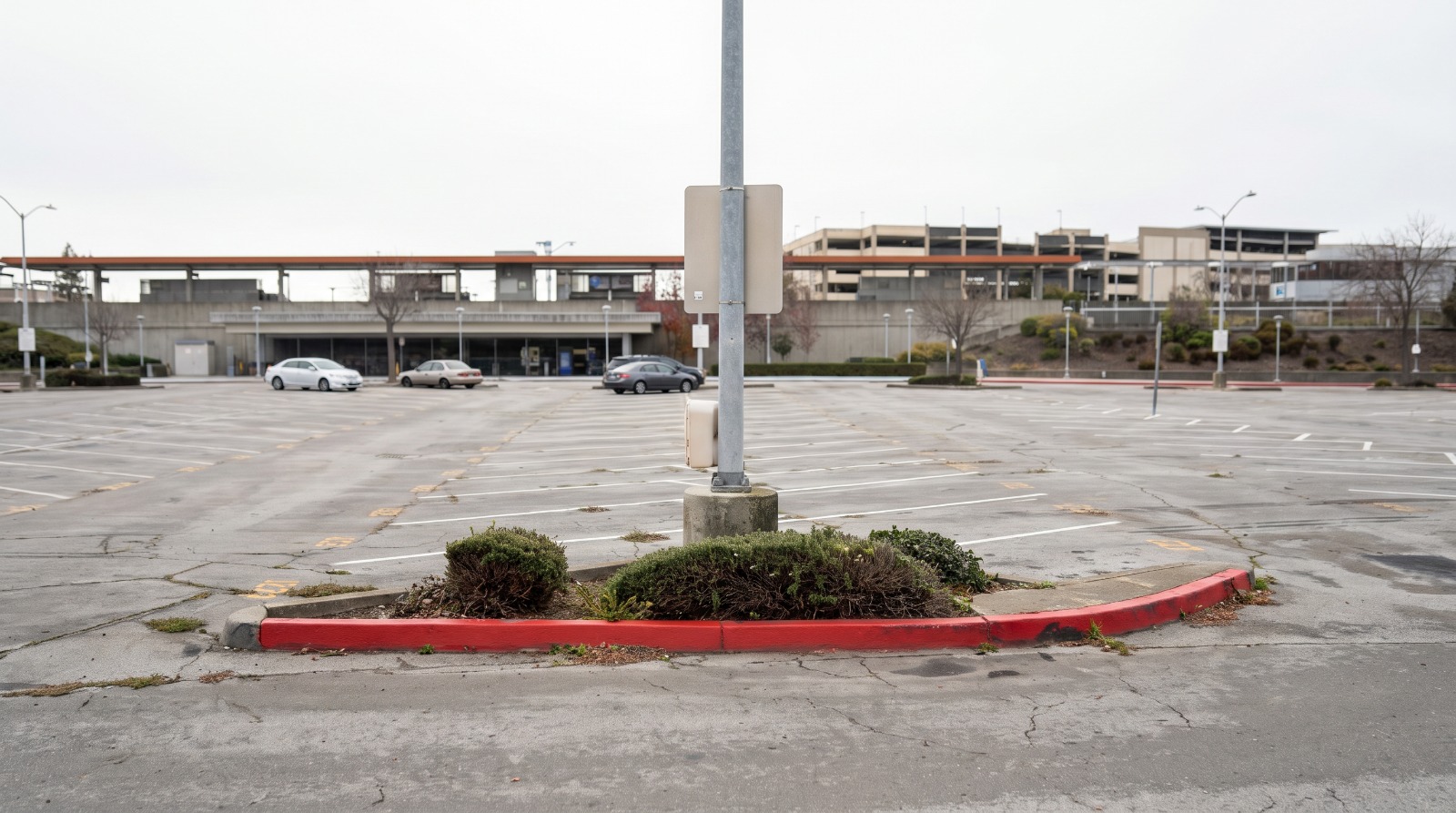
AI-rendered view of the mostly empty east parking lot at Fremont BART Station, Fremont, with the elevated station platform behind it Photo: Houseberry
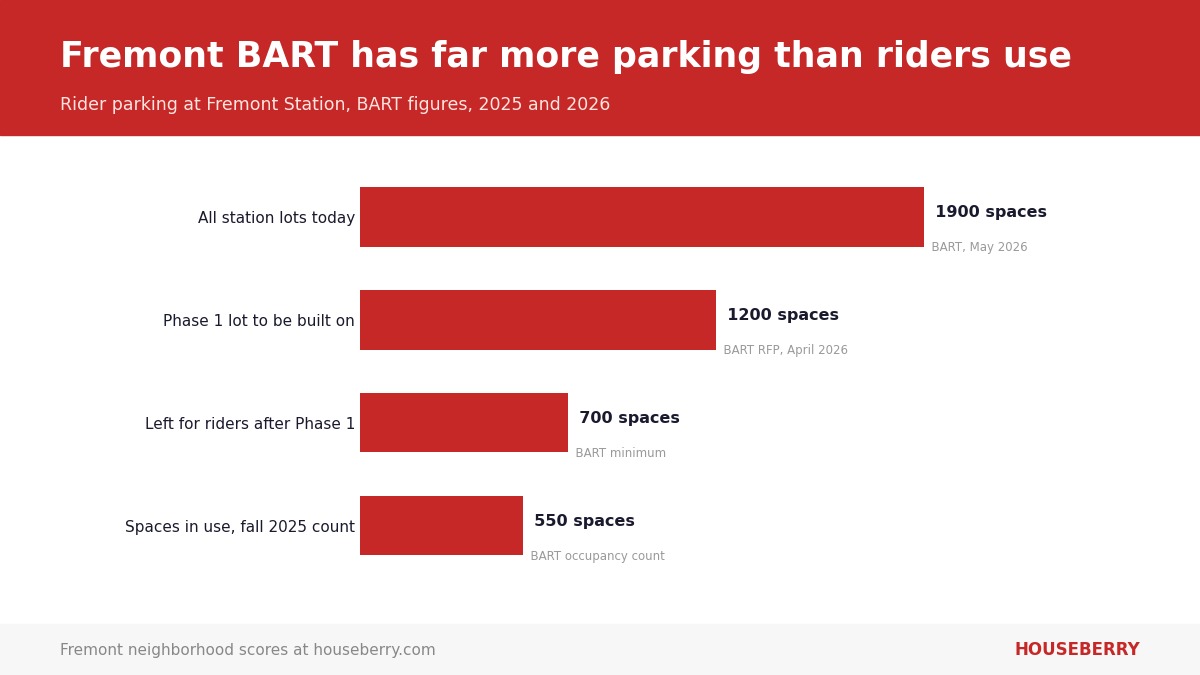
Walk out the east side of Fremont BART on a weekday morning and count the cars. BART did, in fall 2025, and found 550 parked across every lot at the station. The lot between the platform and Tule Pond alone has 1,200 spaces. Most of them sit empty under the light poles.
That lot is where 643 homes are now headed. On Oct. 22, BART's board was asked to pick a team led by Pacific Development and Affirmed Housing to plan them, and BART's project page now says the board authorized the selection. The site sits in Central / Downtown, which Houseberry ranks 23rd of 28 Fremont neighborhoods at 3.5 out of 5, with a typical home price of about $903,000 in September 2026. This is a story about a parking lot that never filled up, and about who gets to live on it.
What would replace the parking
Picture two buildings where the striped asphalt is now. In the team's pitch to the board, the first is a market-rate building with two towers at seven stories. The second is an eight-story affordable building for families. The plan adds a landscaped plaza near the station entrance, a new bike and walking path in from Mowry Avenue, about 5,200 square feet of shops, and a cafe with play and art studio space. Art Play Cafe has already sent a letter of interest. One concept drawing even shows cricket batting cages.
BART owns about 23 acres at the station. This first phase covers the east side only. The west side is held for a second phase and a later bid, and the southeast corner stays as the bus area and parking because the Hayward Fault runs under it.
The numbers move a little depending on which BART document you read. The project page says 643 homes with 176 affordable, which is 27.4 percent. The board presentation lists 641 homes, 927 bedrooms and 28 percent affordable. Either way, it clears BART's 20 percent floor and misses the 35 percent target in the request for proposals.
The parking math BART already did
Here is the part commuters will ask about first. BART's May 2026 parking notice put the station at roughly 1,900 spaces. The Phase 1 lot holds 1,200 of them. BART will not replace those spaces. It promises instead that about 700 stay open in the remaining lots through the build-out.
At the fall 2025 count, that is enough. The 550 cars BART found would fill about 79 percent of the 700 spaces left, by our math. Today the same cars fill about 29 percent of the station's lots. So the lot goes from mostly empty to mostly full, and a busy Monday after ridership grows could push it past full.
Riders have had a preview. Since late May, BART has fenced off about 750 spaces in the lots next to Mowry Avenue to stage a track rebuild, a closure set to run until February 2027. BART said then that there "should still be plenty of parking" based on spring counts. Watch that lot this winter. It is the closest thing to a test run.
The new homes will not add much traffic of their own to the lot. Under the state's BART housing law, AB 2923, buildings on station land can have at most half a parking space per home, and cities cannot require any.
Two bids, and the one BART liked
BART got two proposals on July 16. A five-person panel, three from BART, one from the City of Fremont and one from the Santa Clara Valley Transportation Authority, scored them and interviewed both teams.
The comparison is the most useful thing in the board packet, so here it is.
| Proposal | Homes | Affordable share | Buildings | First to build |
|---|---|---|---|---|
| Pacific Development and Affirmed Housing (picked) | 641 to 643 | 27 to 28 percent | 2 | Market-rate, 7 stories |
| Novin Development and The Core Companies | 768 | 34 percent | 4 | Two affordable buildings, 7 stories |
The losing bid had about 125 more homes and roughly 85 more affordable ones, by our count from the board slides. It also put the affordable buildings first.
BART's staff report picked the other team anyway. It credits Pacific Development's offer to pay for the new streets and utilities on the site with private money, and a financial offer that it says accounts for "the current market and affordable housing funding landscape." Pacific Development has built about 1,200 homes in four years, including the 569-home Alameda Marina. Affirmed Housing says it has delivered more than 5,500 affordable homes, including a 126-home building on a former San Diego transit parking lot.
We think BART made the right call. A plan that leads with tax-credit buildings waits in the same funding line as every other affordable project in California. A plan where the market-rate building pays for the roads can start sooner, and BART's own schedule already runs to 2029. But the order cuts the other way too. If the market softens after the first tower, the family building is the one that slips, and Fremont should write a date for it into the deal.
What the blocks around the station get
The station sits at the edge of Central / Downtown, the part of Fremont that holds Fremont Hub, the civic center and Lake Elizabeth. Houseberry scores it 4.1 out of 5 on schools, 3.4 on amenities and 2.9 on safety. Its typical home price, about $903,000 in September 2026, is roughly $757,000 below Fremont's citywide typical of $1.66 million, by our math from Houseberry's Fremont city page. Prices there peaked near $936,000 in June 2026 and have eased since.
Only three of the 27 priced neighborhoods on Houseberry's Fremont ranking have a typical price under $1 million: Cherry / Guardino, Centerville and Central / Downtown. Two of the three are a short drive from this lot. That is where Fremont's cheaper homes already are, and 643 new ones near the train will add to it rather than change it.
Next door, Parkmont scores 3.8 overall, and Centerville ran about $884,000 in September 2026. For how the safety scores compare across the city, our earlier look at the safest neighborhoods in Fremont walks through every one.
Fremont's other affordable housing is moving faster than the BART homes. The city said on Oct. 19 that six projects with 918 affordable homes are breaking ground this fall in Centerville, Irvington, Warm Springs and downtown, including Capital at City Center downtown. That follows more than 560 affordable homes opened in 2025. The city's goal is more than 7,000 by 2031.
Mayor Raj Salwan says the city is issuing permits for these projects in half the time state law allows after approval. The BART lot will test that promise, because the team still needs Fremont's planning approvals.
How long before anything is built
The vote buys exclusive talks. The staff report asks for a 30-month negotiation, up from 24 months in the original request, with up to 18 more at BART's choice. The team puts down a $150,000 deposit. In that time it has to run community meetings, draw a master plan, line up financing, apply for affordable housing money and win city approvals. Only then does the board vote on a ground lease, which BART prefers at 66 years and will consider up to 99.
BART's own timeline runs design, approvals and deal terms from 2026 to 2029. The minutes from Oct. 22 go to the board for approval at its next meeting on Nov. 12.
Fremont BART opened in 1972, and at BART's fall 2025 count its lots were less than a third full. Before the first tower goes up, see how the station's neighborhood stacks up against the rest of the city on the Fremont ranking.
Sources
- BART Board agenda, Oct. 22, 2026, item 6-A
- BART executive decision document, Fremont TOD Phase 1 ENA
- BART board presentation, Fremont Station TOD Phase 1
- BART Fremont Transit-Oriented Development page
- BART Fremont Phase 1 request for proposals, April 2026
- BART parking alert for Fremont Station, May 18, 2026
- City of Fremont release on 918 affordable homes, Oct. 19, 2026
The Houseberry Research Team is Houseberry's reporting team: Bay Area real estate analysts, data specialists and longtime local market watchers. Every day we check the public record: building permits, city council and planning agendas, county recorder filings, state housing bills, police incident data and school results. Then we tie each story to what it means for specific neighborhoods, using Houseberry's own neighborhood data on prices, appreciation, safety, schools and amenities. Questions or corrections: Contact us.
Map of Fremont Neighborhoods
Loading map...
View Full Map
Top Neighborhoods in Fremont, CA



All information provided on this website including but not limited to - school ratings, safety, amenities, user opinions, and property data - is for general informational purposes only. We do not guarantee its reliability, accuracy, or completeness. Users should independently verify information and consult appropriate professionals as needed. By using this website, you agree Houseberry is not responsible for actions, decisions, or consequences arising from reliance on the information provided
houseberry.com - CA DRE# 01847391
 Bay East ©2025. CCAR ©2025. bridgeMLS ©2025. Information Deemed Reliable But Not Guaranteed. This information is being provided by the Bay East MLS, or CCAR MLS, or bridgeMLS. The listings presented here may or may not be listed by the Broker/Agent operating this website. This information is intended for the personal use of consumers and may not be used for any purpose other than to identify prospective properties consumers may be interested in purchasing. Data last updated at October 22, 2026 12:00 AM