Sacramento e-bike laws today, and what the city wants to add
Sacramento is drafting its own e-bike, e-scooter and e-moto rules. Here is what state law, city code and the American River Parkway already require of riders.

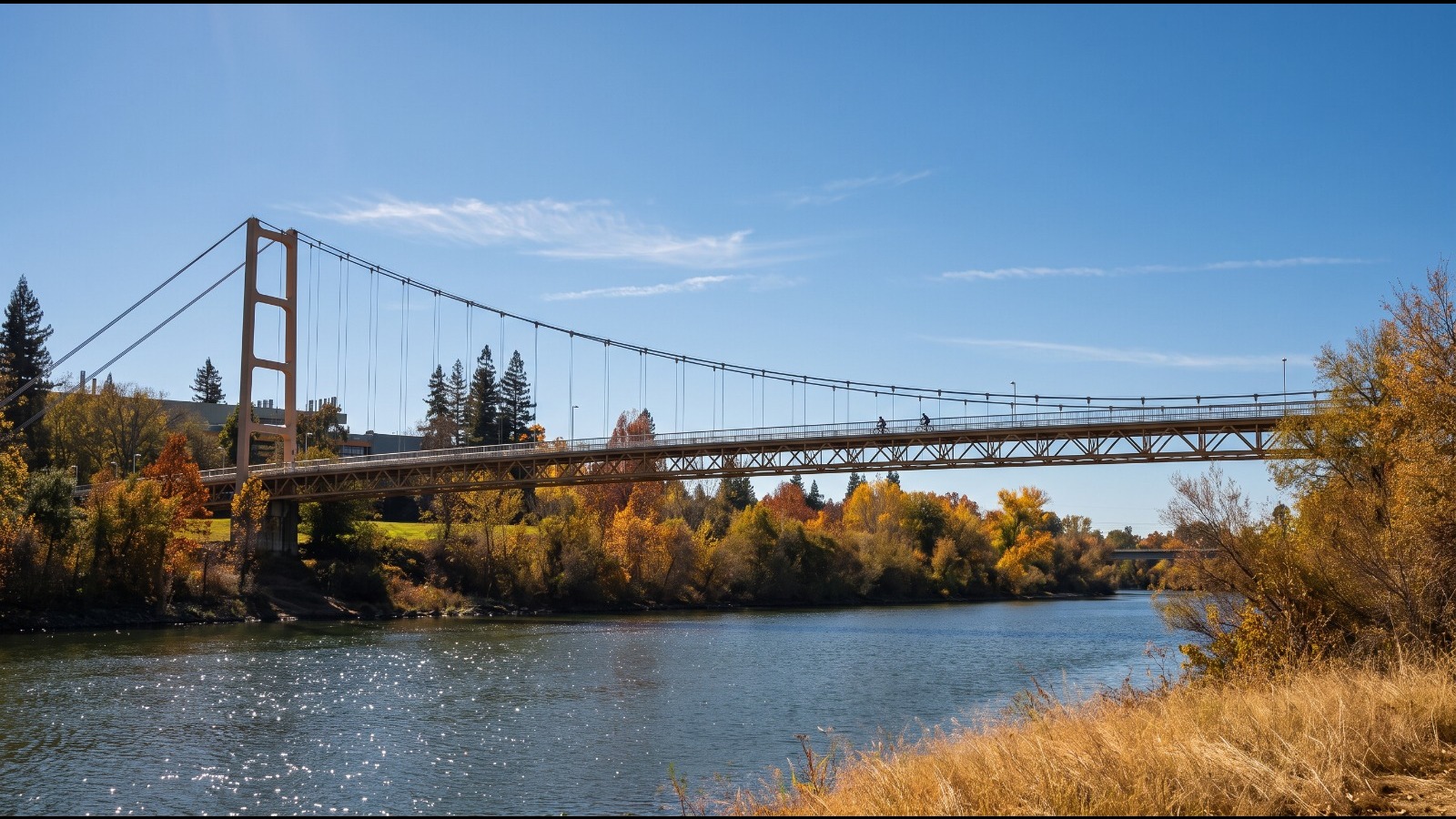
Guy West Bridge over the American River in Sacramento in midday sun, with two small riders crossing the trail bridge Photo: Houseberry
If you ride an e-bike in Sacramento, nothing about the law changed this week. What changed is that the city has started writing its own rules. On Oct. 20 the City Council's Law and Legislation Committee took up Vice Mayor Karina Talamantes's proposal on e-bikes, e-scooters and e-motos, and KCRA reported the next day that it moved forward. City staff now go off and draft. There is no ordinance yet, and the referral names no age limit, speed limit or fine.
So the rules a rider can be cited under today are still the state's, plus a short city sidewalk law and Sacramento County's rules on the American River Parkway.
Those rules already cover most of what people complain about, and the city's problem, by its own account, is that nobody has the time to enforce them. Any new rules will be felt first in central neighborhoods like Midtown, which Houseberry scores 4.4 out of 5 for amenities, against a citywide median of 2.9.
The pressure is real. UC Davis Medical Center in Oak Park treated about 340 e-bike and e-scooter cases in 2025, up from 70 in 2021, the Sacramento Bee reported on Oct. 7. Among trauma patients under 15, the share tied to these devices went from under 0.6 percent to 8.5 percent.
What California already says about your e-bike
State law sorts e-bikes into three classes, and almost every rule hangs on which one you own. The table puts the current rules side by side, drawn from the City of Sacramento's e-bike law page and Sacramento County Regional Parks.
| Device | Top assisted speed | Minimum age | Helmet | American River Parkway trail |
|---|---|---|---|---|
| Class 1 e-bike (pedal assist only) | 20 mph | None in state law | Under 18 | Allowed, 15 mph limit |
| Class 2 e-bike (throttle) | 20 mph | None in state law | Under 18 | Allowed, 15 mph limit |
| Class 3 e-bike (pedal assist) | 28 mph | 16 | Every rider | Banned |
| Motorized scooter | 15 mph | License or permit | Under 18 | Not allowed |
| E-moto (no pedals or over the limits) | No cap | Motorcycle license | Every rider | Banned |
The last row is the one that matters most. A machine with no working pedals, or one that goes past 20 mph on a throttle, is not an e-bike under California law. It is a motor vehicle. It needs registration, a license and insurance, and it cannot legally be ridden on a bike path at all. Most of the machines neighbors complain about, the ones with no pedals and motorcycle speed, are already illegal on a bike path.
Two recent laws tightened this. SB 1271, in effect since Jan. 1, 2025, stopped Class 1 and Class 3 bikes from having throttles beyond a 3.7 mph walk assist, and since Jan. 1, 2026 it requires batteries certified by an accredited lab. AB 1774, also in effect since January 2025, bans selling kits that raise an e-bike's top speed.
The newest round arrived this fall. Gov. Newsom signed SB 1167, by Sen. Catherine Blakespear, which passed the Assembly 77 to 0. From Jan. 1, 2027, a seller cannot market an over-limit machine as an e-bike, every e-bike sold needs a frame label showing its class and top speed, and police crash reports have to say which kind of device was involved. AB 2346 adds a 10 mph limit on sidewalks where riding is allowed and a speedometer on Class 2 bikes sold from 2029.
One rule people expect is missing.
California sets no minimum age for Class 1 and 2 bikes. The under-12 ban that made headlines this month, AB 2595, applies only in San Mateo County, as an optional pilot. Sacramento would most likely need its own state bill to copy it.
Parents carry real exposure either way. Under Civil Code section 1714.1, a parent can be held jointly liable for up to $25,000 per incident of a minor's willful misconduct.
Where Sacramento riders actually get in trouble
Sidewalks downtown and in Midtown
The city's own sidewalk rule is looser than most riders assume. Section 10.76.010 lets bicycles ride on any sidewalk unless the city has posted a sign banning it, and the city posts those only next to streets it rates as low-stress bikeways where it has seen conflicts. Where riding is allowed, you must yield to people walking and give an audible warning before passing. The city says e-bikes may operate wherever regular bicycles can.
E-scooters are different. State law bars them from every sidewalk, and the sidewalk citation in Sacramento runs up to $207.
The collisions happen on the busiest sidewalks in the region. Houseberry scores Midtown 4.9 out of 5 for nearby merchants and 4.6 for public spaces, and Downtown 4.9 and 4.3. Those are the blocks with the most people on foot, the most bike racks and the most scooter traffic.
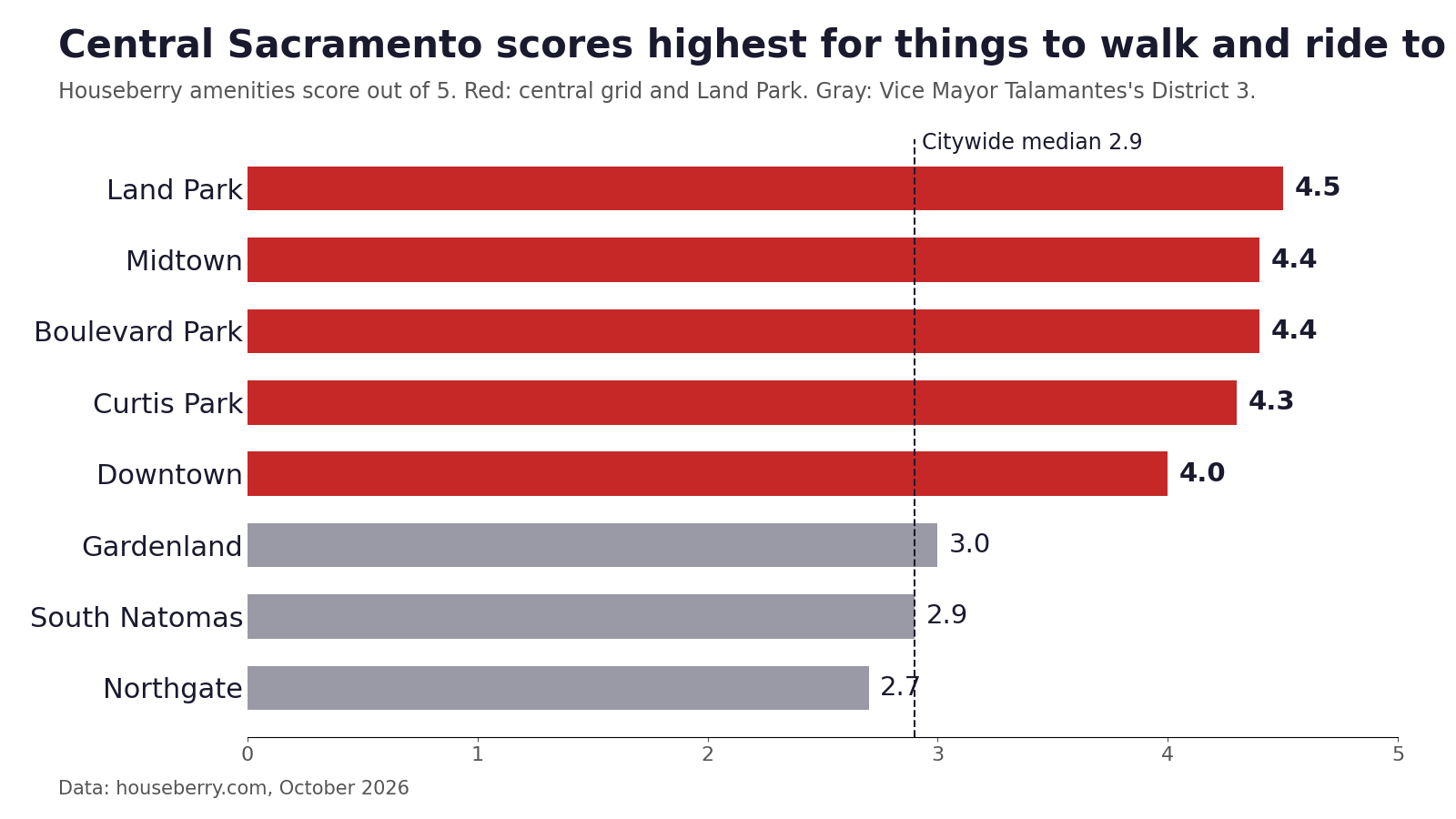
By our count, only 11 of Sacramento's 185 scored neighborhoods reach 4.0 on Houseberry's amenities score, and 7 of those 11 sit in the central city and East Sacramento, from Land Park at 4.5 through Boulevard Park at 4.4 to Downtown at 4.0. The citywide median is 2.9. Talamantes's own District 3 sits right at that median: South Natomas scores 2.9, Northgate 2.7 and Gardenland 3.0. Whatever the council writes, it will be felt most on a few dozen central blocks, and in the neighborhoods along the river trail.
The American River Parkway
The parkway is Sacramento County's, and the county has already written the strictest rules a local rider will meet. Class 3 e-bikes are banned on all Regional Parks trails, including the Jedediah Smith Memorial Trail. E-motos are banned. Every rider, on any bike, is held to 15 mph, even on a Class 1 bike that can do 20.
Rangers are enforcing it. In a June operation they wrote 7 citations and towed 4 vehicles, with some riders clocked near 30 mph, the county said. From June 19, 2026, rangers gained discretion to cite the worst cases as misdemeanors.
The city's ordinance will not change any of this, because the trail is county land even where it runs past River Park and Campus Commons.
Land Park and the city's parks
Land Park is where the gap shows. Houseberry scores it 4.6 for public spaces and 4.9 for curb appeal, and William Land Park's 160-plus acres hold the zoo, Fairytale Town and a loop road shared by joggers, strollers and bikes. The city's e-bike page publishes no separate rule for city parks. A local park rule on classes or speed is the sort of thing the new ordinance could add, and the county's 15 mph limit is the obvious model.
What the city could add, and what we would want
Talamantes has been plain that this is about enforcement. "Education at this point is not enough," she told the Bee. A city document notes Sacramento does not have enough staff, or deputized staff, to cite riders. Police have leaned on outreach, an e-bike safety video released in July 2026 and a free monthly urban riding class.
Elk Grove banned e-bikes and e-scooters from sidewalks in August unless a sign allows them, the reverse of Sacramento's default. Galt passed an urgency ordinance in late 2025 with speed and equipment rules and gave police the power to tow. Folsom wrote 14 citations in July and logged 16 e-vehicle collisions this year, and is weighing its own rules.
We think Sacramento should resist the urge to write many new rules. The worst behavior on our streets, riders on throttle machines doing close to 30 on the parkway, is already illegal under state law. A city ordinance that adds tow and impound power for e-motos, sets a park speed limit that matches the county's, and pays for someone to enforce both would do more than a citywide age ban on ordinary e-bikes. Sacramento has spent years adding protected bike lanes on the downtown grid to get people out of cars. Punishing the commuter on a Class 1 bike for what the e-moto rider did would undo some of that.
The trade-off is honest. Enforcement costs money the city has been short on, and a towing rule needs a place to store what gets towed.
Is there an e-bike rebate in Sacramento?
Not one you can apply for today. The state's E-Bike Incentive Project, run by the Air Resources Board, last opened a voucher window on May 29, 2025, and its news page lists no later round as of Oct. 22, 2026. Any voucher bike must carry a UL 2849, UL 2271 or EN 15194 battery certification, which also matches what state law now requires.
Does an e-bike need a license in Sacramento?
Not for a true Class 1, 2 or 3 bike. If it has no working pedals or goes past the class limits, it is a moped or motorcycle in the eyes of the law, and it needs a license and plates.
Staff will bring options back to the committee or the full council, with no date set. Until then, if you are choosing where to live by how easy it is to leave the car at home, Houseberry's Sacramento rankings show how all 185 neighborhoods compare, and the Houseberry map shows how close each one sits to the parkway.
Sources
- City of Sacramento, Councilmember proposal 2026-009, file 2026-01811, Law and Legislation Committee, Oct. 20, 2026
- Sacramento Bee, "Sacramento councilmember pushing for tougher e-bike, e-moto enforcement as injuries surge," Oct. 7, 2026
- City of Sacramento, Electric Bicycle Safety and Law, and Sacramento City Code section 10.76.010
- Sacramento County Regional Parks, e-bike rules and June 8, 2026 enforcement release
- Office of Sen. Catherine Blakespear, SB 1167 release, Aug. 28, 2026
- KQED, "California cracks down on e-motos, youth e-bike riders with new laws," Oct. 1, 2026
- California Air Resources Board, E-Bike Incentive Project news
The Houseberry Research Team is Houseberry's reporting team: Bay Area real estate analysts, data specialists and longtime local market watchers. Every day we check the public record: building permits, city council and planning agendas, county recorder filings, state housing bills, police incident data and school results. Then we tie each story to what it means for specific neighborhoods, using Houseberry's own neighborhood data on prices, appreciation, safety, schools and amenities. Questions or corrections: Contact us.
Map of Sacramento Neighborhoods
Loading map...
View Full Map
Top Neighborhoods in Sacramento, CA




All information provided on this website including but not limited to - school ratings, safety, amenities, user opinions, and property data - is for general informational purposes only. We do not guarantee its reliability, accuracy, or completeness. Users should independently verify information and consult appropriate professionals as needed. By using this website, you agree Houseberry is not responsible for actions, decisions, or consequences arising from reliance on the information provided
houseberry.com - CA DRE# 01847391
 Bay East ©2025. CCAR ©2025. bridgeMLS ©2025. Information Deemed Reliable But Not Guaranteed. This information is being provided by the Bay East MLS, or CCAR MLS, or bridgeMLS. The listings presented here may or may not be listed by the Broker/Agent operating this website. This information is intended for the personal use of consumers and may not be used for any purpose other than to identify prospective properties consumers may be interested in purchasing. Data last updated at October 22, 2026 12:00 AM