San Francisco's Prop C doubles its housing trust fund, slowly
Prop C would take San Francisco's Housing Trust Fund from about $52 million a year to $125 million by 2035 and extend it to 2058. Here is what the fund has paid for since 2013, what Prop C really adds, and the case against it.

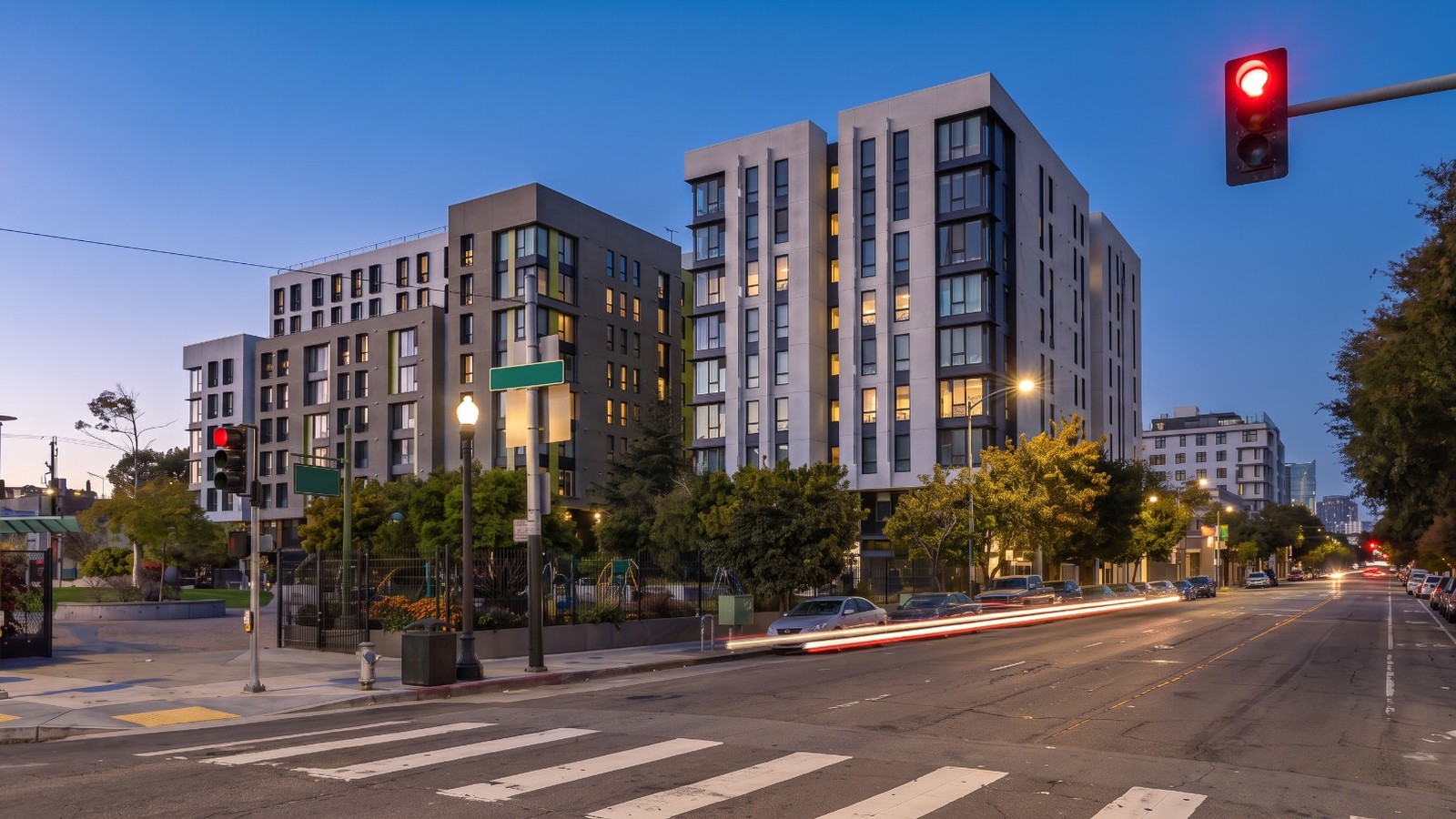
AI-rendered blue-hour view of new affordable apartment buildings on Folsom Street at 17th Street in San Francisco's Mission District, beside In Chan Kaajal Park Photo: Houseberry
Stand at 17th and Folsom after dark and count the lit windows. The mid-rise apartment buildings rising behind In Chan Kaajal Park are some of the newest affordable apartments in the Mission, and one of them, 127 homes at 2060 Folsom Street, drew money from a city account most voters have never heard of. San Francisco's Housing Trust Fund puts about $52 million a year into homes like these. On November 3, Proposition C asks voters to raise that to $125 million and keep it going until 2058.
The fund matters most in the places where it has spent. The typical Inner Mission home was worth about $1.19 million in September 2026, according to Houseberry data, up from $1.12 million eleven months earlier. Citywide the typical home hit about $2.2 million, $310,000 more than in October 2025, on Houseberry's San Francisco city page. This is a story about whether the city can keep paying its share of a $1 million apartment when the market keeps moving the goalposts. Prop C is the city's answer, and the answer is slower than the headline number suggests.
The real increase is $60 million, and it arrives in 2035
The headline comparison, $52 million today against $125 million later, makes Prop C look like a $73 million raise. It is smaller. The city's current formula already grows the fund every year with general fund revenue, and Controller Greg Wagner's statement puts the no-change path at about $65 million by 2034-35. Prop C's version reaches $125 million that same year. The gap is about $60 million.
Nothing changes before July 2028. Then each year's payment becomes the larger of two numbers: last year's payment plus a share of growth in property tax revenue, or last year's payment grown at the general fund's rate. Once it clears $125 million, increases are capped at 3 percent a year.
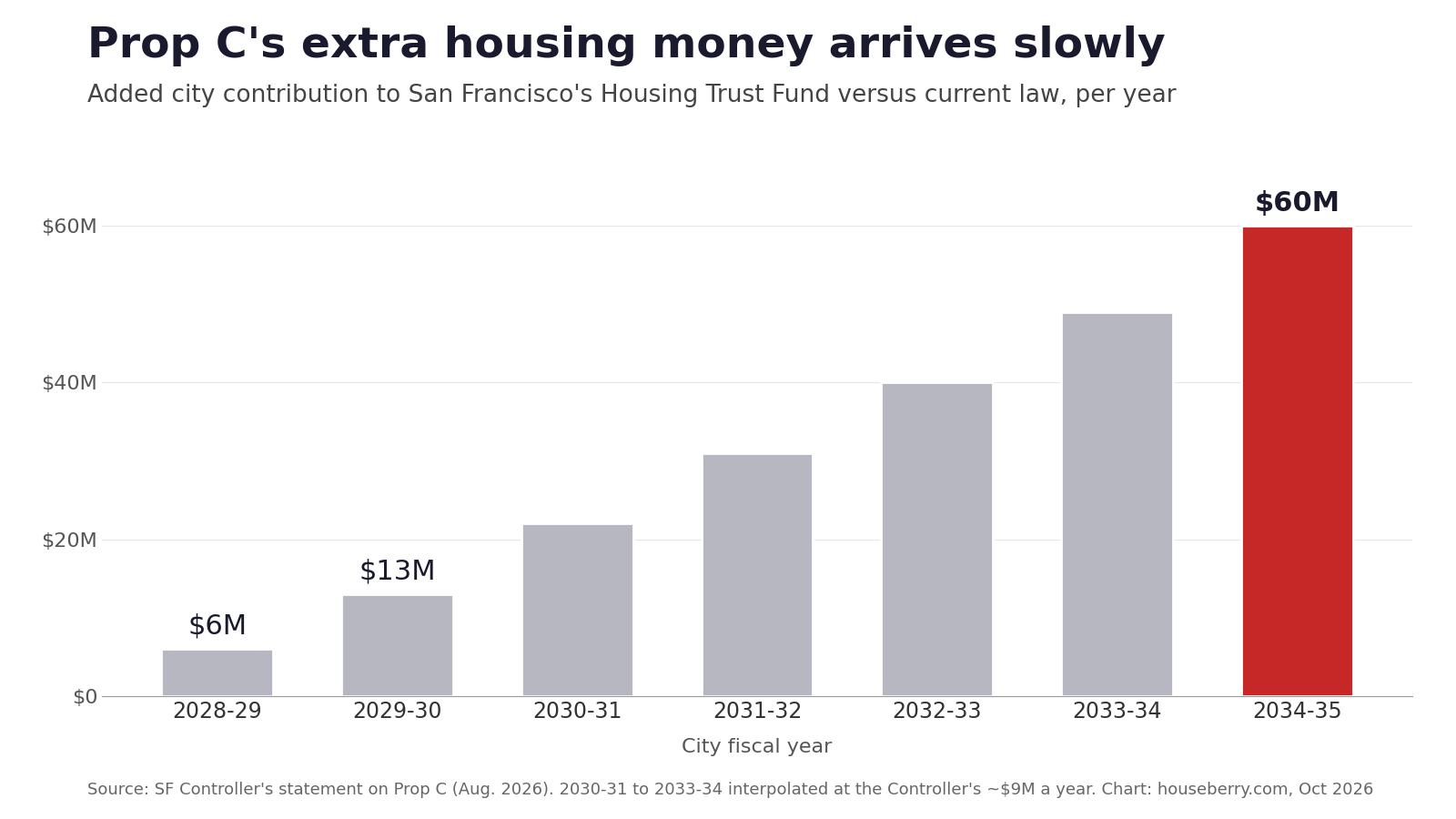
Add the Controller's year-by-year figures and Prop C puts roughly $221 million more into the fund through 2034-35 than current law would, by our sum. The bigger money comes after 2043, when today's fund would simply expire. Prop C keeps it alive for 15 more years at $125 million and up.
There are two escape hatches. The Mayor or the Board can freeze the payment when the city projects a deficit above $250 million, and cut it by up to 10 percent in a year the city may draw on its Rainy Day Reserve. The Controller still flags Prop C as out of step with the city's non-binding policy against new set-asides. Voter-mandated spending already ties up about $2 billion, or 30 percent, of a roughly $7 billion general fund.
What $270 million has bought since 2013
Voters created the fund in 2012, also as a Prop C, with 65 percent of the vote. It started at $20 million in 2013 and rose about $2.8 million a year to $50.8 million in 2024-25. The city's own reports are the best record of where that went.
| Period | Housing dollars | Homes in funded buildings | Down payment loans | Other |
|---|---|---|---|---|
| 2014 to March 2018 | $39.9 million, 27 buildings | more than 2,295 built or preserved | 129 households | 15,892 people helped with eviction prevention |
| July 2018 to June 2023 | $99.3 million, 32 buildings | about 1,380 | 47 households | $28.6 million for eviction defense and tenant help |
The 2014 to 2018 report lists 27 buildings, from 1880 Pine Street to the Potrero Terrace rebuild. The 2018 to 2023 report names 2060 Folsom (127 homes), 455 Fell in Hayes Valley (108), 1939 Market (185) and 555 Larkin in the Tenderloin (80), plus the Hayes Valley North and Plaza East public housing rebuilds.
Read those totals carefully. The trust fund is gap money. It covers a slice of each building and state tax credits, bonds and federal money cover the rest. By our math it put about $17,000 into each home it touched from 2014 to 2018 and about $72,000 per home from 2018 to 2023. So "the fund built 3,600 homes" overstates it. "The fund helped close the financing on buildings holding about 3,600 homes" is closer, and the two reports may overlap.
The per-home cost is the opponents' best point. Casa Adelante at 1515 South Van Ness, 168 affordable homes that broke ground in April 2025, costs $167.7 million, the Mayor's office said. That is about $998,000 a home.
The trade behind Prop C
Prop C is half of a deal. In May, Mayor Daniel Lurie and Supervisor Myrna Melgar agreed with nonprofit housing groups that the city would cut what private builders must set aside as below-market homes, from 15 percent to 5 percent, and that in exchange the trust fund would grow. The Board passed the cut to 5 percent on July 14. That cut is already law and does not depend on Prop C.
The logic: make market-rate buildings pencil again, and replace the hidden subsidy those buildings used to carry with public money the city can count on and borrow against. Lurie also plans a $70 million preservation bond backed by trust fund revenue.
Prop C is easy to confuse with Prop I on the same ballot. Prop I would lock about $120 million a year in transfer tax money from sales over $10 million into affordable housing, SF Standard reported. Lurie and the police and firefighter unions oppose I and back C. They are separate votes, and both could pass. Our Bay Area ballot guide lists every housing measure this fall.
The case against, taken seriously
The San Francisco Republican Party filed the only argument against Prop C in the voter information pamphlet. It calls the fund a failure, notes the cost of an affordable unit runs close to $1 million, and objects that the measure sets no unit target or cost benchmark. It also opposes raising the down payment loan cap from 120 to 200 percent of area median income.
Some of that holds up. Prop C sets no minimum number of homes and no cost ceiling, and the Casa Adelante numbers back the cost complaint. A unit target written into the charter would be a reasonable thing to want.
One figure does not hold up. The argument says 200 percent of median is up to $402,000 for a family of four. The city's 2026 income table puts it at $324,200, up from $194,500 at 120 percent. That is $78,000 less than the argument claims.
We think Prop C is the right call. San Francisco has to plan for more than 46,000 lower- and moderate-income homes by 2031 under state rules, and local bond money for them is running low. The city just told private builders to carry less of that load. Someone has to pay for it, and a formula that grows with tax revenue, can be frozen in a bad year and sits in the city charter is the most honest way to do it. The cost problem is real. Killing the funding does not fix it.
Where the money lands, by neighborhood
The buildings named in the city's trust fund reports sit mostly in the Tenderloin, South of Market, the Mission, Hayes Valley, Potrero Hill and Visitacion Valley's Sunnydale. Here is what the typical home in those places was worth in September 2026, from Houseberry's neighborhood price histories, with October 2025 for scale.
| Neighborhood | Typical home, Sep 2026 | Oct 2025 | Houseberry overall score |
|---|---|---|---|
| Tenderloin | $499,000 | $436,000 | 2.0 |
| South of Market | $767,000 | $744,000 | 2.1 |
| Visitacion Valley | $1.05 million | $1.00 million | 2.6 |
| Inner Mission | $1.19 million | $1.12 million | 2.1 |
| Hayes Valley | $1.25 million | $1.21 million | 3.1 |
| Potrero Hill | $1.55 million | $1.33 million | 3.1 |
| San Francisco citywide | $2.20 million | $1.89 million | 3.5 |
The down payment change is the piece buyers will notice. At 200 percent of median, a family of four earning $324,200 would face a citywide typical price of about 6.8 times its income, by our math. In Visitacion Valley, where Houseberry's safety score is 3.7 out of 5, the ratio is about 3.2. Every neighborhood's typical price is sorted on Houseberry's most affordable San Francisco neighborhoods page, and current below-market listings are in our BMR condo roundup.
Quick answers
Does Prop C raise taxes?
No. It moves existing general fund money into the trust fund, which leaves that much less for everything else the city pays for.
Can a future mayor skip the payments?
Only within limits. A projected deficit above $250 million allows a freeze, and a Rainy Day Reserve year allows a cut of up to 10 percent.
When would the extra money show up?
Starting in July 2028, about $6 million the first year, reaching about $60 million more than current law in 2034-35.
The fund that helped finance the buildings at 17th and Folsom expires in 2043 if nothing changes. Prop C buys it 15 more years and about twice the budget, and whether that money buys homes or just more expensive ones is the question the city will have to answer in public. Before you vote, see how every San Francisco neighborhood scores on safety, schools and price.
Sources
- San Francisco Department of Elections, Voter Information Pamphlet, November 3, 2026, Proposition C digest, Controller's statement and arguments, pages 78 to 81
- San Francisco Controller, statement on Proposition C, August 10, 2026
- Mayor's Office of Housing and Community Development, Housing Trust Fund report, 2014 to 2018 and five-year report, 2018 to 2023
- MOHCD, 2026 income limits by area median income, effective June 1, 2026
- KALW, San Francisco's Proposition C explained, October 19, 2026
- San Francisco Examiner, Supervisor wants city voters to grow Housing Trust Fund, May 5, 2026
- SF Standard, Prop I and the police and fire unions, August 13, 2026
- Houseberry city and neighborhood price histories, September 2026
The Houseberry Research Team is Houseberry's reporting team: Bay Area real estate analysts, data specialists and longtime local market watchers. Every day we check the public record: building permits, city council and planning agendas, county recorder filings, state housing bills, police incident data and school results. Then we tie each story to what it means for specific neighborhoods, using Houseberry's own neighborhood data on prices, appreciation, safety, schools and amenities. Questions or corrections: Contact us.
Map of San Francisco Neighborhoods
Loading map...
View Full Map
Top Neighborhoods in San Francisco, CA





All information provided on this website including but not limited to - school ratings, safety, amenities, user opinions, and property data - is for general informational purposes only. We do not guarantee its reliability, accuracy, or completeness. Users should independently verify information and consult appropriate professionals as needed. By using this website, you agree Houseberry is not responsible for actions, decisions, or consequences arising from reliance on the information provided
houseberry.com - CA DRE# 01847391
 Bay East ©2025. CCAR ©2025. bridgeMLS ©2025. Information Deemed Reliable But Not Guaranteed. This information is being provided by the Bay East MLS, or CCAR MLS, or bridgeMLS. The listings presented here may or may not be listed by the Broker/Agent operating this website. This information is intended for the personal use of consumers and may not be used for any purpose other than to identify prospective properties consumers may be interested in purchasing. Data last updated at October 22, 2026 12:00 AM