Gilroy's new civic center would replace Wheeler with a pool
Gilroy's council adopted a plan to replace City Hall, Wheeler Auditorium and the senior center with a new City Hall, a swim center and a park. Here is what changes on which blocks, what it costs and when voters get a say.

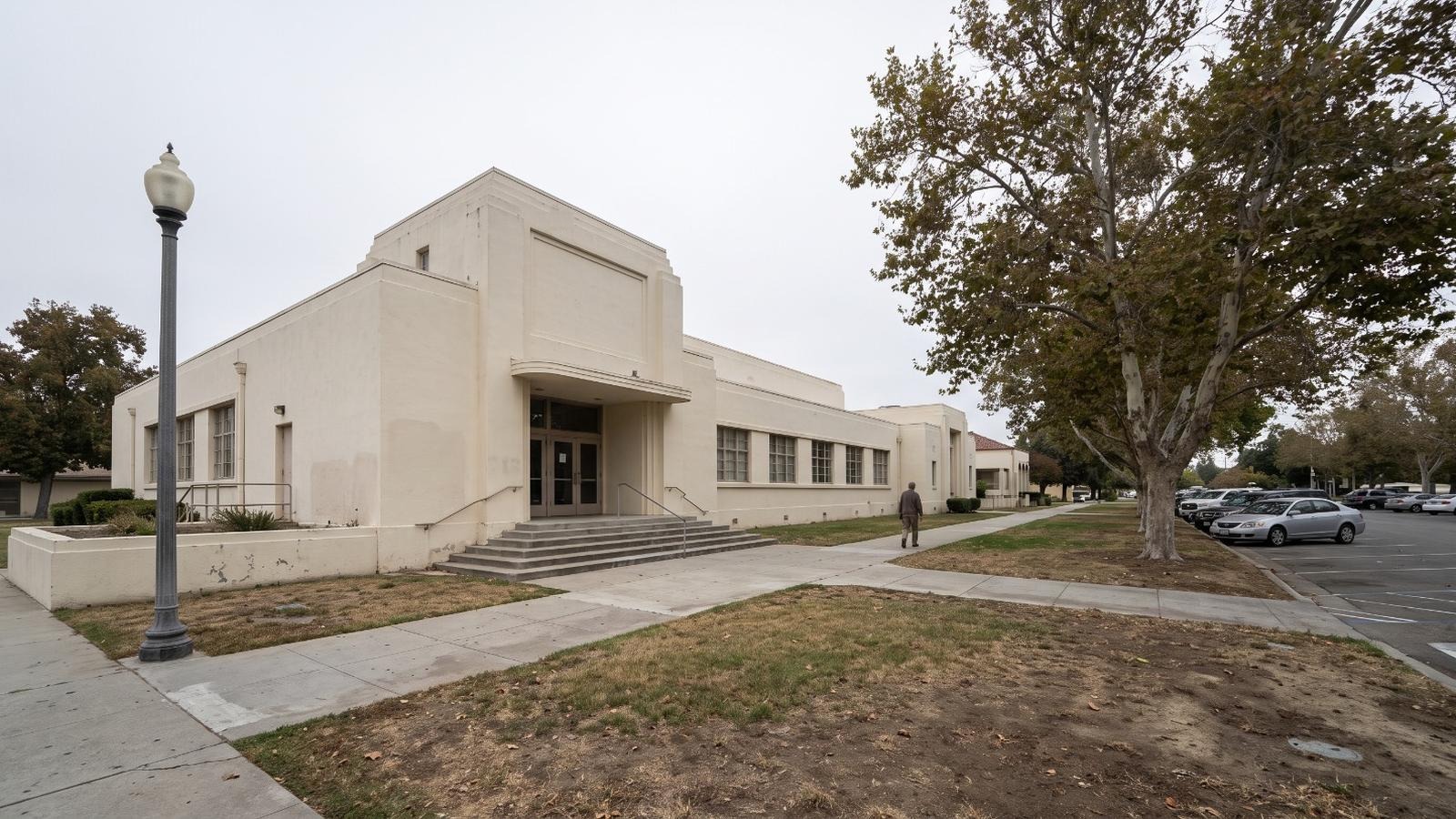
AI-rendered view of Wheeler Auditorium on West Sixth Street in Gilroy under an overcast sky, with the civic center parking lot to the right Photo: Houseberry
Wheeler Auditorium has stood on West Sixth Street in Gilroy since 1940, a cream Streamline Moderne hall where the town held dances, wedding receptions, the Christmas bazaar and, lately, pickleball. On Oct. 5 the Gilroy City Council voted to replace it with a two-story recreation and swim center.
That vote adopted the city's Civic Center Master Plan, a 14-acre redo of the three blocks between Sixth, Seventh, Church and Dowdy streets. City Hall, its annex, Wheeler and the senior center would all come down. A new City Hall, a pool complex, a community center with a theater and a park about the size of a football field would go up. City staff put the cost of building all of it today at $230 million, according to the Gilroy Dispatch.
Nothing has been funded. This is a plan for downtown Gilroy's west side, and the real decision is a bond measure the city is aiming at the 2028 ballot. The site sits two blocks west of Monterey Street, on the edge of Downtown Gilroy, where Houseberry's price history shows the typical home rose about 9 percent in a year, to roughly $932,000 in September 2026.
What comes down and what goes up
Four buildings, a parking lot and one block of Hanna Street are on the list. The city's Draft EIR, its environmental review, measures them at 73,524 square feet combined. City Hall, built in the 1960s, is the biggest at about 27,000 square feet. Its annex adds 16,900. Wheeler is 18,575. The senior center is 11,071.
The replacements are larger, and they sit in different places on the site.
| Building | Size | Where | What is in it |
|---|---|---|---|
| New City Hall | about 47,500 sq ft, two stories | central block, replacing today's City Hall | Council chambers facing the park, permit counters, Public Works, Finance, Community Development, Fire Administration and the emergency operations center under one roof |
| Recreation and aquatics center | about 42,600 sq ft, two stories | northeast corner at Church and Sixth, Wheeler's site | Eight-lane 25-yard outdoor competition pool, a recreation pool, a gym with an elevated running track, weight room and three multipurpose rooms |
| Multi-generational community center | about 41,600 sq ft | Church and Seventh | Senior lounge and activity room, teen center, a dining hall for about 150, an art studio and a 250-seat theater |
| Civic park and paseo | about a football field | between the buildings | Shaded walk, a walking loop, a water play feature and bike parking |
Parking goes from scattered lots to about 425 spaces in two main areas, with room to stack 180 more in a structure if the city ever needs them, according to the draft master plan. Fourteen driveways shrink to five. The block of Hanna Street between Sixth and Seventh disappears into the park.
The senior center does not vanish. It moves into the new community center, at roughly 2,000 square feet of dedicated senior rooms plus the shared dining hall. Wheeler's stage moves there too, as the 250-seat theater.
Wheeler is the one real fight
The environmental review found exactly one impact the city cannot mitigate: losing Wheeler, which the council designated a historic resource in 1983. The architects Binder and Curtis designed it in 1940, according to the Pacific Coast Architecture Database.
The Gilroy Historical Society asked the city to pick the review's Alternative 2, keeping Wheeler in place and redesigning around it. Its president, Joan Lewis, also argued that a pool at Church and Sixth would bring traffic and noise to two busy streets, and suggested the Gilroy Sports Park instead. City staff and the consultants found that renovating Wheeler would cost as much as or more than tearing it down and building new.
The council split the difference without saying so. Mayor Greg Bozzo's motion added a requirement to run a fresh cost analysis of Wheeler's options closer to construction. Councilmember Dion Bracco voted yes and still told the room that "Wheeler Auditorium has a lot of significance for the people of this community."
We think the plan is right about the site. A pool, a gym and a city hall a short walk from the Caltrain station and the Monterey Street storefronts will put more people on downtown sidewalks than the same buildings at the sports park on the south edge of town ever would. Bozzo's addendum is the right hedge. If the numbers move by 2028, Wheeler should get another look before a demolition permit is signed.
$230 million against a city of 17,500 households
Gilroy has about 60,800 residents and 17,459 households, by the Census Bureau's count. Spread evenly, $230 million is about $3,800 a resident, or $13,200 a household, before any interest. A general obligation bond in California needs two-thirds of voters to pass and gets repaid through property tax bills, so the people who own homes near the site would carry part of it.
Divide the price by the floor area and the plan comes to roughly $1,750 a square foot. That number overstates the buildings alone, since it also covers the park, the parking and the demolition, but it shows why the city is not starting with a shovel.
The same council meeting offered a warning. Staff priced the proposed ice rink at the sports park at $64 million against about $49 million in borrowing capacity, and recommended pausing it as financially infeasible for now, according to a meeting summary. A plan more than three times that size has no money attached at all.
Gilroy has done this before. The 2002 master plan carried an estimate of $50 million to $70 million and a 2039 finish line, according to Morgan Hill Times reporting from 2003. It produced the police station, at about $26.7 million, and the library, at about $18.2 million. City Hall, Wheeler and the senior center were also on that list. They are still standing.
Church Street, Dowdy Street and the prices nearby
For now, very little changes on the ground. The Gilroy Library's separate renovation, paid for with leftover bonds from its original construction, was scheduled to start in fall 2026 in the city's February presentation. Everything else waits on a financing plan and design contracts.
The homes on Dowdy, Church and the streets off Sixth and Seventh are the ones that would live with years of construction, and then with a pool, a gym and a park across the street. That trade cuts both ways. Houseberry rates Downtown Gilroy at 2.1 out of 5 overall, last of the city's 11 ranked neighborhoods, with a 1.7 safety score and a 4.1 for nearby merchants. A public space score of 2.7 is exactly the number a civic park is meant to move.
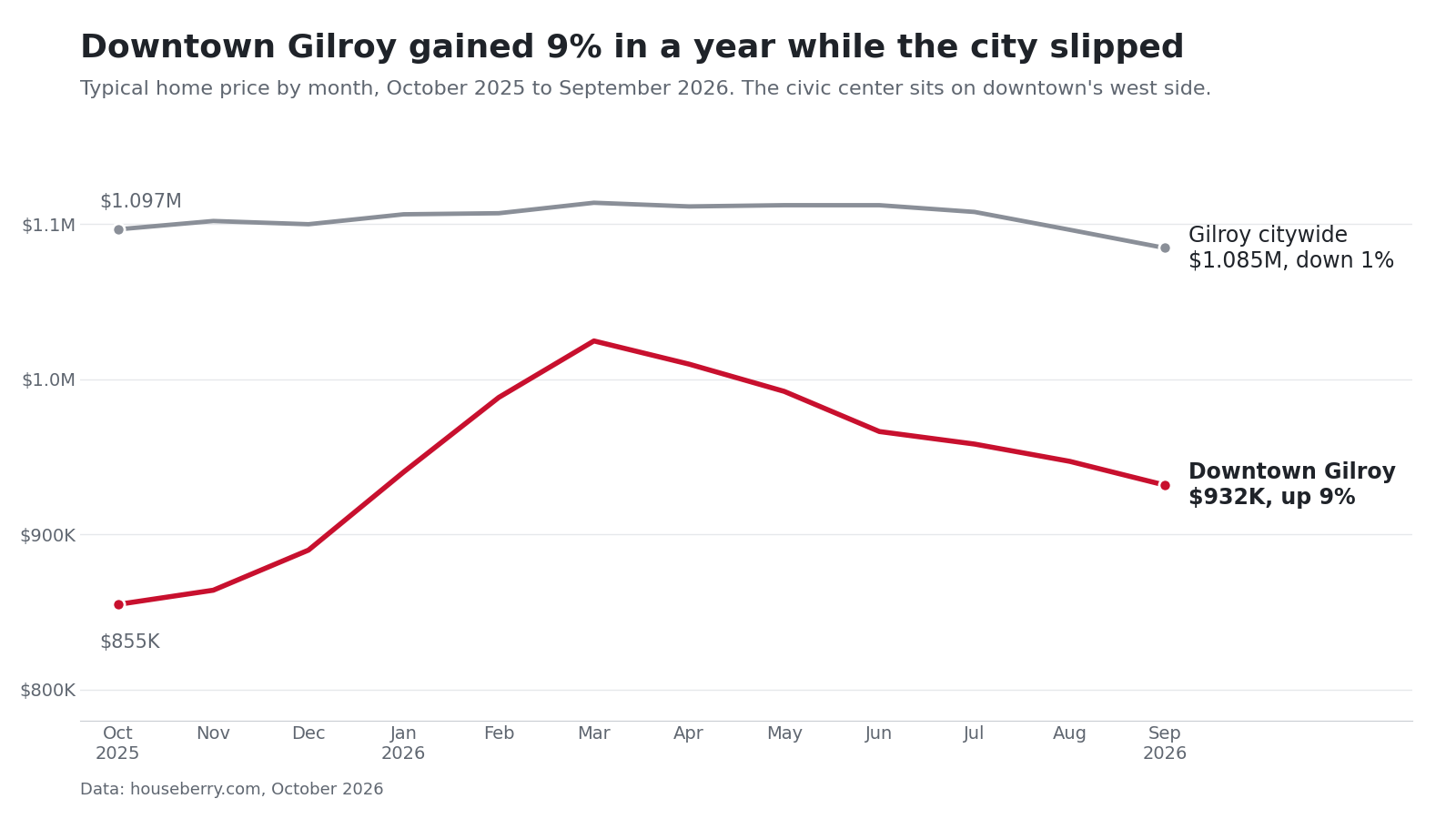
Prices downtown already moved before any of this. Houseberry's price history puts the typical Downtown Gilroy home at about $855,000 in October 2025 and about $932,000 in September 2026, after a spring peak near $1.02 million. Over the same months the Gilroy citywide figure slipped about 1 percent, to $1.085 million. That leaves downtown about 14 percent, or roughly $153,000, below the city as a whole. Just west, Miller Avenue went the other way, down about 5 percent to roughly $981,000.
None of that gain comes from a plan with no budget. It does mean a buyer looking at the older blocks near Church Street is paying for proximity to downtown, and a funded civic center would add a pool and a park to that list. We have covered Gilroy's other big bets this year, from the Hecker Pass builder's remedy fight to the high-speed rail station downtown. This one moves slowest.
Questions Gilroy residents are asking
When would construction start? No date is set. The city's next steps are a financing plan and design contracts, and its stated goal is a 2028 ballot measure.
Is the police station or the library affected? No. Both stay, and the library's own renovation is a separate project.
Where does the senior center go during construction? The plan does not say. Phasing has not been decided, and staff said the work could be split into stages in the City Council's next five-year capital budget.
Can Wheeler still be saved? Yes, in theory. The council required a new cost analysis of Wheeler's options before construction, and no demolition permit can be issued until a historian documents the building to federal survey standards.
If you own near Sixth and Church or are shopping the older streets west of Monterey, the 2028 ballot is the date that matters, and the Gilroy neighborhood rankings show how Downtown Gilroy stacks up against the 10 other neighborhoods the money would come from.
Sources
- CEQAnet, Gilroy Civic Center Master Plan, SCH 2025091066, Notice of Determination
- City of Gilroy, Civic Center Master Plan project page
- City of Gilroy, Draft Civic Center Master Plan, August 2025
- City of Gilroy, Draft Environmental Impact Report
- City of Gilroy, February 25, 2026 community meeting presentation
- Gilroy Dispatch, Gilroy City Council adopts new Civic Center Master Plan, Oct. 7, 2026
- Gilroy Dispatch, Letter: Preserve Wheeler Auditorium's place in Gilroy history, April 2, 2026
- U.S. Census Bureau, QuickFacts: Gilroy city, California
The Houseberry Research Team is Houseberry's reporting team: Bay Area real estate analysts, data specialists and longtime local market watchers. Every day we check the public record: building permits, city council and planning agendas, county recorder filings, state housing bills, police incident data and school results. Then we tie each story to what it means for specific neighborhoods, using Houseberry's own neighborhood data on prices, appreciation, safety, schools and amenities. Questions or corrections: Contact us.
Map of Gilroy Neighborhoods
Loading map...
View Full Map
Top Neighborhoods in Gilroy, CA



All information provided on this website including but not limited to - school ratings, safety, amenities, user opinions, and property data - is for general informational purposes only. We do not guarantee its reliability, accuracy, or completeness. Users should independently verify information and consult appropriate professionals as needed. By using this website, you agree Houseberry is not responsible for actions, decisions, or consequences arising from reliance on the information provided
houseberry.com - CA DRE# 01847391
 Bay East ©2025. CCAR ©2025. bridgeMLS ©2025. Information Deemed Reliable But Not Guaranteed. This information is being provided by the Bay East MLS, or CCAR MLS, or bridgeMLS. The listings presented here may or may not be listed by the Broker/Agent operating this website. This information is intended for the personal use of consumers and may not be used for any purpose other than to identify prospective properties consumers may be interested in purchasing. Data last updated at October 22, 2026 12:00 AM