80 Homes on the Closed Glider School Site in San Jose
San Jose planners cleared 80 homes on the Glider Elementary campus that Oak Grove School District sold for $26.6 million. What that trade actually means for Blossom Valley, and the affordable number nobody has flagged.

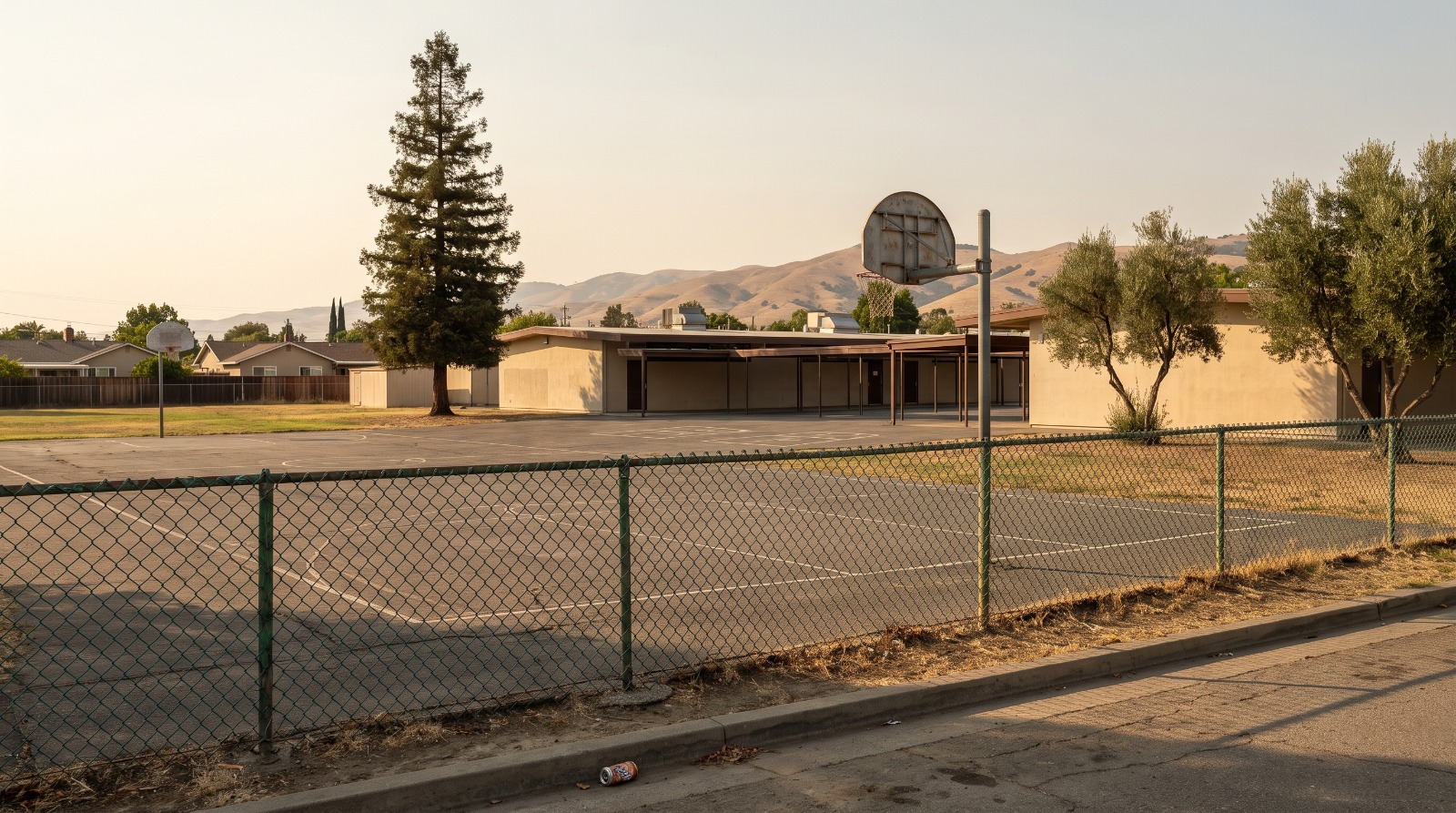
The closed Glider Elementary campus in South San Jose behind a chain-link fence, the site where 80 homes are now planned. Photo: Houseberry
Anyone who bought on Cozy Drive after 2018 has never watched a child walk into the school at the end of the block. Glider Elementary closed that June. On Wednesday, August 26, San Jose’s Planning Commission cleared the plan that replaces it: 80 homes on 9.51 acres, on land Oak Grove School District sold to a developer for $26.6 million. City Council still has to sign off, and no date is on the calendar.
Here is the part worth sitting with. This is not a one-off, and it is not really a fight about 80 houses. Oak Grove teaches 2,339 fewer children than it did a decade ago. Santa Clara County has lost more than 45,000 public school students since 2014-15. Districts across the South Bay are converting closed campuses into housing because the campuses are empty and the budgets are not balanced. And the detail nobody seems to have flagged at Glider is that the number of deed-restricted affordable homes in the plan appears to have dropped from 16 to 11 somewhere between 2024 and 2026.
What Oak Grove sold, and what the $26.6 million is supposed to buy
The short answer: nine and a half acres at 511 Cozy Drive, at the corner of Cozy and Glider drives in Council District 10, sold to The True Life Companies on a unanimous board vote on January 20, 2022.
The longer answer is a nine-year paper trail, and it matters because the neighbors’ central complaint has always been about process. Oak Grove convened a school consolidation committee in 2017. Glider closed on June 30, 2018, after 38 years. The district tried to lease the site that year and got no viable offers. A 7-11 advisory committee, the body California law uses to review surplus school property, was appointed in November 2019. The board formally declared Glider surplus in January 2020, adopted its intent-to-sell resolution that March, reviewed five proposals in May 2021, and picked True Life that June.
What the money does is much less specific than the price. Trustees have described it as funding school modernization, staff retention and student support services, which is another way of saying it goes into a district that is short on money. Oak Grove adopted a fiscal solvency plan on December 11, 2025 at the direction of the Santa Clara County Office of Education, targeting about $3 million in cuts in 2026-27 and another $2 million in 2027-28. One national outlet has reported that Oak Grove faces $11 million annual deficits. The district’s own published plan does not say that, and when a district filing and a news summary disagree about the size of a hole, the filing is the one to trust.
There is one line from the early days that has aged badly. In September 2021, then-superintendent Jose Manzo assured the community that the purchase and lease proposals the district had received “do not propose high-density development.” At 8.41 homes per acre, with 64 of the 80 detached, that assurance is technically intact. It is also not what the neighborhood heard.
The affordable count appears to have gone from 16 to 11
This is the number we could not find anyone else reporting, and it is the one we would put to the city first.
The Notice of Preparation circulated in September 2024 describes 16 units, 20 percent of the project, deed-restricted for lower-income households. The Draft Environmental Impact Report published on January 9, 2026 describes 11 units, 13 percent. Both documents sit on the state’s CEQAnet clearinghouse under the same file number. Five affordable homes are not a rounding error in a county where a below-market unit is effectively a lottery ticket.
We are flagging this as a discrepancy rather than a finding. It could be a correction, a design change, or a transcription error in a state database. The Final EIR, amended on August 14, 2026, is where the real number lives, and the Council hearing is the place to ask out loud. But if the plan really did shed five affordable homes on its way to approval, that is the most consequential thing that has happened to this project in two years, and it happened without a single headline.
Oak Grove teaches 2,339 fewer children than it did ten years ago
The reason there is a closed school here at all is that there are not enough children to fill it.
Oak Grove enrolled 10,700 students in 2015-16. In 2025-26 it enrolled 8,361. That is a 22 percent decline in a decade, and it is not a local quirk. Santa Clara County lost more than 45,000 public school students between 2014-15 and 2024-25, including 4,198 in the 2025-26 year alone. California lost 74,961 students last year, its steepest single-year drop since 2021-22. Campuses closed at a rate of 79 in 2024, 79 in 2025 and 73 through July 2026.
Glider’s own numbers tell the story more bluntly than any of that. In its final years the school enrolled roughly 620 students, and only 237 of them came from the surrounding neighborhood. The rest were transfers in. A neighborhood school drawing two-thirds of its enrollment from somewhere else is already a district asset rather than a neighborhood one, whatever it feels like from the sidewalk.
And Oak Grove is not the only district running this math. San Jose Unified voted 3 to 2 in March 2026 to close five elementary schools. Cambrian did the same trade Oak Grove is doing, four years earlier and on a smaller lot.
| Glider Elementary | Metzler School | |
|---|---|---|
| District | Oak Grove | Cambrian |
| Board approved sale | January 2022 | 2022 |
| Buyer | The True Life Companies | Robson Homes |
| Price | $26.6 million | About $10 million |
| Land sold | 9.51 acres | 3 acres of a 10-acre site |
| Homes planned | 80 | 39, counting ADUs |
| Deed-restricted affordable | 11 | 4 townhouses |
The comparison that matters here is not the price. It is the density. Cambrian fit 39 homes onto three acres. Oak Grove’s site is more than three times larger and carries barely twice as many. Whatever else Glider is, it is not a dense project.
What the neighbors are actually arguing about
Traffic, mostly, and the size of the park.
The organized opposition has been going since 2021, first as the Save Glider School Committee and now as Glider Neighborhood Advocates. Their asks have been consistent: preserve the neighborhood’s character, get real consolidated open space, and match the number of new homes to the density of the streets around them. At the August hearing, one resident argued that the city’s traffic study leaned on counts collected while the school sat closed, which would understate the baseline, and that the local power grid and sewer lines are already overburdened. Several asked the Commission to cap the project at 62 homes instead of 80.
The traffic point is the fair one. Counting cars at a closed school and calling that the before picture is a real methodological problem, and it is exactly the kind of thing a Council hearing can fix by conditioning the approval. The park complaint is fair too. The plan sets aside 0.68 acres of public park, about 7 percent of the site, on land that used to hold a full elementary school play yard.
The density argument is the weakest of the three. Sixty-four detached houses and 16 attached ones, in a part of San Jose that is already detached houses, is not a change in kind. And there is the other side of a vacant campus, which a different neighbor raised at the same hearing after a break-in on the empty property. Nothing sits emptier than a closed school.
Where we land: the site should be housing. The questions worth pressing at Council are the traffic baseline, the affordable count, and who is maintaining that park in year twenty.
What it does to Blossom Valley
Probably very little to prices, and rather more to the question of which school a future kid actually attends.
Blossom Valley had a median home price of $1.54 million in July 2026, up from $1.49 million a year earlier, running just under the $1.63 million San Jose citywide median. Next door, Edenvale sits at $1.35 million and fell about $100,000 over the same twelve months. Eighty new homes of 1,233 to 2,234 square feet, arriving over a build the developer estimates at 44 months, will not move a market that size in either direction. Nobody should buy or hold on this news.
The school picture is the part worth understanding, and it is genuinely confusing here. Blossom Valley is served by three separate districts depending on the address: Oak Grove for elementary and middle, San Jose Unified in places, and East Side Union for high school. Houseberry scores Blossom Valley at 3.3 overall, with a 3.7 for schools that sits above San Jose’s citywide 3.1, and a 3.6 for safety.
Those scores describe the schools as they are today. What consolidation does to them over the next decade is a forward risk, not something already reflected in a number, and it is why we tell people to look at a district’s enrollment trend alongside its current scores when they compare school neighborhoods in San Jose. A district that has lost a fifth of its students in ten years has more decisions like this one ahead of it.
If you are shopping this pocket, the practical move is dull and important: confirm the actual attendance zone for the specific address before you fall in love with a score. Two houses four blocks apart in Blossom Valley can feed different districts.
What happens next
City Council, on a date nobody has set.
The Final EIR was amended on August 14, 2026 and the Planning Commission cleared the project twelve days later. Council will set conditions like construction hours and traffic mitigation before anything breaks ground, and the build itself runs close to four years after that. Three things to watch: whether the affordable count lands at 11 or 16 in the final approval, whether the traffic conditions get rewritten against a real baseline, and whether that 0.68-acre park ends up city-maintained or handed to a homeowners association.
One footnote on how San Jose is approving housing this year. Glider ran a three-year environmental review, while 264 homes on Winchester Boulevard skipped CEQA entirely this summer under new state law. Same city, same year, two completely different procedural roads.
And Miner Elementary, the district’s other surplus property, has not been in the news at all. If you live in this part of San Jose, that is the next one to keep an eye on.
Sources
- City of San Jose, Glider Residential Project environmental review
- CEQAnet, SCH# 2024091026, Notice of Preparation and Draft EIR records
- Oak Grove School District, Glider Elementary property timeline
- Oak Grove School District, Budget Stabilization Plan
- San Jose Spotlight, Oak Grove board approves the Glider sale
- San Jose Spotlight, the district on selling or leasing Glider, September 2021
- Hoodline, 80 homes proposed for a shuttered South San Jose school
- Ed-Data, Oak Grove Elementary district enrollment
- ProPublica Miseducation, Oak Grove 2015-16 enrollment
- EdSource, California school closures through July 2026
- EdSource, California enrollment fell 74,961 in 2025-26
- SV@Home, housing affordability and school closures in Santa Clara County
- San Jose Spotlight, San Jose Unified closes five schools
- San Jose Spotlight, Cambrian School District and Robson Homes
- SF YIMBY, Draft EIR published for 511 Cozy Drive
The Houseberry Research Team is Houseberry's reporting team: Bay Area real estate analysts, data specialists and longtime local market watchers. Every day we check the public record: building permits, city council and planning agendas, county recorder filings, state housing bills, police incident data and school results. Then we tie each story to what it means for specific neighborhoods, using Houseberry's own neighborhood data on prices, appreciation, safety, schools and amenities. Questions or corrections: Contact us.
Map of San Jose Neighborhoods
Loading map...
View Full Map
Top Neighborhoods in San Jose, CA


All information provided on this website including but not limited to - school ratings, safety, amenities, user opinions, and property data - is for general informational purposes only. We do not guarantee its reliability, accuracy, or completeness. Users should independently verify information and consult appropriate professionals as needed. By using this website, you agree Houseberry is not responsible for actions, decisions, or consequences arising from reliance on the information provided
houseberry.com - CA DRE# 01847391
 Bay East ©2025. CCAR ©2025. bridgeMLS ©2025. Information Deemed Reliable But Not Guaranteed. This information is being provided by the Bay East MLS, or CCAR MLS, or bridgeMLS. The listings presented here may or may not be listed by the Broker/Agent operating this website. This information is intended for the personal use of consumers and may not be used for any purpose other than to identify prospective properties consumers may be interested in purchasing. Data last updated at October 13, 2026 12:00 AM