Proposition 37 and the Bay Area: What 17 Percent Actually Buys
California's Proposition 37 would cover 17 percent of a home price with a state-backed second mortgage. Run the numbers county by county and it fails in four Bay Area counties on price alone.
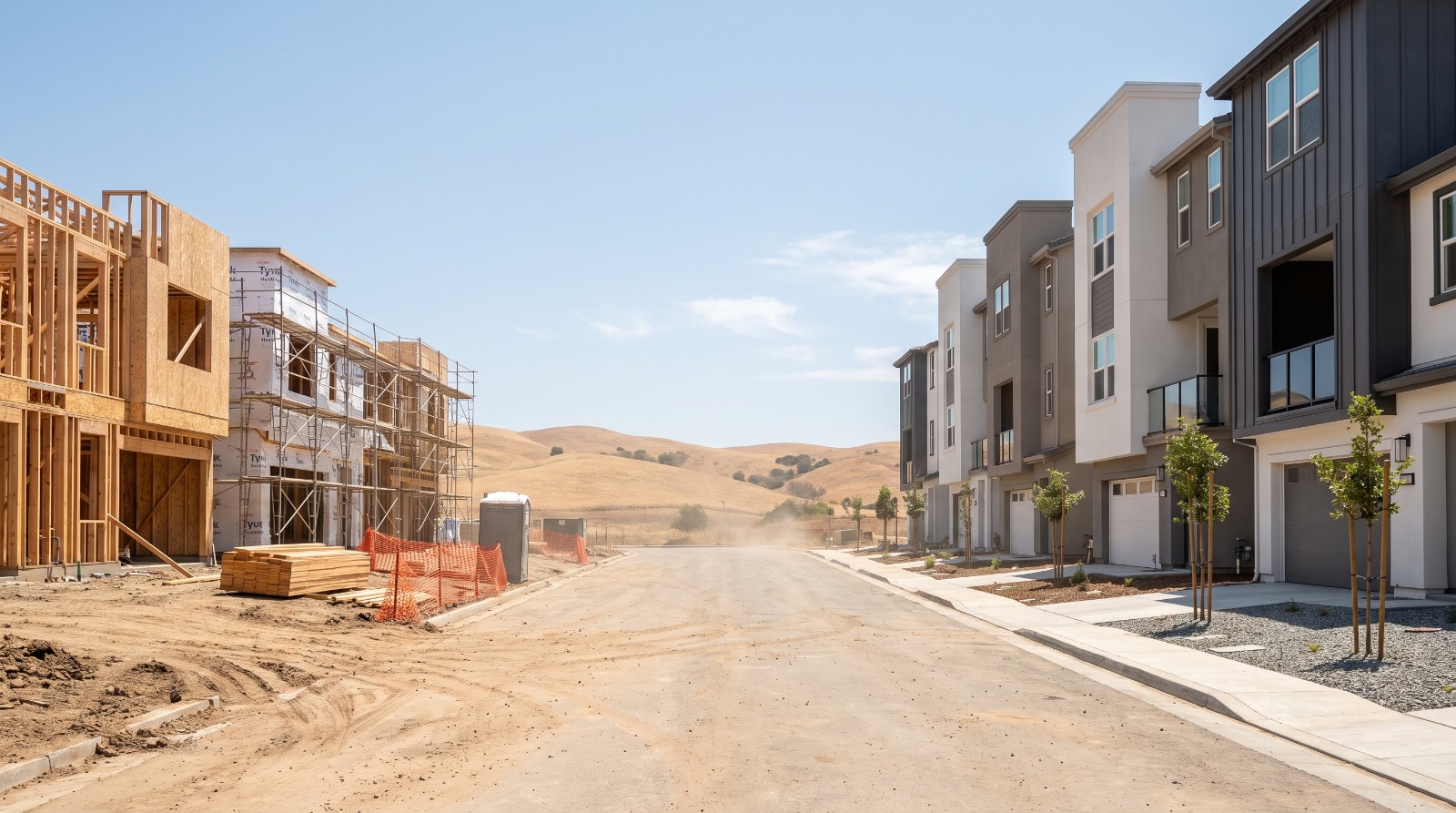
New three-story townhomes finished and under construction in an eastern Contra Costa County subdivision, the kind of home California Proposition 37 would finance. Photo: Houseberry
Three things about Proposition 37 are being reported wrong almost everywhere, and each of them changes the answer for Bay Area buyers. It is not a shared appreciation loan. It cannot be used on an existing home. And it comes with a price cap that four Bay Area counties blow straight through.
The short version: Prop 37 works at the county median in five of the nine Bay Area counties, all of them east or north of the bay. In San Francisco, San Mateo, Santa Clara and Marin it does not, and the thing stopping you is not your income. It is a statutory ceiling of about $1.56 million on the price of the home.
What Proposition 37 is
It is a citizen initiative, filed by former Assembly Speaker Bob Hertzberg, that would let the California Housing Finance Agency issue up to $25 billion in revenue bonds. The bonds fund second mortgages of up to 17 percent of a home's price. A buyer puts down 3 percent of their own money, takes a conventional first for 80 percent, and the state's second closes the gap to 20 percent so there is no mortgage insurance.
| Feature | Proposition 37 | California Dream For All |
|---|---|---|
| Assistance | Up to 17% of price | Up to 20%, capped at $150,000 |
| Interest rate | Market rate, not set in the statute | 0% |
| Monthly payment | Yes, amortizing from closing | None, deferred |
| State takes appreciation | No | Yes, up to 20% of net gain |
| Eligible homes | New construction only | New or existing |
| Income cap | 200% of area median income | 120% of area median income |
| First-time buyer required | No | Yes |
| Funding | Up to $25 billion | About $150M to $300M per round |
The Legislative Analyst's Office finds no direct state or local cost, because homeowner payments repay the bondholders. That is accurate, and say it twice, because the "taxpayers will pay billions in interest" argument you will hear this fall is simply wrong. The borrower pays the interest. On Contra Costa County's median that works out to roughly $218,000 over thirty years on the second mortgage alone. Because the assistance is 17 percent of a purchase price that is itself capped, the largest Prop 37 second mortgage available anywhere in the Bay Area is about $265,400.
The LAO also does not estimate how many households it would serve, what it would cost in total, or what happens if borrowers default. The campaign advertises 190,000 to 200,000 homes. The state's own analyst offers no number at all.
Can I use Prop 37 on a house that already exists?
No. The initiative defines a qualified home as a newly constructed home, townhome, rowhouse, condominium or manufactured home where the borrower is the first purchaser, or the first sale of a building converted from nonresidential use. That is the single most consequential fact in the measure and it is missing from most summaries.
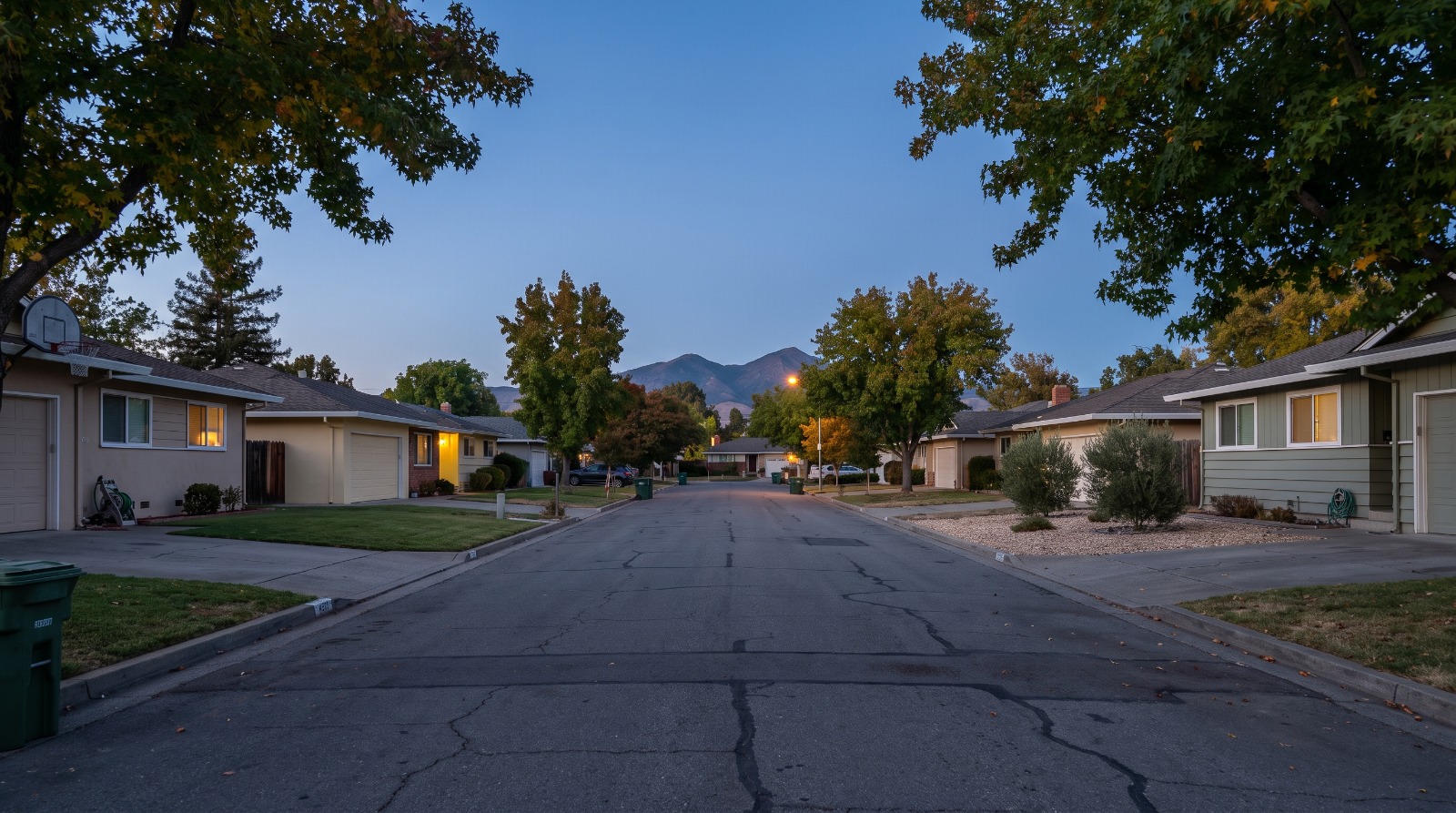
In a region where the overwhelming majority of transactions are resales of homes built between 1950 and 1990, that restriction does most of the work. Every county median price quoted below is an existing-home median, and a Prop 37 buyer cannot touch any of those houses. The relevant question is whether new homes under the cap exist in volume in Contra Costa, Solano and Sonoma, and nobody has published an answer.
Proponents argue the restriction is the point: because the money can only buy new construction, the program creates its own supply rather than bidding up a fixed stock. That is a real argument and it is the best one they have. Whether a 17 percent second mortgage makes projects pencil that do not otherwise pencil is an empirical question and it is unanswered.
Four Bay Area counties are priced out by the cap itself
Prop 37 caps the purchase price at 125 percent of the county's one-unit conforming loan limit. Six Bay Area counties sit at the high-cost ceiling, so their cap is $1,561,406. Napa, Sonoma and Solano have lower conforming limits and therefore lower caps.
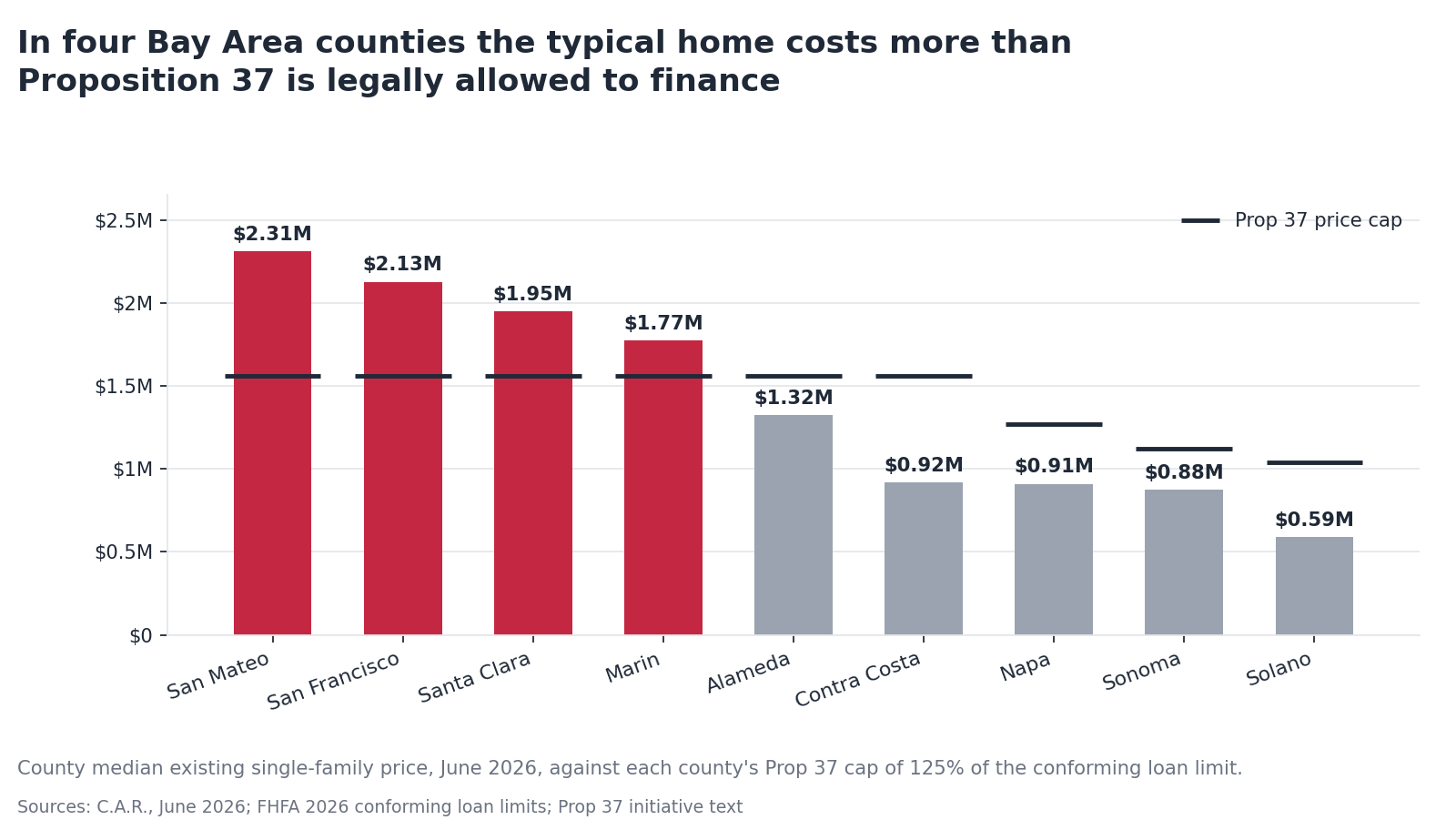
| County | Median price, June 2026 | Prop 37 price cap | Works at the median? |
|---|---|---|---|
| San Mateo | $2,310,000 | $1,561,406 | No, over by $748,594 |
| San Francisco | $2,128,000 | $1,561,406 | No, over by $566,594 |
| Santa Clara | $1,950,000 | $1,561,406 | No, over by $388,594 |
| Marin | $1,775,000 | $1,561,406 | No, over by $213,594 |
| Alameda | $1,325,000 | $1,561,406 | Yes, on the bubble |
| Contra Costa | $920,000 | $1,561,406 | Yes |
| Napa | $910,000 | $1,272,188 | Yes |
| Sonoma | $875,000 | $1,121,250 | Yes |
| Solano | $590,000 | $1,040,938 | Yes |
Read the San Francisco line carefully. A four-person household there earning $401,600, which is exactly 200 percent of the county's 2026 area median income, is legally barred from using Prop 37 on a median-priced San Francisco home. Not priced out. Barred. Their income is not the problem.
The second mortgage has a payment, and that changes what you qualify for
This is where the amortizing structure stops being a technicality. Dream For All's silent second sits there and does nothing to your monthly budget. Prop 37's second shows up on your debt-to-income calculation every month, which means it eats the qualifying capacity you would otherwise spend on the first mortgage.
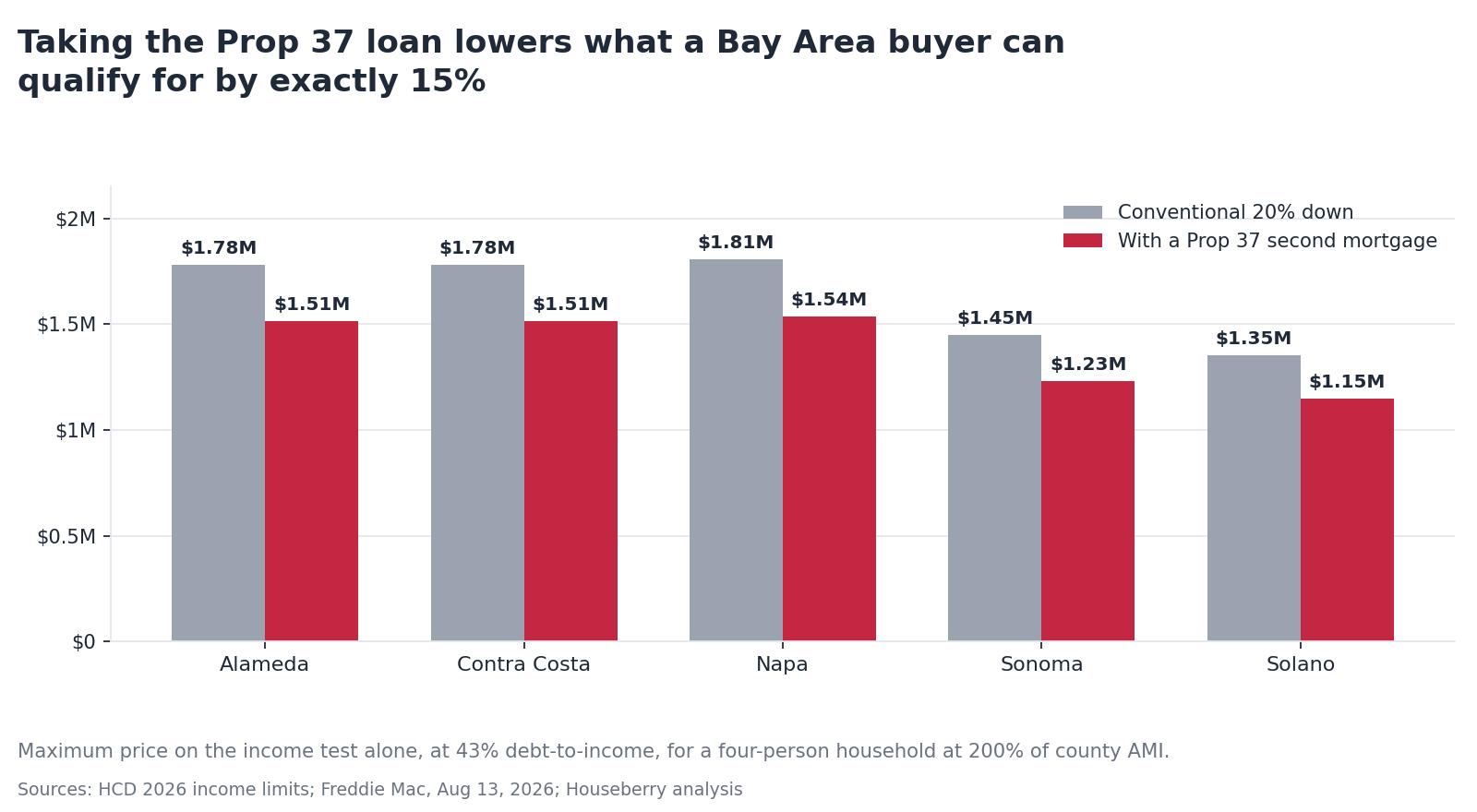
Run the same household through both structures at 43 percent debt-to-income and the answer is the same everywhere: Prop 37 lowers your maximum purchase price by exactly 15 percent. In Alameda and Contra Costa counties that is $267,497 less house. In Sonoma it is $218,002. The chart below covers the five counties where Prop 37 is usable at the median, since in the other four the statutory cap binds first and the income test never comes into play.
What you get in exchange is the cash. The down payment drops from 20 percent to 3 percent, which in Contra Costa County means $27,600 at the closing table instead of $184,000, and in Alameda $39,750 instead of $265,000. That is not nothing. The California Budget and Policy Center puts the median California household's checking and savings balance at just over $18,000, so even the 3 percent is a stretch for the households the measure is aimed at.
The trade in one sentence: Prop 37 cuts the cash you need at closing by $100,300 to $265,400 and cuts the price you can qualify for by exactly 15 percent, while adding $667 to $1,766 a month to your payment for thirty years. It converts a savings problem into an income problem rather than closing the affordability gap.
Assumptions, since they matter: a 6.67 percent 30-year first, per Freddie Mac for the week ending August 13, 2026, an assumed 7.0 percent on the state second, property tax at 1.15 percent, insurance at 0.35 percent, and $280 a month in HOA dues. That last one is not padding. Roughly 70 percent of newly built homes nationally carry HOA dues against 38 percent of existing homes, and Prop 37 only buys new. The statute does not set the second mortgage rate, so the 7.0 percent is an estimate, and every number above moves if CalHFA prices it differently.
Where the math clears
County medians are blunt instruments. Below the median, plenty of Bay Area neighborhoods sit comfortably inside both the price cap and the payment test, and several of them score better than their city average.
| Neighborhood | City | Median price, July 2026 | Overall | Safety |
|---|---|---|---|---|
| Fairway Park | Hayward | $976,630 | 3.5 | 4.6 |
| Glen Cove | Vallejo | $710,140 | 2.7 | 3.5 |
| Hunter Ranch | Vallejo | $715,110 | 2.9 | 4.0 |
| West-Hartley | Antioch | $702,750 | 3.3 | 4.4 |
| Ellis Lake | Concord | $629,910 | 2.7 | 3.4 |
| Bay Point | Pittsburg | $539,770 | 2.6 | 4.2 |
Fairway Park in Hayward is the standout on that list: a 4.6 safety score, third of Hayward's 20 neighborhoods overall, and still under $1 million in July 2026. Bay Point in Pittsburg posts a 4.2 safety score at $539,770, the cheapest verified entry in the set.
Two of those are places where Prop 37 could plausibly be used as written. Hunter Ranch in Vallejo is a newer hillside subdivision on the city's eastern side, and West-Hartley is described on our own page as the newest housing in Antioch, on the hillsides toward the Diablo foothills. Both have stock recent enough that new phases are plausible. Everywhere else on that list the homes already exist, which puts them outside the program no matter how well the payment math works. Vallejo's citywide median was $544,870 in July 2026, the lowest of the eight Bay Area cities we track.
What does 25 billion dollars fund?
Divide $25 billion by 17 percent of California's $904,640 statewide median and you get about 162,600 loans. California existing single-family sales were running at a seasonally adjusted annual rate of 279,880 in June 2026. So the entire program, spent to the last dollar, covers about seven months of statewide transaction volume, or roughly 6 percent of annual sales if it is spread across a decade.
In the Bay Area, where a qualifying new home runs closer to $1 million, the same $25 billion buys fewer loans and the region does not build anywhere near that many new homes to begin with. Whatever Prop 37 is, it is not a solution at the scale of the problem.
For a sense of how fast these programs get consumed: California Dream For All exhausted about $300 million in eleven days in 2023 and was converted to a random lottery for its next round. Prop 37 is roughly eighty times larger, which does blunt the rationing critique. The scale critique survives it.
The best argument for it, and the best against
For: it is new-construction-only and it costs the state nothing directly. If the second mortgage is what makes a Contra Costa or Solano project pencil, the program adds homes rather than bidding for existing ones, and the buyer keeps every dollar of appreciation instead of handing a fifth of it back to the state. Prop 37 also carries supply-side provisions most coverage skips, including a 30 percent cap on construction-defect attorney contingency fees and modified prelitigation notice rules for participating builders.
Against: it is a demand subsidy in a supply-constrained market, and the research on that is not encouraging. An American Enterprise Institute study of a comparable federal down-payment program found it would raise constant-quality home prices about 4.1 percent, with roughly 77 percent of the subsidy capitalized into higher prices. There is also a distributional problem worth naming: with a 200 percent AMI ceiling, no first-time requirement and no first-generation requirement, a household earning $411,000 in Santa Clara County who already owns a home is eligible for a $25 billion state program.
And a risk nobody has answered. These buyers are at 97 percent combined loan-to-value on new construction. If prices fall, the second lien is wiped out first, and neither the LAO nor the initiative says who absorbs that. Revenue bondholders, presumably. It is a fair question to put to CalHFA before November.
The bottom line for a Bay Area household
If you are shopping in Solano, Sonoma, Napa or most of Contra Costa and you are looking at new construction, Prop 37 is a genuine cash-flow tool. It gets you into a house years earlier than saving 20 percent would, at the cost of a smaller house and a bigger monthly payment. That is a real trade and plenty of people would take it knowingly.
If you are shopping in San Francisco, San Mateo, Santa Clara or Marin, it is not for you, and no amount of income changes that. The cap decides it.
Prop 37 does not appear on the November 3 ballot alone. It sits alongside the $11.25 billion affordable housing bond now numbered Proposition 1, which we covered in our piece on what a yes vote funds, and alongside four local measures, two of them in the Bay Area, pulling the other way. One subsidizes demand, one subsidizes supply, four try to stop building. Voters get to send all three signals at once, which is how California housing policy has always worked and part of why it works badly.
Sources
- Legislative Analyst's Office analysis of Proposition 37
- California Secretary of State, qualified statewide ballot measures
- California Budget and Policy Center: Will Prop 37 make homeownership more affordable?
- California HCD revised 2026 state income limits, June 23, 2026
- Freddie Mac Primary Mortgage Market Survey, week ending August 13, 2026
- California Association of Realtors June 2026 county sales and price report
- CalHFA California Dream For All program
- CalMatters on the Dream For All relaunch and lottery, January 2024
- American Enterprise Institute on the price impact of down payment assistance, October 2024
- Ballotpedia News: six housing measures on 2026 ballots, August 11, 2026
- Houseberry city and neighborhood price data, May to July 2026
All information provided on this website including but not limited to - school ratings, safety, amenities, user opinions, and property data - is for general informational purposes only. We do not guarantee its reliability, accuracy, or completeness. Users should independently verify information and consult appropriate professionals as needed. By using this website, you agree Houseberry is not responsible for actions, decisions, or consequences arising from reliance on the information provided
houseberry.com - CA DRE# 01847391
 Bay East ©2025. CCAR ©2025. bridgeMLS ©2025. Information Deemed Reliable But Not Guaranteed. This information is being provided by the Bay East MLS, or CCAR MLS, or bridgeMLS. The listings presented here may or may not be listed by the Broker/Agent operating this website. This information is intended for the personal use of consumers and may not be used for any purpose other than to identify prospective properties consumers may be interested in purchasing. Data last updated at October 1, 2026 12:00 AM